
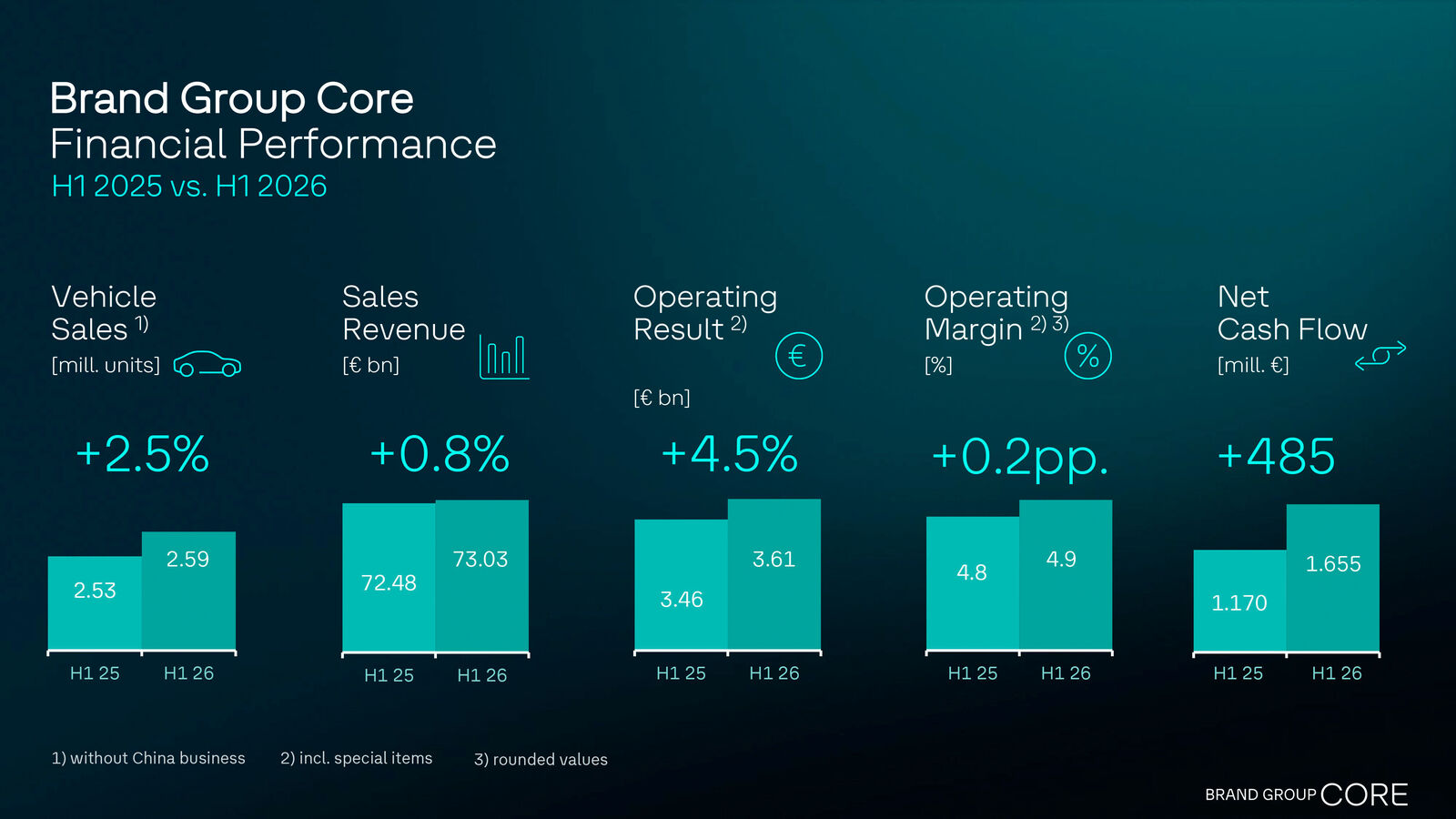


Volkswagen’s Brand Group Core — the sprawling volume-brand empire encompassing VW Passenger Cars, Škoda, SEAT & CUPRA, and VW Commercial Vehicles — posted an operating result of 3.61 billion euros for the first half of 2026. That’s a 4.5 percent improvement over the same period last year. On paper, progress. In practice, a company still running well below where it wants to be.
The operating margin ticked up to 4.9 percent from 4.8 percent. Strip out the restructuring costs and the expense of killing ID.4 production at Chattanooga, and you get 5.9 percent. That’s the number Wolfsburg would rather you focus on. But the one-time charges are real money, and they reflect real strategic retreats.
Unit sales climbed to 2.59 million vehicles, up from 2.53 million. Revenue, however, barely moved — 73.0 billion euros versus 72.5 billion. Selling more cars for roughly the same money tells you everything about the pricing pressure these brands face globally.
Škoda was the standout performer, growing unit sales 8.2 percent and pulling more than its weight on the revenue side. SEAT & CUPRA continued clawing back from years of underperformance. VW Commercial Vehicles posted a stronger operating result despite softer sales.
The Volkswagen passenger car brand itself, the flagship, actually slipped. It was dragged down by North American headwinds, promotional spending, and the Chattanooga wind-down.
The Chattanooga situation deserves scrutiny. Discontinuing ID.4 production there wasn’t a minor adjustment. It was an admission that the electric crossover couldn’t compete in its price segment against a rising tide of Chinese-designed alternatives and Tesla’s relentless cost-cutting. The financial drag shows up clearly in VW brand numbers, and management isn’t pretending otherwise.
The bright spot is the Electric Urban Car Family. More than 70,000 orders have landed in just a few weeks for three of the four planned models — CUPRA Raval, the ID. Polo, and the Škoda Epiq. The fourth hasn’t even launched yet. If those conversion rates hold, it validates a bet Volkswagen made years ago: that affordable, small EVs would find buyers faster than the premium-priced ID.4s and ID.7s that struggled to gain traction.
But the bigger story here is organizational. Starting July 1, Volkswagen created a new governing body called the Core Executive Committee, a super-board sitting above the individual brand boards. It brings together the CEOs of all four volume brands with the heads of finance, procurement, production, and technical development. The mandate is blunt: cut complexity, enforce cooperation, and eliminate the redundancies that have bled margins for years.
Thomas Schäfer, who leads both the VW brand and increasingly the broader volume group strategy, framed it diplomatically. CFO David Powels was more direct, acknowledging that sales revenue growth lagging behind unit sales growth is a flashing warning light. The business model needs to get “significantly more robust” by 2030, he said.
This is Volkswagen doing what it periodically does — reorganizing its way toward efficiency after years of letting brands operate as semi-independent fiefdoms. The question, as always, is whether a new committee structure actually changes behavior on the factory floor and in the engineering centers. Or whether it just adds another layer of meetings.
Net cash flow jumped to 1.66 billion euros from 1.17 billion, a genuine improvement driven by tighter inventory management and disciplined capital spending. That’s the kind of number that buys time and credibility with investors while the harder work of structural reform grinds forward.
The first half of 2026 shows a company making incremental gains through cost discipline while the competitive landscape shifts beneath it. Tariffs, Chinese competition, and softening demand in key markets aren’t going away. Neither is the gap between a 4.9 percent margin and the targets Volkswagen has set for itself. The new committee had better move fast.

Share this Story