
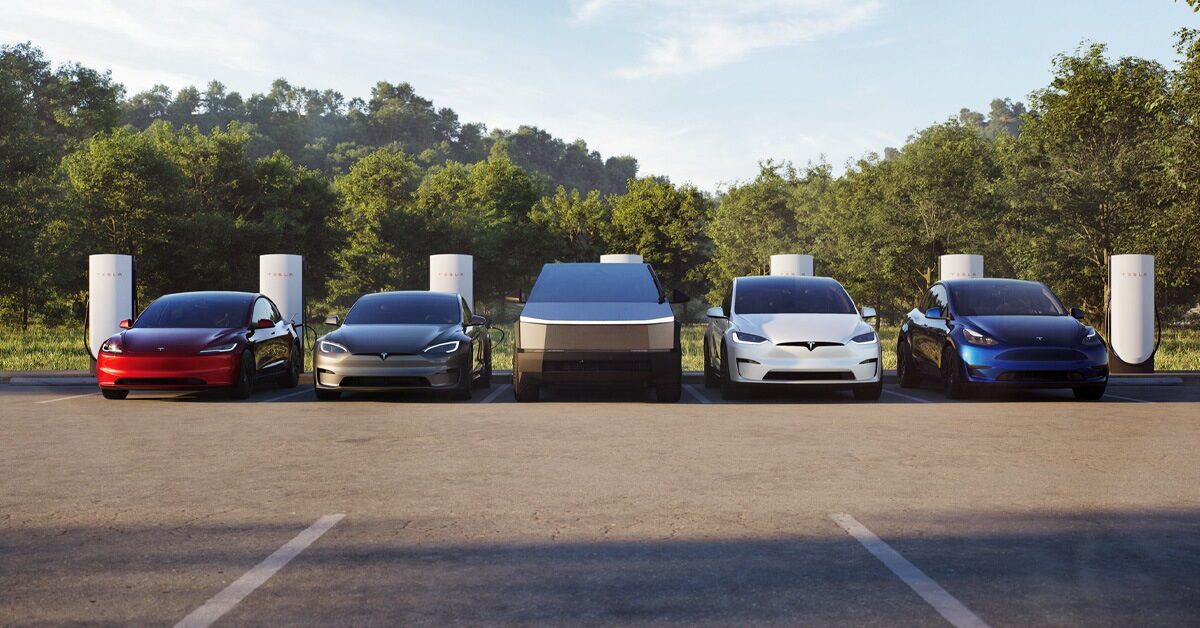


Tesla posted its company-compiled analyst consensus for Q1 2026 on Wednesday: 365,645 deliveries. That number is now the line in the sand, and every trader, short seller, and fan with a brokerage account knows it.
The figure comes straight from Tesla’s Investor Relations page, aggregated from 23 sell-side analysts at shops ranging from Goldman Sachs and Morgan Stanley to Canaccord and Needham. Tesla was careful to note it “does not endorse any information, recommendations or conclusions” from those analysts. It never does, but it publishes their math anyway.
That’s the game. By releasing the consensus itself, Tesla anchors the market’s expectations with surgical precision. Beat 365,645 in early April, and the stock pops. Miss it, and the damage is self-inflicted.
The number itself isn’t pretty. Q4 2025 actual deliveries came in at 418,227, meaning Wall Street expects a roughly 12.5 percent sequential decline to start the new year. Seasonal softness in Q1 is nothing new for Tesla, but a drop to 365K would mark a quarter that looks modest against the full-year 2026 consensus of nearly 1.69 million units.
Dig into the individual estimates and the uncertainty becomes clearer. UBS pegged Q1 at just 345,000 deliveries, a full 20,000 units below consensus. RBC Capital came in at 367,000.
That spread of 22,000 vehicles between the low and the high among tracked analysts is not trivial. It reflects real disagreement about demand conditions, pricing power, and whether refreshed Model Y momentum can offset headwinds in Europe and China.
The standard deviation across the 23 estimates is 25,941 units, which means the analysts aren’t remotely in lockstep. For a company that has trained the market to react violently to delivery beats and misses, that dispersion is a loaded gun.
The longer-term projections are where the optimism lives. The same group of analysts sees Tesla scaling to 1.88 million deliveries in 2027 and over 3 million by 2030. The “all other models” line, which captures Cybertruck, Semi, and whatever else Tesla puts on wheels, grows from roughly 14,000 units in Q1 2026 to over 570,000 by 2030. Those are big numbers built on products that either don’t exist yet or are still ramping in limited volumes.
The energy storage business, meanwhile, continues to be the quiet overachiever. Analysts expect 14.4 GWh of deployments in Q1, flat with Q4 2025’s 14.2 GWh. The full-year 2026 consensus is 65.2 GWh, scaling to 166 GWh by 2030.
Megapack demand is driven by utility-scale contracts that don’t care about consumer sentiment or Elon Musk’s latest social media adventure. It’s becoming the ballast in Tesla’s business model — steady, growing, and far less volatile than automotive.
Tesla stopped giving formal delivery guidance long ago. What it does instead is arguably more powerful: it publishes the market’s expectations under its own logo, on its own investor relations page, with the implicit challenge to judge the company against that number. It’s a transparency flex that doubles as expectation management.
The actual Q1 delivery count will land in the first days of April. Until then, 365,645 is the only number that matters — not because Tesla chose it, but because Tesla made sure everyone saw it.





Share this Story