
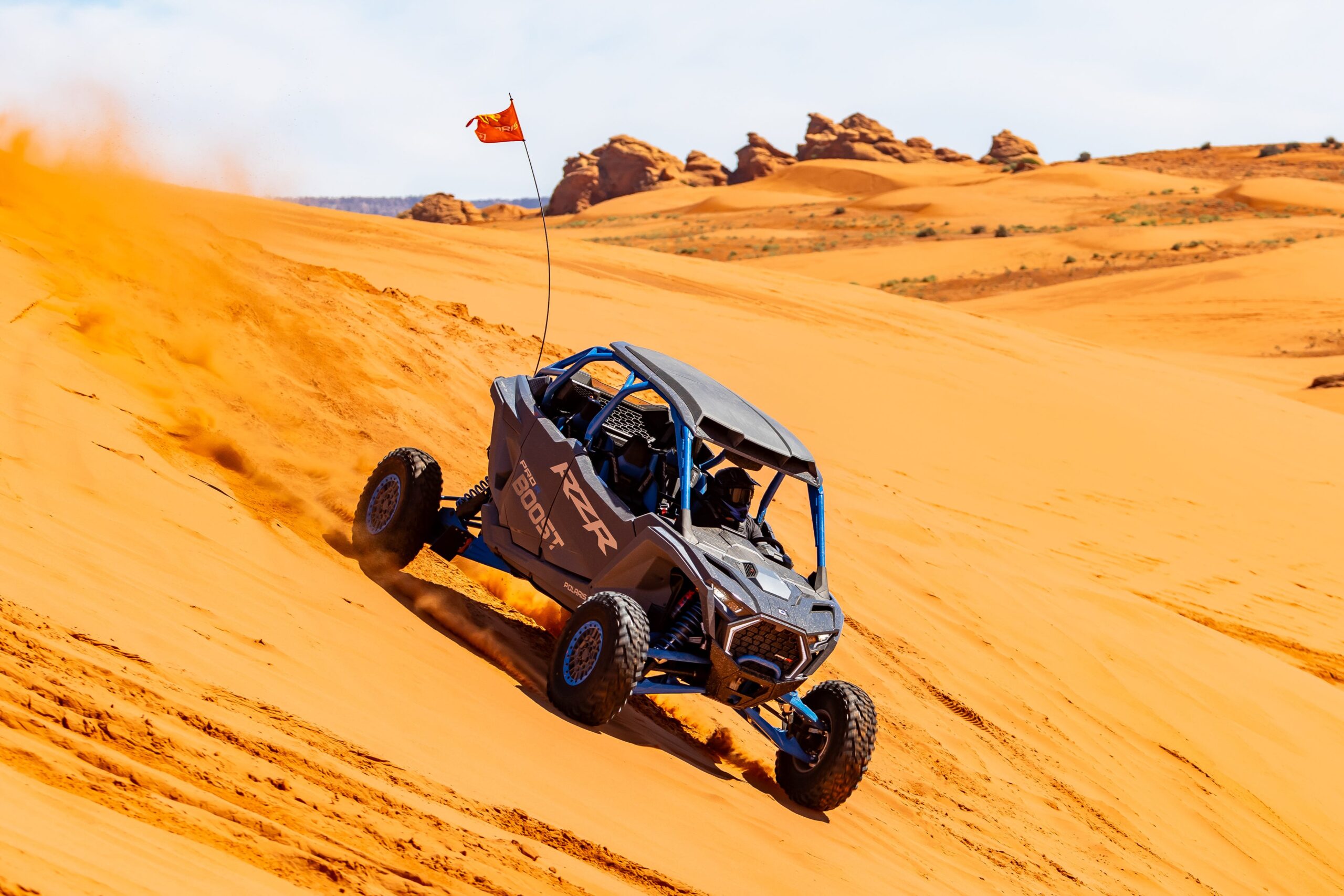


Two hundred seventy-five horsepower in a buggy that weighs roughly 2,600 pounds. Polaris has effectively built a sand-eating muscle car, and it starts at $51,994.
The 2027 RZR Pro R Boost is the company’s answer to a side-by-side arms race that has escalated beyond what anyone predicted five years ago. Can-Am’s Maverick R makes 240 horsepower. Kawasaki’s Teryx H2 pushes 250. Polaris looked at both numbers and decided 275 was the appropriate response, backed by 223 pound-feet of torque that neither competitor can touch.
The engine is a turbocharged 2.0-liter DOHC inline-four, force-fed by a 60-mm turbo large enough to generate serious lag in lesser applications. Polaris claims it mitigates that problem by using residual boost pressure to keep the turbo spinning during on-off throttle transitions rather than venting it through a blow-off valve. The company also guarantees full power at 10,000 feet elevation and in ambient temperatures up to 115 degrees.
Those are bold promises for a machine that will spend much of its life in the desert Southwest.
One of the smarter engineering moves sits behind the occupants’ heads. Polaris relocated the radiator from the front to a rear-mounted position fed by a roof scoop. In a vehicle with no windshield, that change alone transforms the cockpit experience.
No more superheated air washing over your face from a front-mounted rad. It sounds minor until you’ve spent four hours in a side-by-side at Sand Mountain, Utah, in July.
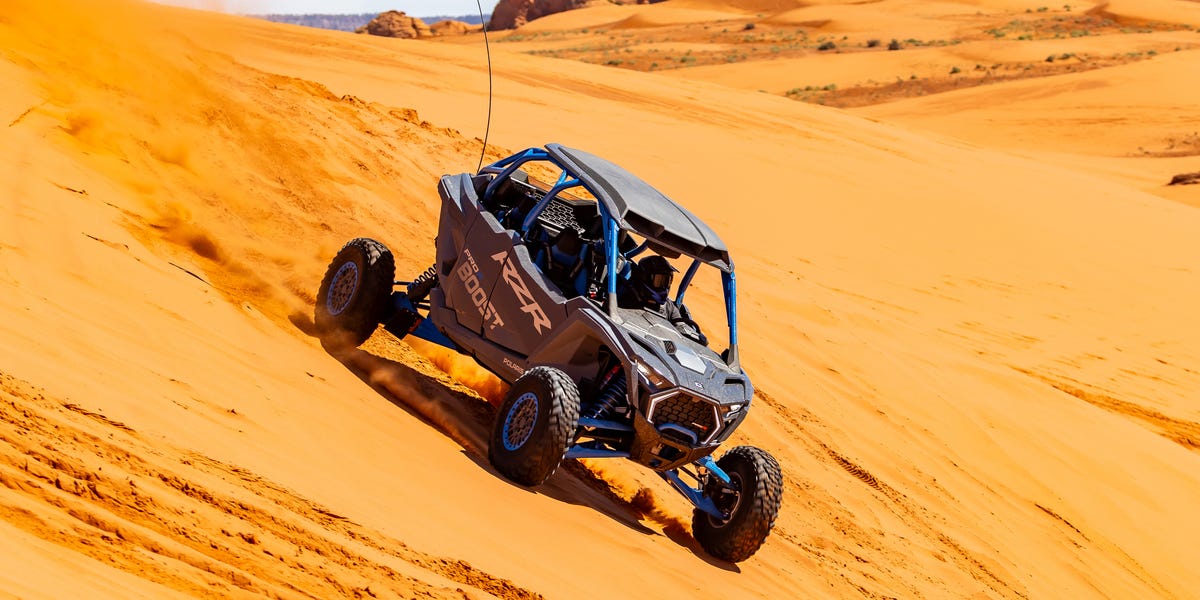
The suspension hardware matches the engine’s ambition. Adaptive Fox Live Valve dampers adjust compression and rebound up to 200 times per second across four modes: Comfort, Rock, Baja, and Track. Front and rear wheel travel stretches to roughly two feet.
A panic button on the steering wheel temporarily maxes out damper firmness when you spot a crater that could rearrange your vertebrae. For $3,000 more, Ultra models add adaptive anti-roll-bar links.
The CVT, often the weak link in high-horsepower side-by-sides, gets specific tuning for the Boost. A larger secondary clutch with added cooling fins, beefier half-shafts, a stronger drive belt, and a reinforced front differential all aim to keep the drivetrain alive when the turbo four is screaming at full song. Three air intakes feed the belt cooler alone.
Car and Driver’s estimated quarter-mile time of 13.2 to 13.3 seconds and a 4.0-to-4.4-second sprint to 60 mph put this buggy in the company of legitimate sports cars. Estimated top speed sits at 90 mph. In a machine with no doors, no airbags, and a five-point harness as your primary safety system.
The obvious comparison hangs in the air. A Ford Bronco or Jeep Wrangler costs about the same money and comes with air conditioning, windows, and a license plate. Polaris knows this.
But a Bronco creeps up rock faces. The Pro R Boost, with its wheels pushed to the outermost corners and approach angles that border on infinite, treats vertical rock walls like mild inconveniences. A toggle switch moves from rear-drive to four-wheel drive to locked front diff.
Low range and softened throttle mapping in Rock mode handle the technical stuff. When the trail opens up, 275 horsepower handles everything else.
The four-seat version runs $55,994. Ultra trims push past $58,000. These are serious numbers for machines that can never legally touch pavement.
The side-by-side segment stopped being a niche hobby years ago. It is now a full-blown horsepower war with price tags to match, and Polaris just fired the loudest shot of 2027. Whether Can-Am and Kawasaki respond with more power or smarter engineering is the question that keeps this arms race interesting.
Share this Story