
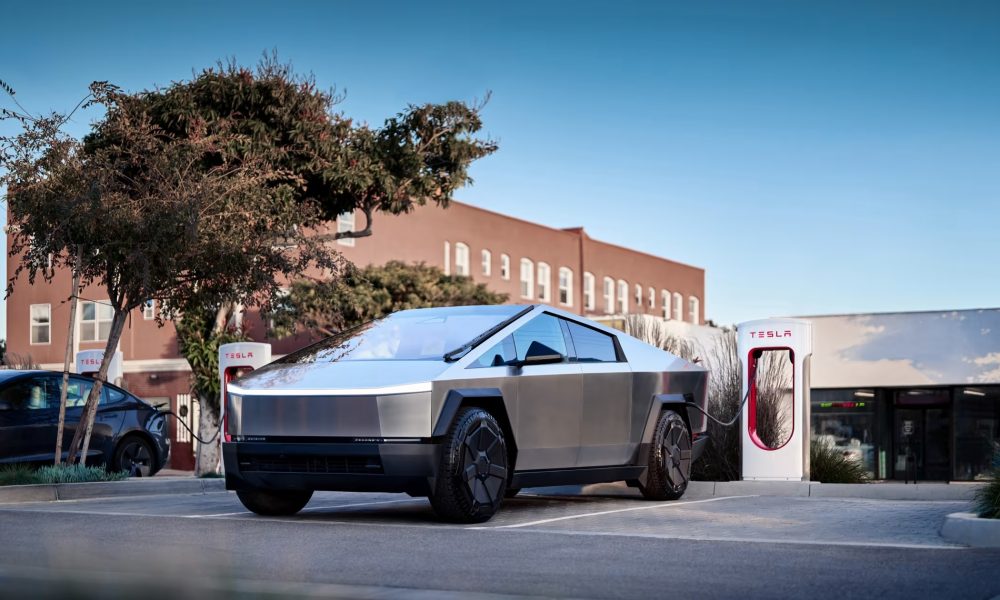


Six weeks ago, Tesla was in federal court begging a judge to stop a parts supplier from holding Cybertruck production hostage. Now the company is raising prices on the truck by $5,000 across two trims, a move that tells you everything about what just happened behind the scenes.
The Base All-Wheel-Drive Cybertruck jumped from $69,990 to $74,990. The Premium AWD climbed from $79,990 to $84,990. The Cyberbeast stays put at $99,990.
Tesla framing this as a demand signal is bold, considering the mess it just crawled out of.
In late July, Tesla filed an emergency lawsuit against Angstrom Automotive Group, which operates a facility in Troy, Texas, where critical Cybertruck stamping tools, dies, fixtures, and 700 finished parts sat locked behind closed doors. Tesla alleged Angstrom demanded an extra $250,000 per week to keep the lights on, calling it ransom. When Tesla sent people with law enforcement to retrieve its own equipment, they were turned away.
A judge granted a temporary restraining order on August 5, giving Tesla access to its tooling. Within days, aerial footage of Giga Texas showed roughly 100 Cybertrucks filling the outbound lot again after weeks of thin inventory. Production snapped back fast enough to suggest Angstrom was the sole bottleneck choking output.
So now Tesla has its tools, its production line humming, and it immediately tacks on $5,000. The timing raises a question the company probably does not want asked: is this a price increase driven by demand, or one driven by the need to recoup legal costs and supply chain disruption?
The Cybertruck has been on a pricing roller coaster since its 2019 unveiling, when the top trim was advertised at $69,990. That number is now the floor, and it just got more expensive. Earlier this year, Tesla briefly offered a $59,990 AWD variant and said the price would hold for only ten days because of order volume. That kind of blink-and-miss-it pricing does not exactly scream stable demand forecasting.
Meanwhile, Tesla has been quietly upgrading the truck itself. In early August, lead engineer Wes Morrill confirmed the Cybertruck’s underbody panels switched from aluminum to carbon fiber across all trims. The change improves durability and aerodynamic efficiency around bolt points, a genuine engineering upgrade that also happens to give Tesla a talking point when justifying higher stickers.
Carbon fiber is not cheap. Someone pays for that material swap, and it is not Tesla’s margins.
The all-electric pickup segment remains a strange market. Cybertruck is the best-selling electric truck in America, which sounds impressive until you remember how few competitors are moving real volume. Rivian’s R1T is niche. The Ford F-150 Lightning has seen production cuts. GM’s Silverado EV is still finding its footing.
Cybertruck wins by default as much as by merit.
Tesla’s own fans acknowledge the core tension. Plenty of would-be buyers love the truck but cannot stomach the price, especially when a loaded Model Y costs $30,000 less. Pushing the entry point to $75,000 does not solve that problem. It deepens it.
Angstrom Automotive has not spoken publicly since the lawsuit. The restraining order is temporary, with a fuller hearing still ahead. If that case takes an ugly turn, Tesla could find itself cutting prices just as quickly as it raised them.

Share this Story