
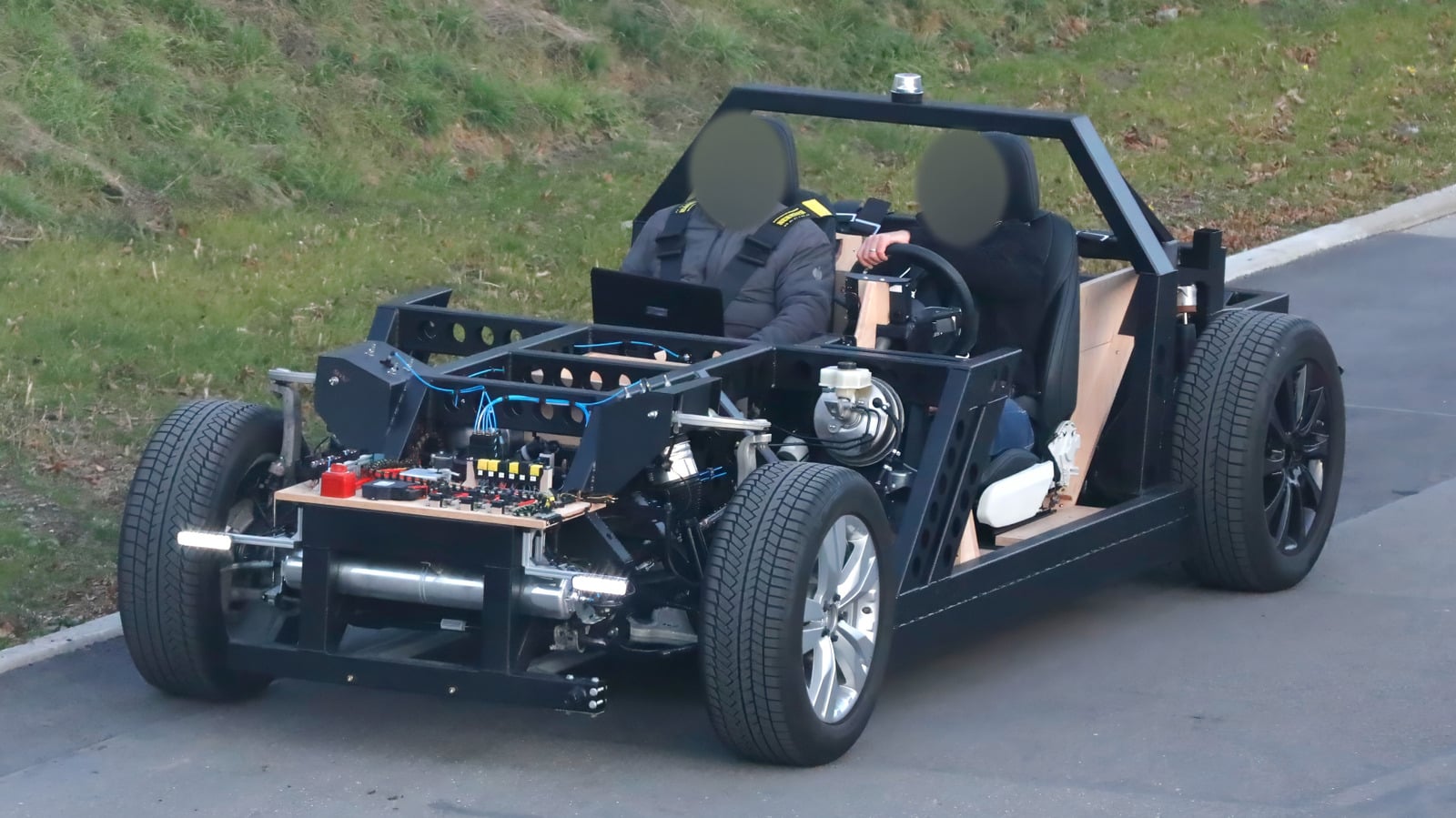


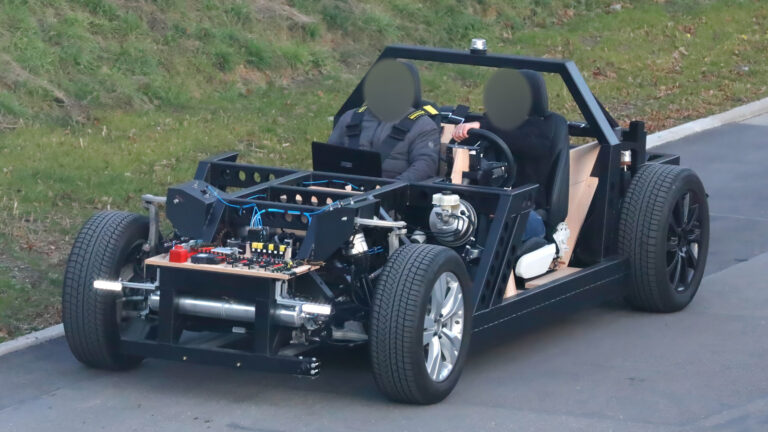
The floor is wood. So is the dash. Two engineers sit strapped in with racing harnesses, one of them staring at a laptop, and there’s no body anywhere on the thing.
This is a Mercedes-Benz prototype, caught by spy photographers. It looks more like a university engineering project than anything wearing a three-pointed star.
Look past the plywood and the hardware gets interesting. There’s no engine, just a large electric motor at the rear axle.
The battery isn’t under the occupants, which is where Mercedes has spent years putting it in its EVs. Instead, a small pack hangs out past the rear axle.
No electric car Mercedes currently sells is built that way.
Up front, you get a cluster of electronics, a pair of comically small LED lamps, and little else. The shock towers are exposed, and so is what appears to be electronically controlled suspension.
The chassis is black, presumably steel, and hefty. It shares nothing obvious with any architecture Mercedes uses today, including the body-on-frame bones of the G-Class.
At the back, the control arms sit in open air beside another set of tiny LEDs. There are no bumpers and no panels.
What it’s for is anyone’s guess. Mercedes has announced no electric two-seater, and nothing in its public plans points to one.
It could be a test bed for a new battery pack or rear motor. It could be evaluating suspension bound for future models.
It could also be an early mule for a new electric platform meant to underpin several vehicles.
The timing makes it stranger. Mercedes has spent the past couple of years trimming its EV lineup, not growing it.
The EQE sedan and EQE SUV, both slow sellers, are on their way out. The EQS will be retired at the end of its lifecycle, replaced by a more conventional electric S-Class.
That’s a brand admitting its EVs never needed a separate identity. The electric push now runs through familiar names: the new CLA, the C-Class, the GLC.
AMG is on its own track. It launched the AMG GT 4-Door Coupe to take on the Porsche Taycan, then followed with the related GT SUV.
Both ride on the dedicated AMG.EA platform, and AMG is spending heavily to make it pay off.
So Mercedes already has a mainstream EV plan and a performance EV plan underway. This skeleton fits neither.
That may be the point. Development mules exist to isolate variables, not to preview styling, and a bare frame with a wooden floor is about as isolated as it gets.
Even so, some details don’t add up. Hanging the battery behind the rear axle is the opposite of how Mercedes builds its current electric cars.
A heavy steel chassis is also an odd choice for a company chasing range and efficiency everywhere else.
It may be a simple component test. It may be the first glimpse of something bigger, and the photos alone can’t tell us which.
Mercedes isn’t talking. The engineers in those harnesses, laptop open, already know what the rest of us will have to wait to find out.
Share this Story