
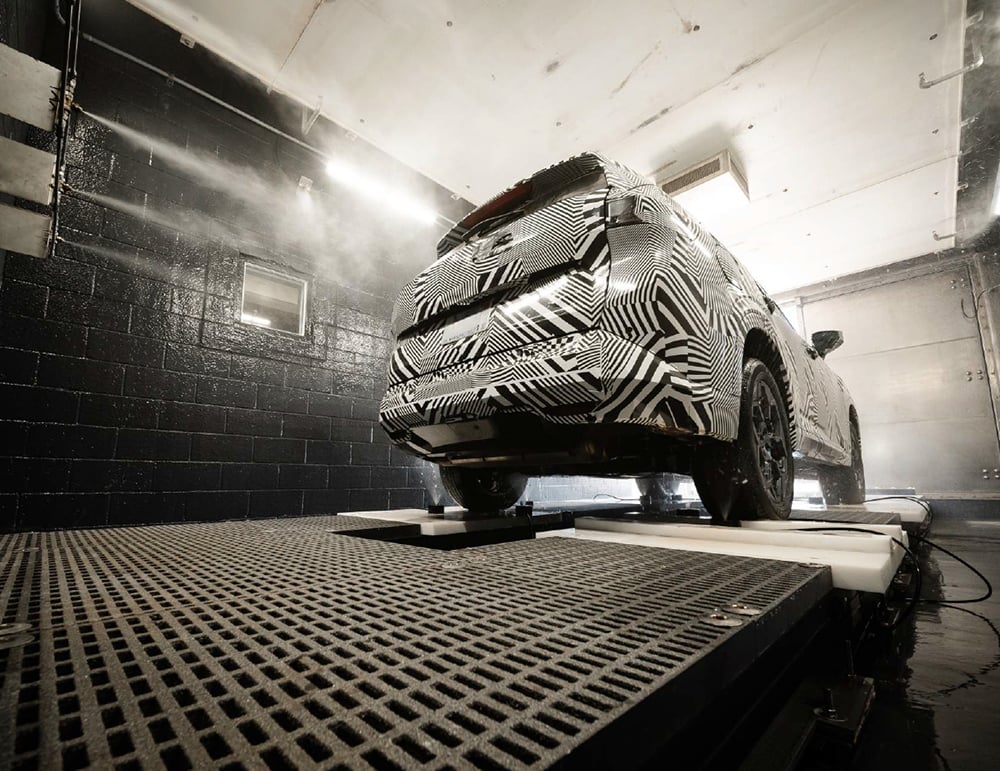


In under four months, a box in the Arizona desert can do to a car what 10 to 15 Michigan winters would. That’s Nissan’s claim for the new corrosion chamber at its Arizona Testing Center. The company says the window covers 99.5 percent of the North American market.
There’s some irony in the address. Nissan is studying rust in one of the driest places in the country, where cars bake but rarely rot.
That’s the point, of course. You don’t wait for the weather when you can make it.
The process is blunt. A vehicle gets sprayed with saltwater from every angle, then the chamber turns into an oven, cooking it in high heat and humidity. Repeat the cycle, and the metal starts giving up years ahead of schedule.
The first guests are telling. One is a camouflaged 2027 Rogue Hybrid, Nissan’s bread-and-butter crossover. The other is a Frontier pickup, the kind of truck that spends its life on salted roads and boat ramps.
“By simulating a decade of environmental exposure in a controlled setting, engineers can identify improvements early and deliver vehicles that are built to last,” said Ryan Regehr. He helps run the facility and has been with Nissan since 1997.
Accelerated corrosion testing is nothing new, and every serious automaker does some version of it. Nissan’s pitch is precision. Better automation and monitoring make each run more repeatable than the last.
“The new chamber creates more consistent and repeatable test conditions while reducing environmental impact and operating costs,” said Yosmany Lopez, the lead corrosion engineer on Nissan’s Durability and Reliability team.
Notice the order there. Consistency first, then cost, and a chamber that runs cheaper gets used more.
Part of that comes from a water filtration system imported from Italy. It holds salinity at exact levels, recycles more water and keeps every vehicle under identical conditions. In a desert, recycling water isn’t a press release flourish, it’s arithmetic.
Nissan’s list of enemies is a familiar one. There’s sodium chloride on northern highways, plus magnesium chloride and calcium chloride, de-icers that keep working in deeper cold and can be even harder on metal than traditional road salt. Then come ocean spray, humidity and mud packed into wheel wells, holding moisture and salt against bare steel.
The company makes a sharp point here. A car living through a Northeast winter and one parked near a Florida beach can suffer strikingly similar damage, thousands of miles apart.
Nissan also ties the chamber to a changing climate, noting how a strengthening El Niño can push coastal water levels higher and shift weather patterns across parts of the U.S. The engineers are careful not to overreach. They say they aren’t trying to forecast the weather, only to test against a wide range of it.
Lopez said the chamber is calibrated against decades of field data gathered across North America. It recreates the cycles of salt, moisture, temperature swings and drying that wear a vehicle down slowly.
It sits alongside the rest of the facility’s punishment menu. That includes rough-road durability loops, frame-twisting undulations, a mud bath and water fording.
The payoff Nissan promises is the one owners actually feel. Fewer corrosion repairs, longer life, better resale value.
One detail sits quietly in Nissan’s own wording. The chamber reaches its full capability “when fully complete,” which means the facility is still being finished.
So the Rogues and Frontiers already inside are early test subjects in a lab that isn’t done yet. The rust they grow over the next four months will tell Nissan what owners in Buffalo and Galveston would otherwise find out around 2040.


Share this Story