
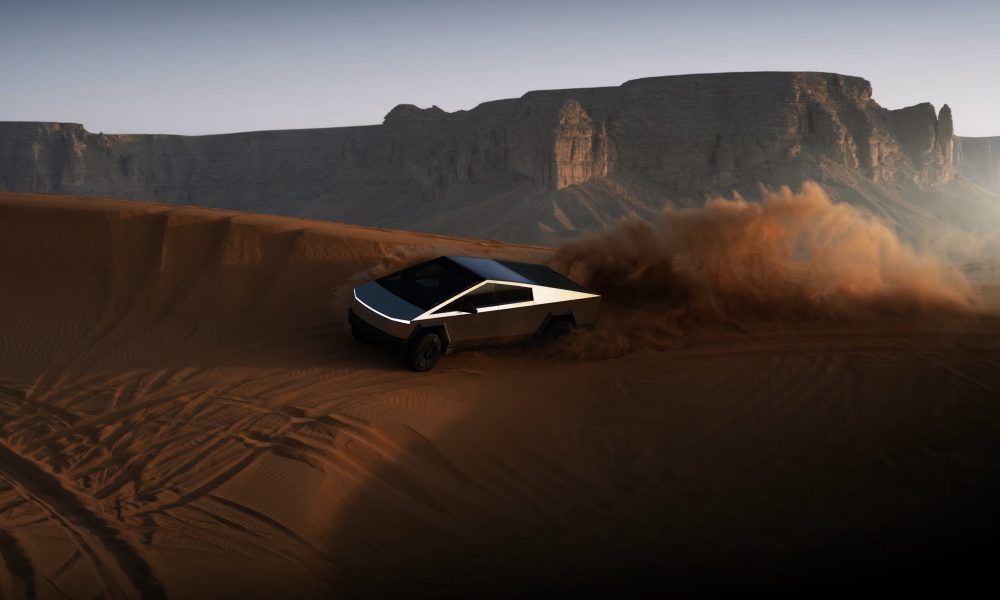


Tesla has switched the Cybertruck’s underbody panels from aluminum to carbon fiber, a material upgrade that touches every trim level of the polarizing pickup. Lead engineer Wes Morrill confirmed the change after it was spotted on a Cyberbeast by Out of Spec’s Coleton Guerin.
The swap is not cosmetic. Morrill said carbon fiber tested stronger than the aluminum panels Tesla had used since first deliveries began in late 2023. It also allowed engineers to better shape the areas around bolt points, cleaning up underbody airflow in ways the old material could not.
Carbon fiber is lighter and more rigid than aluminum, which is why it shows up on supercars and around EV battery enclosures. But it is not cheap. Tesla framed the move as a pricing efficiency gain, suggesting the company found a way to make the material work at Cybertruck volume without adding cost.
Applying it across all trims, rather than reserving it for the top-spec Cyberbeast, keeps supply chain variance low. This is the first time Tesla has used carbon fiber on any exterior surface of the Cybertruck.
The truck’s body is still its trademark ultra-hard 30X cold-rolled stainless steel exoskeleton, but the underbody has always been a different story. Those panels take the worst of what roads dish out, and until now they were conventional aluminum.
The timing is interesting. Tesla is simultaneously fighting to keep Cybertruck production running at all. A federal lawsuit filed July 28 in the Western District of Texas accuses supplier Angstrom Automotive Group of refusing to release Tesla-owned tooling from a plant near Troy, Texas.
According to the complaint, Angstrom told Tesla on July 13 it planned to close the facility, then blocked a scheduled parts shipment. Tesla representatives who arrived with law enforcement on July 21 were turned away.
Tesla alleges Angstrom demanded $250,000 per week to keep the plant open, calling it ransom. The automaker warned the court that Cybertruck supply would run dry “in mere days” without emergency relief. Angstrom has said nothing publicly.
So Tesla is upgrading the truck’s underbody with advanced materials and going to court to pry stamped parts out of a supplier’s locked building. That tension captures the Cybertruck program in miniature: ambitious engineering wrapped in operational chaos.
The carbon fiber change lands alongside a strong safety narrative. In June, the IIHS gave the 2025-2026 Cybertruck crew cab its Top Safety Pick+ award, the only full-size pickup to earn the top designation. The truck avoided every pedestrian collision scenario in testing, including nighttime crossings.
The Ford F-150 and Ram 1500 did not qualify for either tier of IIHS safety recognition. That same rigid construction that earned those scores keeps the Cybertruck banned from UK and European roads. Regulators there say its sharp edges and unyielding body fail pedestrian protection standards.
The truck protects the people inside it better than any pickup tested. Whether it protects the people outside it is a question different regulators answer differently.
Tesla has never treated the Cybertruck as a finished product. Hardware revisions have been constant since the first units rolled out of Giga Texas. The post-April 2025 structural upgrades to the front underbody and footwell were what pushed it over the IIHS threshold, and the carbon fiber swap continues that pattern.
The question hanging over all of it is whether Tesla can keep the line moving long enough for any of these improvements to matter at scale. A ruling on the Angstrom dispute could come any day.

Share this Story