
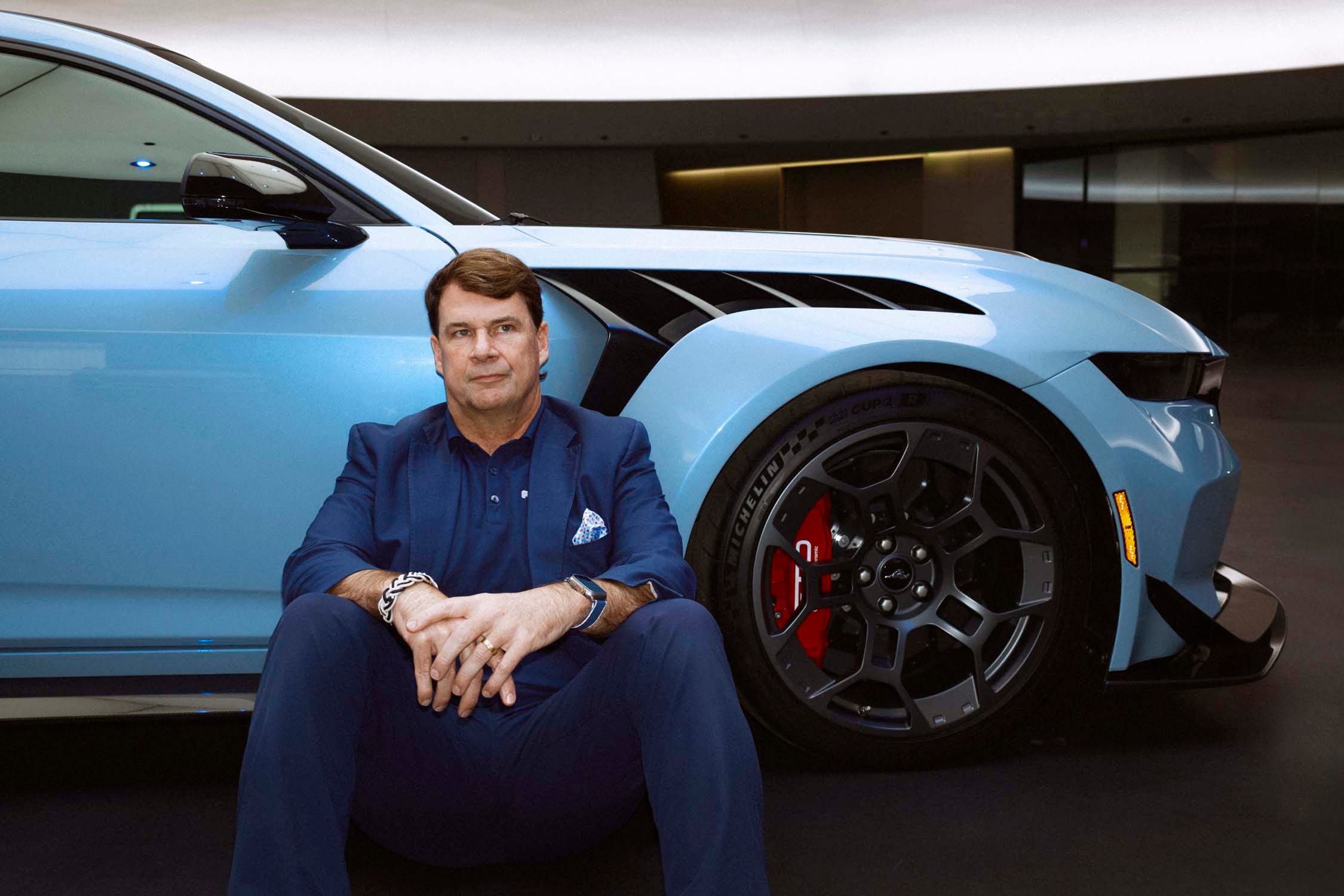


Five years into steering Ford Motor Company, CEO Jim Farley isn’t sugarcoating the mess. The F-150 Lightning is dead. Partnerships with Korean battery makers have been dissolved.
A staggering $19.5 billion write-down sits on the books. And the man in charge says he would have done it all differently.
In a wide-ranging interview with Car and Driver, Farley laid bare what went wrong with Ford’s first serious push into electrification and where the company goes from here. The candor was striking, even by his standards.
The turning point, Farley said, came when he and former Apple and Tesla executive Doug Field literally ripped apart a Tesla to see what was inside. What they found stunned him.
“The Mach-E’s wiring harness was 70 pounds heavier and 1.6 kilometers longer,” Farley admitted. “We didn’t know what was going on in their minds. But now we understand. They had no prejudice. We had prejudice.”
Ford’s engineers had approached EV development the way they’d always built cars, going to the supply chain and ordering another wiring harness. Tesla’s team started from scratch, designing every vehicle around the smallest possible battery. Totally different philosophy, totally different cost structure.
COVID made things worse by sending false signals. With chip shortages limiting production, every vehicle that rolled off a line sold at prices 30 to 40 percent higher than pre-pandemic levels. That tricked an entire generation of product planners into thinking customers would keep paying inflated prices for electric trucks. They wouldn’t.
Now Ford is betting its future on a completely new EV platform that Farley calls a “Model T moment.” It debuts in 2027 as a mid-size pickup built at a retooled Kentucky plant. Whether it can close the gap with Tesla and a surging wave of Chinese competitors remains the billion-dollar question.
Speaking of China, Farley described visiting the country after COVID restrictions lifted and being floored by what he saw. We both looked at each other after about an hour, and we were like, ‘Holy shit, what the hell happened?'” he recalled of the trip with Ford vice chair John Lawler. Chinese automakers had leapfrogged Ford in design, technology, and cost.
BYD, he noted, has been building electric vehicles for two decades.
On the policy front, Farley outlined three seismic shifts reshaping Ford’s business. The Trump administration’s massive relaxation of emissions standards is the biggest, freeing automakers from decades of regulatory constraints. Tariffs are the second, and despite Ford building roughly 80 percent of its U.S.-sold vehicles domestically, the company still faced an enormous bill on imported parts.
After negotiations with the administration, that number dropped from a projected three to four billion dollars to about one billion. That still represents roughly 10 percent of Ford’s profit.
The third challenge is China itself, the most government-subsidized and increasingly capable auto market on earth.
But Farley insists the software revolution dwarfs all of it. “Everyone thinks these three things, China, software, and EVs, they’re all the same. No, they’re not the same,” he said. “The software thing is 10 times bigger to me.”
He envisions vehicles becoming a third living space, where autonomous highway driving frees up 45 minutes for entertainment, work, or something entirely new. The car-as-smartphone analogy isn’t subtle, but Farley believes it’s accurate.
Not everything at Ford is a turnaround story. The off-road lineup, Broncos, Raptors, Tremors, has become a surprise profit engine. “We can’t make enough of the stuff around the world,” Farley said.
In Europe, the electric Puma Gen-E has climbed to the top of UK EV sales charts.
Farley, who spent 17 years at Toyota before jumping to Ford in 2007, recalled his first day walking into the executive garage and finding it full of Range Rovers and Volvos instead of Fords. When he introduced himself to a fellow executive, the response was blunt: “We don’t need any help from Toyota.”
“How’s that working for you?” Farley shot back.
Nearly two decades later, the guy who spends weekends racing a 1964 Shelby Cobra at Laguna Seca is still asking Ford hard questions. The difference now is that he’s the one who has to answer them.
Share this Story