


Tesla has known for years that its wireless phone charger cooks smartphones. The company’s best official fix so far? A software toggle that lets you turn the charger off entirely and use the pad as a shelf. That’s not a solution. That’s a surrender.
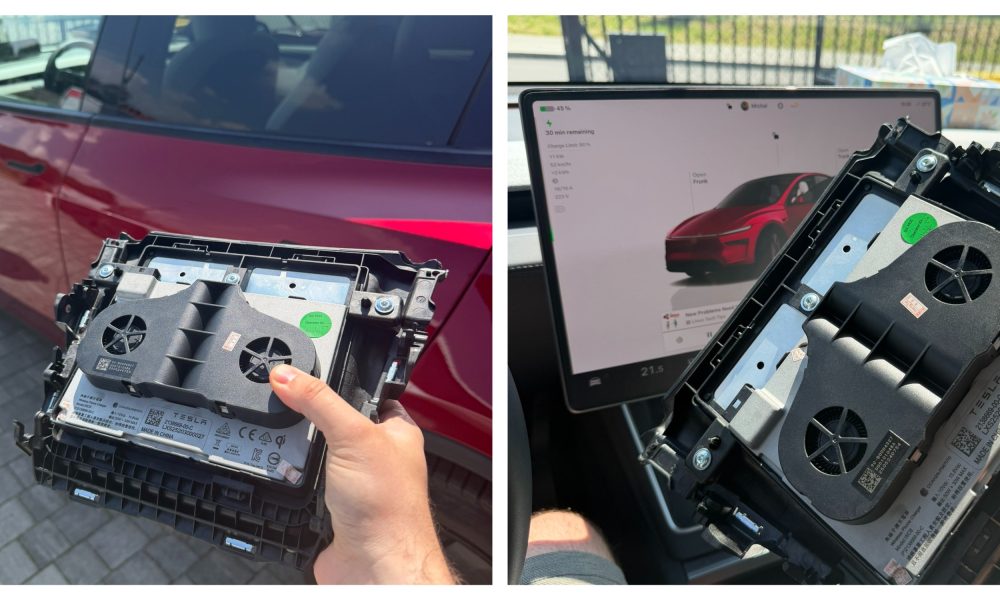
Software engineer Michał Gapiński decided to actually solve the problem. The Model Y owner sourced the actively cooled wireless charging pad from Tesla’s China-built Model YL, swapped it into his U.S.-spec vehicle, and got his phone charging at a comfortable 86 degrees Fahrenheit. The whole job cost under $200 for the part.
The gap between these two components tells you everything about regional product decisions at Tesla. The U.S.-market Model Y ships with a passive charging pad that relies on basic heat dissipation, a design that routinely pushes phone temperatures past 100 degrees within half an hour. The Chinese-market Model YL gets a small integrated fan for active cooling. Same connector, same console footprint, radically different user experience.
Gapiński confirmed the connector matched perfectly. He handled minor trim differences, then enabled the fan through custom coding outside Tesla’s official Toolbox software since the parameter isn’t fully locked down. The fan runs quietly enough to blend with the cabin’s AC and seat cooling systems.
This isn’t a complicated engineering problem. It’s a fan. A small, quiet fan that costs Tesla virtually nothing to integrate at the factory level. And yet U.S. customers have been living with a charging pad that functions as a phone warmer for multiple model years.
The complaints have been loud and consistent. Owners across forums and social media have documented the overheating cycle: place phone on pad, wait 20 minutes, get a thermal warning, watch charging stop. Many gave up and went back to cables. Tesla responded with incremental software patches and, eventually, that option to simply disable the feature. None of it addressed the hardware deficiency.
Gapiński’s retrofit is clean and effective, but it shouldn’t be necessary. The fact that a software engineer in his garage can fix a factory shortcoming with an off-the-shelf part from China raises an obvious question. Why hasn’t Tesla already rolled this cooling solution into U.S. production?
Reports suggest the company will begin installing cooled pads in new U.S.-built vehicles soon. That’s welcome, if overdue. But it leaves the existing fleet in limbo. There’s no word on an official retrofit kit or service bulletin for current owners, which means anyone who wants a functional wireless charger today either needs Gapiński’s DIY skills or a USB cable.
The cooled pad doesn’t support faster Qi2 charging on iPhones, so it’s not a perfect solution even on the hardware level. But keeping a phone at 86 degrees versus north of 100 is the difference between a feature that works and one that owners learn to ignore.
Tesla has always leaned on its ability to improve cars after purchase through over-the-air updates. That narrative works brilliantly for software. It falls apart when the problem is a missing fan. No amount of code can cool a passively designed charging pad in a sun-soaked cabin.
Gapiński proved the fix exists, it’s cheap, and it fits without modification. Now the question is whether Tesla will make it available to the people who already paid for a feature that never worked as promised, or whether owners will keep fixing the company’s homework themselves.



Share this Story