



The 2001 Dodge Neon R/T and the 2000 Nissan Sentra SE weighed exactly the same — 2,720 pounds each — cost within a thousand dollars of each other, and ran nearly identical quarter-mile times. Car and Driver’s comparison from its August 2000 issue, recently resurfaced in the magazine’s archives, reads like a dispatch from a parallel universe where affordable performance sedans still mattered to somebody other than used-car flippers.
The Sentra SE won. It won because Nissan built something that drove like a small Maxima — solid, refined, with a shifter that moved like it had been dipped in butter and a steering wheel that aimed the car with what reviewer Barry Winfield called “easy accuracy.” The 145-hp DOHC four didn’t scream, but it responded instantly, and the whole car felt more expensive than its $16,397 sticker had any right to deliver.
The Neon R/T finished second, but not by much, and not without a fight. Its 150-hp SOHC four, fed by a dual-plenum intake and exhaling through a stainless header, made a great noise and got to 60 mph in 7.7 seconds — three-tenths quicker than the Nissan. On the Streets of Willow road course, the Dodge’s SCCA-bred chassis showed its teeth, lapping 0.8 seconds faster.
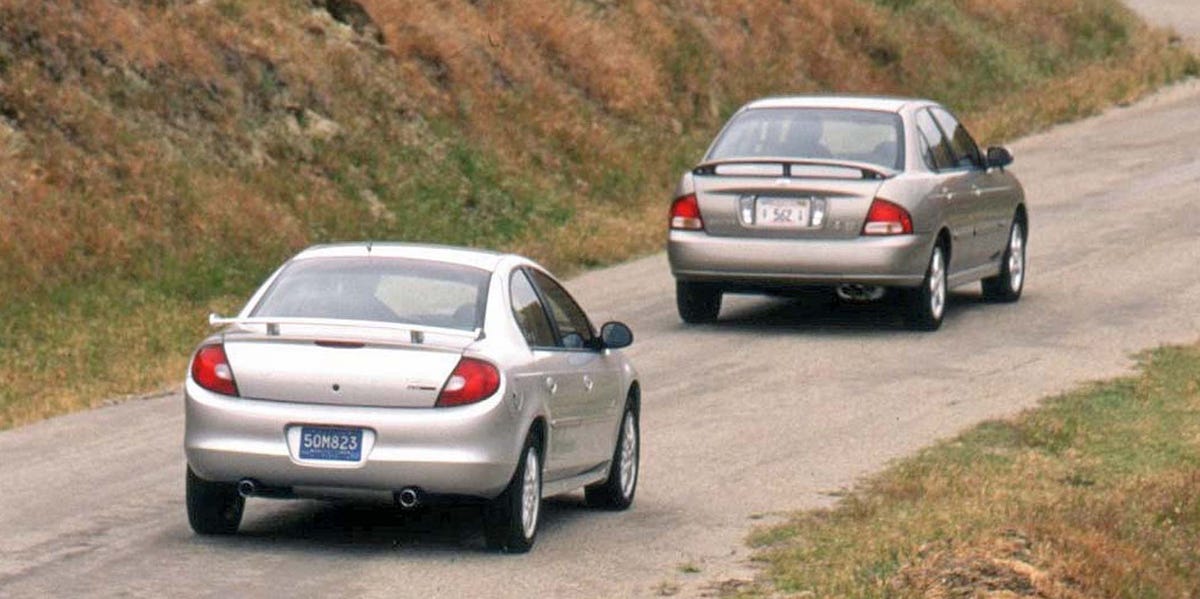
That track advantage didn’t save it. The Neon’s shifter was rubbery. Its clutch pedal traveled too far and made rev-matching a chore.
The interior textures felt cheaper. Power windows up front, hand-cranks in back. A single 12-volt outlet, a CD changer buried so deep under the dash that one tester cracked it “may as well be in another car,” and auto-locking doors that imprisoned your passengers until you got out first. These are the details that separate a car built to a price from one engineered with discipline.
Both cars rode on 16-inch alloys with 195-section rubber. Both had tuned suspensions, white-face gauges, and five-speed manuals. They were separated by five horsepower and five dollars’ worth of philosophy. Dodge went for flamboyance — the grinning face, the aggressive bolsters, the extroverted personality. Nissan went for composure.
The Sentra’s trunk was a cubic foot smaller, but the Neon’s rear strut towers ate into its cargo space anyway. The Nissan’s rear seat had less legroom but more headroom, which made it more livable. The Sentra’s upholstery pattern — geometric shapes in gray and rust — was questionable, but the adjustable seat cushion angle and height, controlled by simple knobs, showed the kind of thoughtfulness Dodge couldn’t match at the price.

A base price of $15,500 for the Neon R/T. Under $16,400 for the Sentra SE with the performance package, limited-slip differential, and a rear spoiler that actually improved the car’s otherwise generic styling. These were real cars with real engineering, sold to real people who wanted to drive something engaging on a budget that wouldn’t require a second mortgage or a seven-year loan.
The segment these two occupied is dead. Today’s cheapest new cars start around $20,000, weigh 500 to 800 pounds more, and come loaded with screens and safety nannies but almost never with a third pedal. The Neon nameplate died with Dodge’s compact ambitions. The Sentra survived but drifted toward appliance status, its SE-R days long buried.
What this comparison captured, without trying, was the last real window when an automaker could hand a young buyer a genuinely fun car for less than the price of a decent used SUV today. The Sentra SE won because it was the more complete machine. But both cars delivered something the modern market has walked away from — cheap thrills without apology, sold at a price that respected the buyer’s wallet as much as their desire to have a good time behind the wheel.


Share this Story