
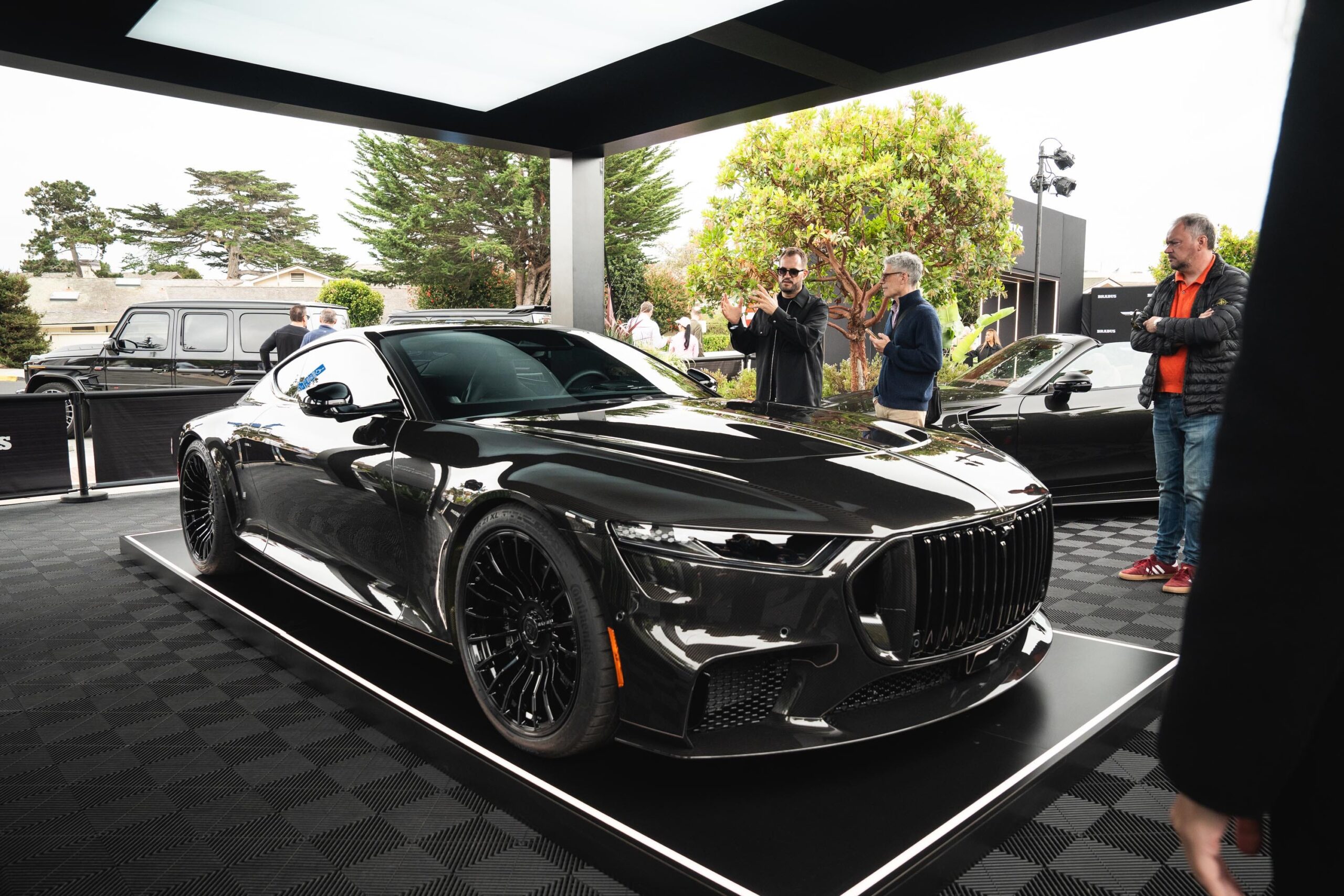


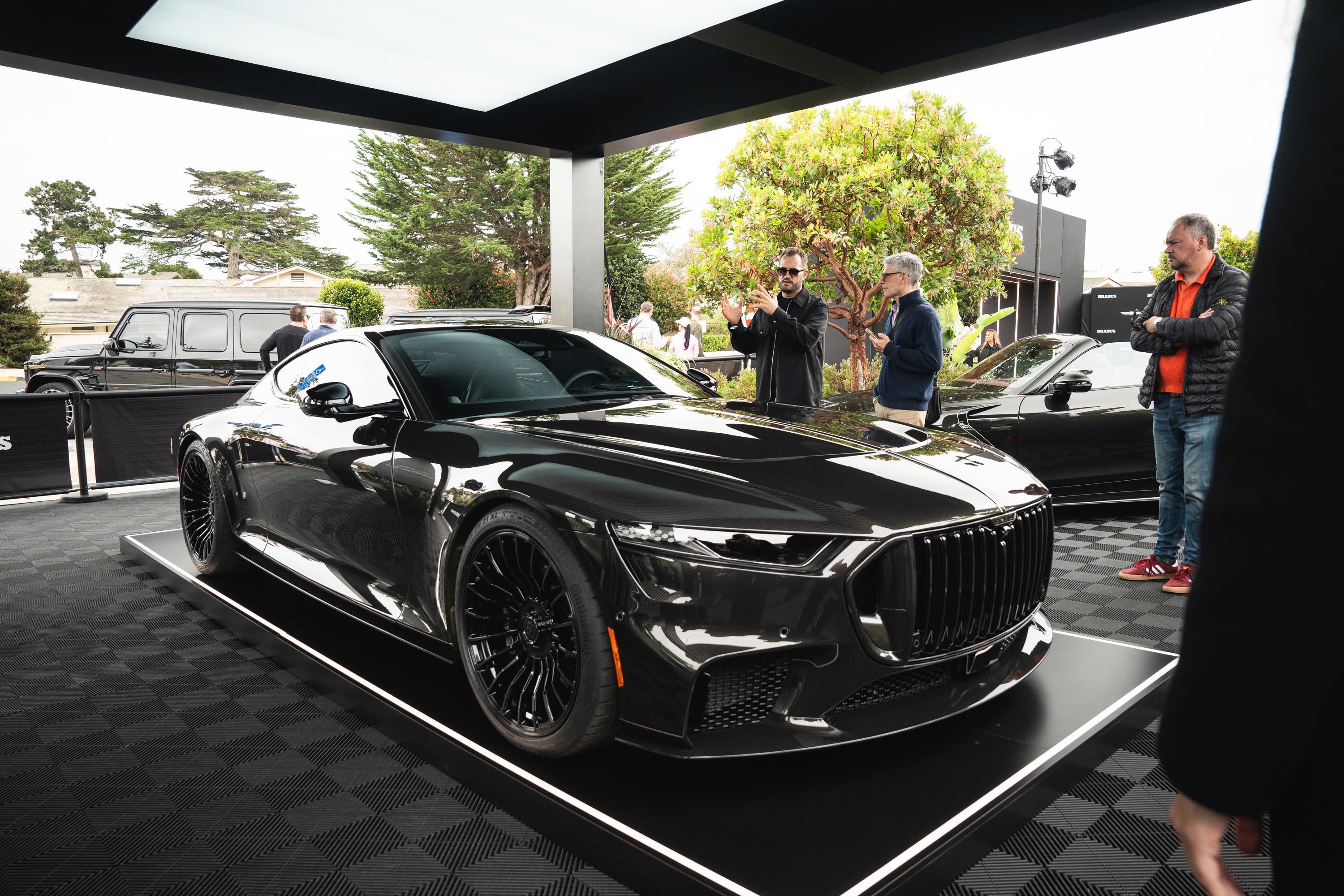
Brabus is selling a 1000-horsepower, carbon-fiber-bodied grand tourer that starts life as an Aston Martin Vanquish and ends up looking like something out of a 1930s coachbuilder’s fever dream. The company calls it the Bodo, after founder Bodo Buschmann, and it debuted during Monterey Car Week with a price tag starting at $1.15 million.
That figure buys you a car built on top of a $450,000 Aston Martin that gets completely stripped and rebodied. Every panel is hand-formed carbon fiber. The twin-turbo 5.2-liter V-12 gets new intercoolers, new turbos, and Ram-Air intakes, pushing output to a round 1000 horsepower and 885 pound-feet of torque.
Brabus claims sub-3.0 seconds to 60 and a top speed nudging 225 mph.
Constantin Buschmann, who took over as CEO after his father’s death in 2018, walked Car and Driver around the car at Pebble Beach before handing over the keys. He explained why Brabus, a company synonymous with aggressive Mercedes-Benz modifications, chose the Vanquish as its foundation.
“Only the Aston had the proper combination of long wheelbase, rake and curvature to the structural A-pillar and windshield,” he said. The fact that Aston Martin shares some electronic architecture with Mercedes through their existing partnership gave Brabus engineers familiar territory underneath.
Brabus buys fully finished Vanquishes from Gaydon rather than acquiring bare platforms. Buschmann was blunt about why: “With this low-volume product it doesn’t make sense to rely on something that hasn’t undergone a final full approval testing for regulations and safety.” So each Bodo begins as a complete, road-legal car before it gets torn down to its skeleton.
The result, driven on the grounds at Pebble Beach, is a car literally as long as a Kia Telluride but planted, in Car and Driver’s words, “like an old-growth redwood.” The eight-speed torque-converter auto sends everything to the rear wheels through a limited-slip differential, with 335-section 22-inch Pirelli P-Zeros doing the dirty work. There was no space to explore the car’s limits amid Monterey traffic, but brief bursts revealed a machine that can feel surprisingly docile for something with four figures on the dyno sheet.
That docility appears intentional. The styling is the tell. This is not the scooped, straked, aggressive Brabus the tuning world knows. The Bodo is clean, almost austere. Think Gorden Wagener’s Sensual Purity design language rather than carbon-fiber war paint.
“This is clearly a sign of where we are right now, what we’re thinking about car design, and also where we want to take the brand,” Buschmann said. “But then again, we’re talking about a $1 million luxury car.”
Brabus plans to build 77 coupes and 77 convertibles. The cabriolet was unveiled just the day before, so Buschmann couldn’t share sales figures for it, but the coupe allocation is already well on its way to selling out. Customization of paint, trim, and materials will push individual cars several hundred thousand dollars above the base price, meaning some examples will likely crest $1.5 million.
The business math is worth sitting with. Brabus takes a car Aston Martin spent years developing and building, pays roughly $450,000 for it, tears it apart, rebuilds it in carbon fiber with 1000 horsepower, and sells it for more than double. For 154 total units across both body styles, that’s potentially north of $175 million in revenue before options.
At Pebble Beach, the reaction was immediate. Bystanders pointed. Phones came out. People mouthed the name “Bodo” as the car rolled past.
Buschmann allowed himself a moment of satisfaction: “If people would always react to it the way they did to this car, that would mean good things for us.” The question now is whether Brabus can sustain this pivot from tuner to coachbuilder, or whether the Bodo remains a one-off flex from a company still figuring out what it wants to be when it grows up.
Share this Story