
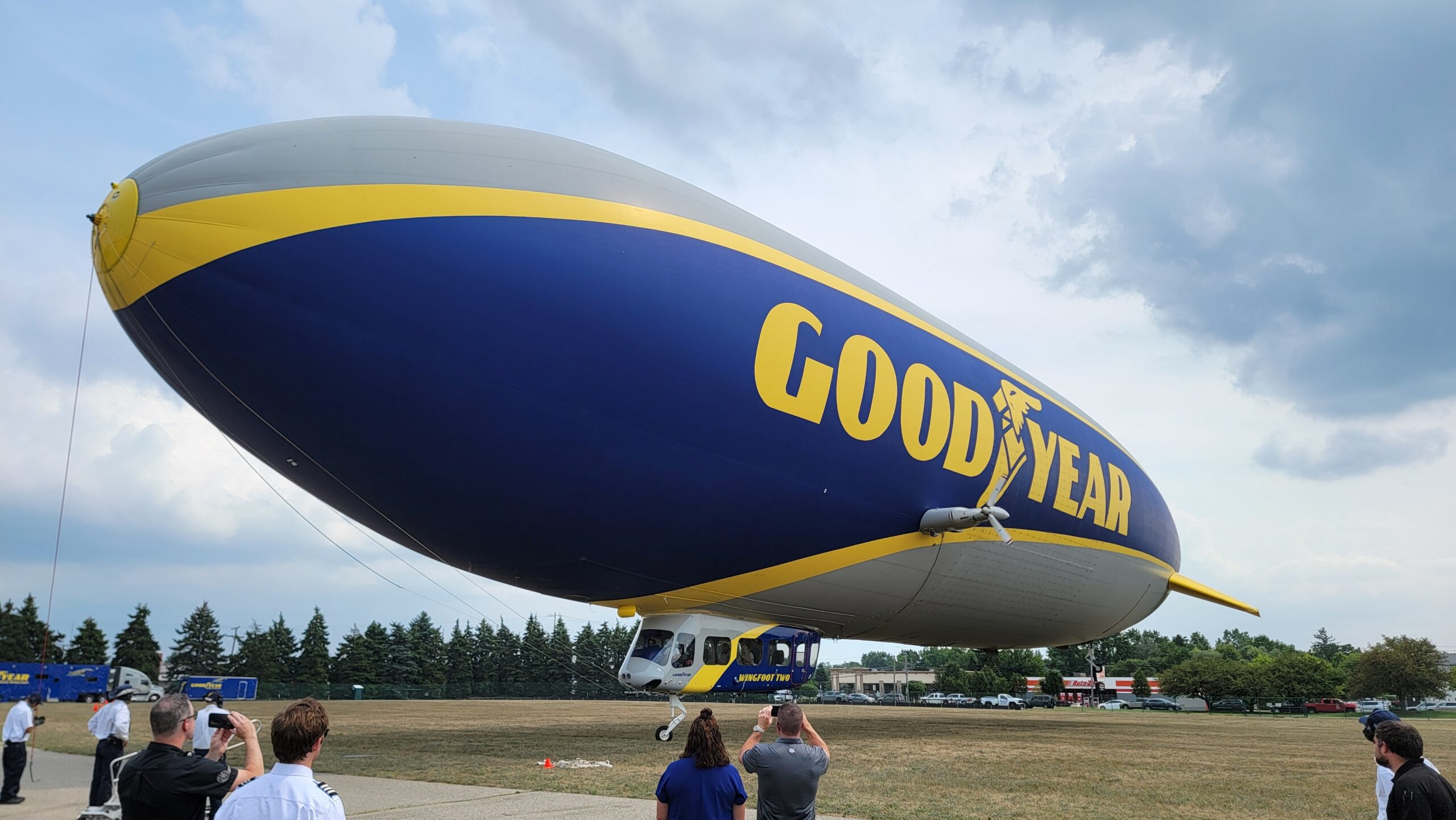


Forty-six miles per hour, windows open, no air conditioning. That’s the Goodyear Wingfoot Two experience in 2025, and it might be the most honest form of travel left in America.
The Drive’s Byron Hurd recently climbed aboard the airship for a flight out of Oakland County Airport in suburban Detroit, and his account reads less like a press junket and more like a love letter to obsolete engineering. The Wingfoot Two seats seven passengers. There are no bad seats because there are barely any seats at all.
Boarding alone is a spectacle. The blimp never fully lands between passenger rides. A wheeled gangway ladder rolls alongside it as the craft pivots on its mooring cable, drifting at varying speeds while ground crew wrestle with 20,000 pounds of helium-filled nylon.
Passengers serve as ballast. New riders board before the previous group disembarks, because letting the thing get too light means it simply floats away. Pilots spend most of their ground time flying the ship into the earth.
Once airborne, the sensation is unlike any powered aircraft. Planes glide. Helicopters beat air into submission. The blimp just floats, catching every thermal and gust like a sail the size of a building.
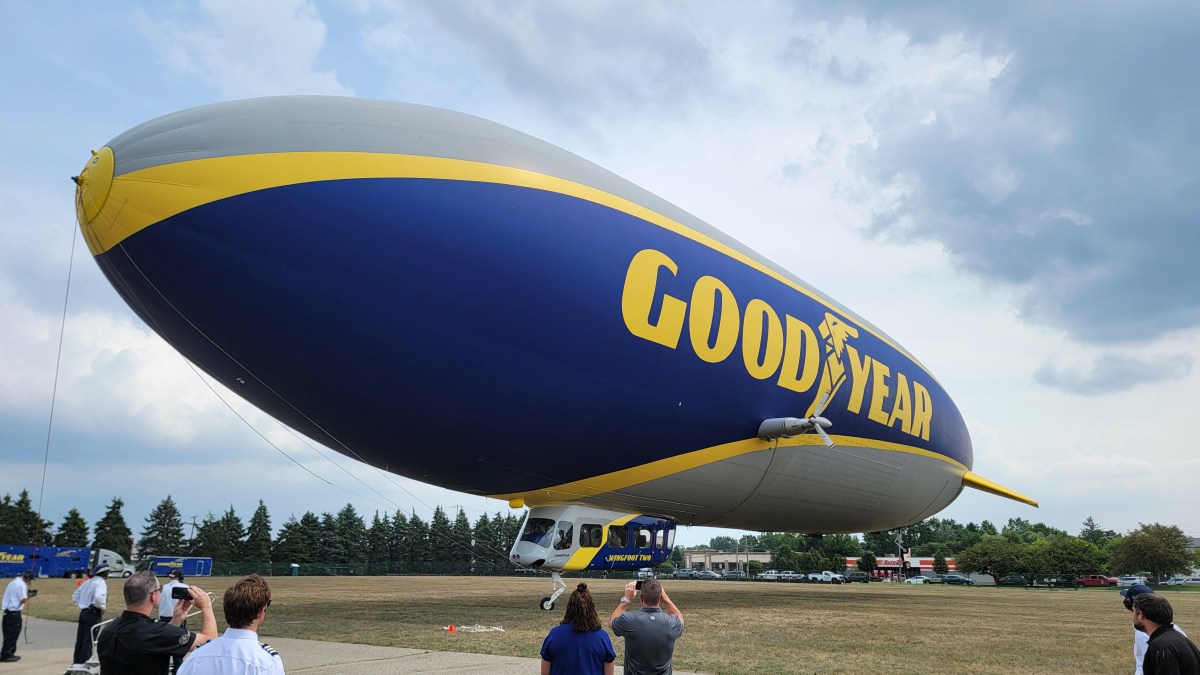
At a cruising altitude of 1,000 feet, passengers are told to find their “sea legs,” a nautical term that fits perfectly. The Wingfoot Two behaves more like a submarine turned inside out than anything resembling modern aviation.
The props provide thrust, not lift, which keeps cabin noise remarkably low. A crew member delivers the standard tour presentation at conversational volume with the windows wide open. No microphone needed. It is easy to understand why airship travel was once considered the pinnacle of luxury.
Goodyear calls these “exposure” flights. The company wanted to draw attention to its new flagship store on Woodward Avenue in Detroit. The skyline was obscured by haze during Hurd’s ride, but the mission was never really about the destination.
It was about the spectacle of getting there. Cars pulled over near the airfield at both takeoff and landing. People climbed out with phones raised.
A century after the first Goodyear blimp launched as an airborne yacht for wealthy landlocked enthusiasts, the formula has not changed. Float something enormous and slow over a populated area and people will stop what they are doing to look up.
The 46 mph cruising speed puts the Wingfoot Two in an awkward competitive position against, well, everything. Consumer drones are faster. Cars are faster.
The crew noted they could make the run from northern Detroit suburbs to Goodyear’s historic Airdock in Akron, Ohio, in about three hours by cutting over Ontario and Lake Erie. A car doing the same trip via Toledo would get there in roughly half the time but would miss the shortcut over international waters.
Hurd floated the idea of a race. Blimp versus car, Detroit suburbs to Akron, bragging rights on the line. Goodyear has not responded.
The airship is an artifact operating in plain sight. It is slow, weather-dependent, thermally unstable, and about as aerodynamic as anything designed before the Wright brothers got their act together. It cannot be climate-controlled. It drifts sideways on a whim.
And yet every single person who sees it stops to stare, which makes it arguably the most effective advertising platform ever devised. No algorithm required. Just helium, propellers, and the primal human instinct to gawk at something enormous floating where it probably should not be.
Goodyear has three of these semi-rigid airships in its current fleet. They are not for sale. They are not prototypes for some revival of lighter-than-air passenger service. They exist to make you look up from your phone for five seconds, and that alone might justify their existence.





Share this Story