
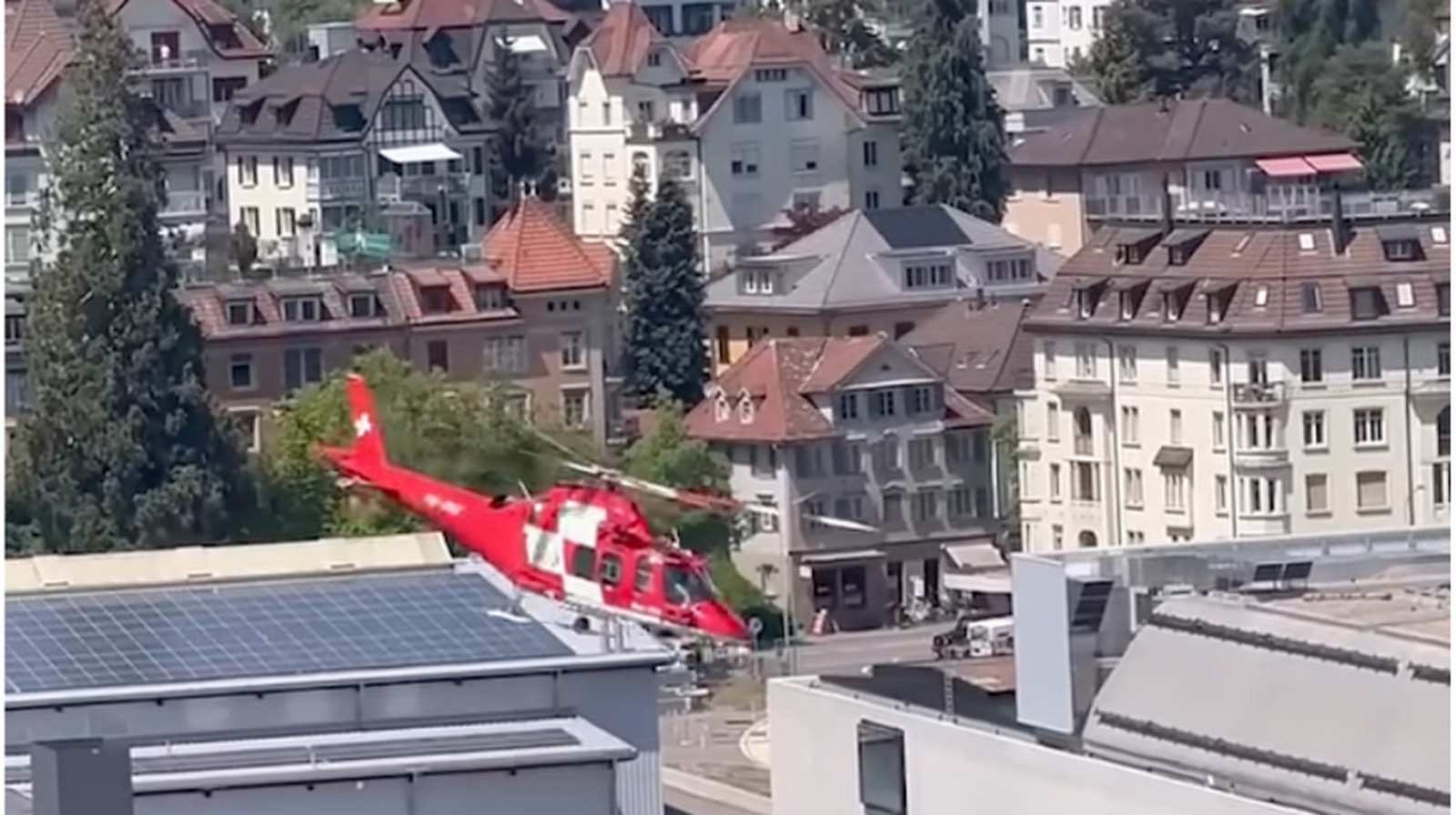


A video of a Swiss air ambulance helicopter sliding sideways into a hospital landing zone like a rally car on a mountain pass has racked up millions of views, and for good reason. It’s one of the most technically precise pieces of rotary-wing flying you’ll see outside a combat zone.
The pilot, operating one of Rega’s AgustaWestland Da Vinci helicopters, came in hot at an oblique angle between tall buildings, the aircraft traveling sideways through much of the final approach before straightening out and planting it on the pad. The internet is calling it a drift. That’s not technically wrong.
Rega is Switzerland’s non-profit air rescue service, running around-the-clock operations that pull critically injured patients off Alpine mountainsides and rush them to trauma centers. Speed isn’t optional. Every second of approach time shaved off is a second closer to surgical intervention.
The Da Vinci was built to Rega’s own specifications. It’s an Italian-designed machine with a low cowl and oversized windows engineered for visibility during aggressive maneuvering in tight spaces. Two Pratt & Whitney engines deliver 778 horsepower, pushing the 7,000-pound helicopter to a top speed of roughly 145 mph. It was designed for exactly this kind of flying.
What makes the video remarkable isn’t the showmanship. It’s the absence of it. The pilot isn’t grandstanding.
Watch carefully and you see a calculated decision: given the surrounding buildings and the approach geometry, sliding the helicopter in sideways was likely the fastest route to the pad. The aircraft’s nose swings through the turn while the fuselage tracks laterally, and just before touchdown the whole thing snaps straight. Clean. Controlled. Done.
Anyone who has watched competitive drifting knows the tell. The driver isn’t looking where the car is pointed. They’re looking where it’s going.
Same principle applies here. During that sideways approach, the pilot was almost certainly focused out the side window, eyes locked on the landing zone while the helicopter’s nose pointed somewhere else entirely. That takes a level of spatial awareness and stick-and-pedal coordination that most fixed-wing pilots will never develop.
Purists will argue that drifting, by definition, requires an automobile making a controlled skid with the front wheels opposing the direction of travel. Fair enough. A helicopter has no wheels in play during flight, no tire smoke, no opposite lock.
But the body language is identical: a machine traveling in one direction while pointed in another, under total control, with the operator looking sideways to thread the needle.
Switzerland’s mountain terrain makes conventional straight-in approaches a luxury that Rega pilots often don’t have. Tight valleys, sheer cliff faces, hospital helipads boxed in by urban architecture — these are the daily operating conditions. The Da Vinci’s design reflects that reality, and the pilots who fly them train relentlessly for exactly these scenarios.
So yes, a helicopter can drift. Whether the dictionary agrees is irrelevant. And somewhere in Switzerland, a patient arrived at a trauma center a few seconds faster because a pilot chose the aggressive line and executed it flawlessly. That’s not a stunt. That’s the job.





Share this Story