
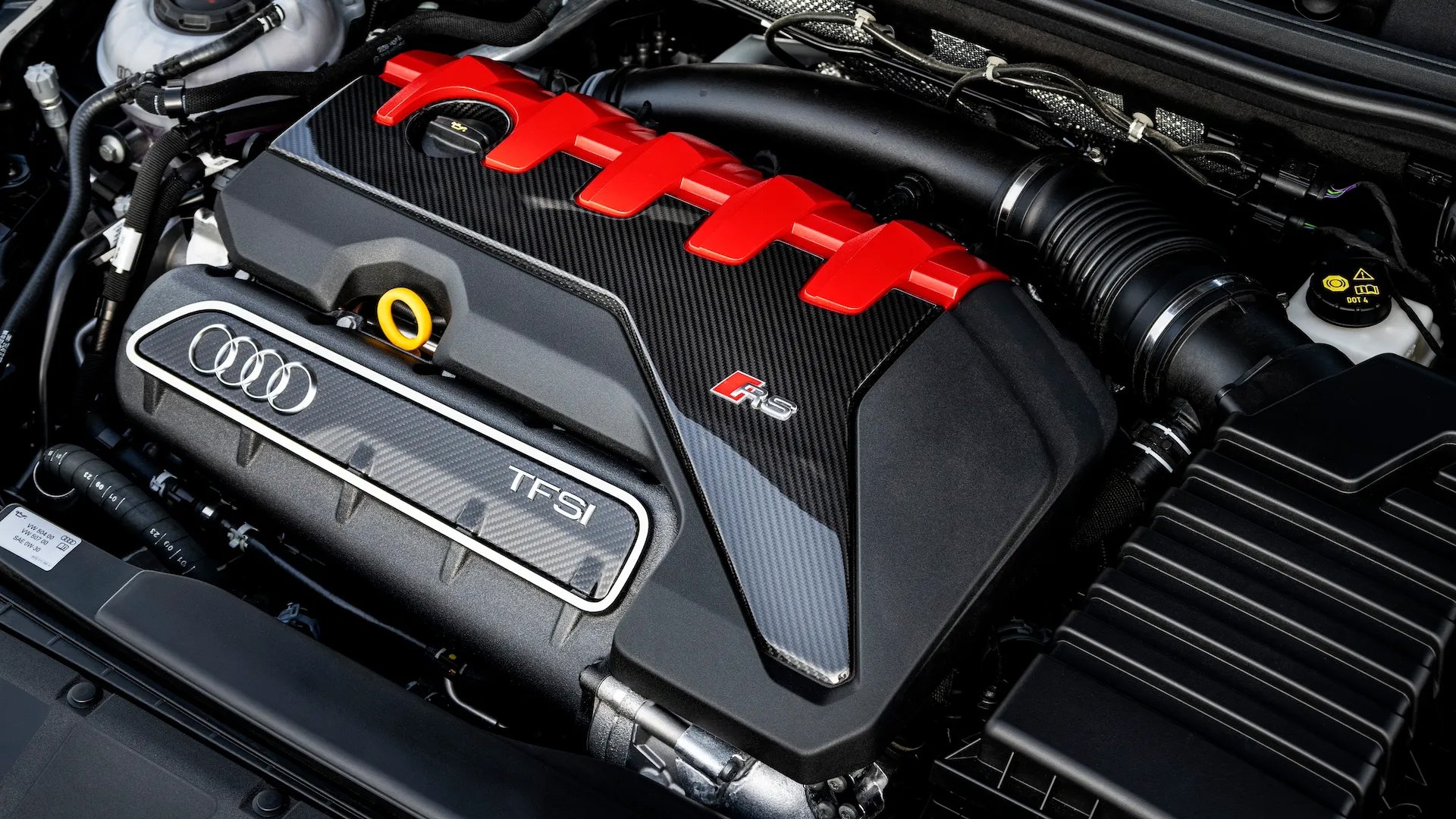


Audi Sport boss Rolf Michl is practically begging enthusiasts not to panic about the five-cylinder engine’s future. In a new interview, Michl acknowledged both his personal attachment and the motor’s deep roots in Audi’s DNA, saying evaluations are still running on how to keep the oddball powerplant alive. Right now, the warbling five-pot lives exclusively in the RS3, and tightening emissions rules across Europe make its continued existence anything but guaranteed.
Michl’s language was carefully affectionate without being committal. “We’re well aware about the historical meaning of the five-cylinder,” he said, adding that people who know him understand his personal relationship with the engine. That’s not a promise. It’s a politician’s answer wrapped in a gearhead’s sentiment.
Meanwhile, Stellantis is dealing with a more immediate headache. The company is recalling just under 850,000 vehicles across 15 model lines spanning Chrysler, Dodge, Jeep, and Ram over faulty backup cameras. It is yet another massive camera-related recall in an industry that has made rearview cameras mandatory safety equipment but keeps stumbling on reliability.
On the trade front, negotiations between the U.S. and Canada over vehicle tariffs are entering a critical phase. The current 25% tariff rate on Canadian-built vehicles could drop to 15%, and depending on how content rules are written, the effective rate might fall into single digits. The sticking point is whether the deduction formula counts North American content broadly or U.S. content specifically. That distinction alone could reshape where automakers choose to build.
Jaguar Land Rover is not waiting around for the tariff dust to settle. The British luxury automaker confirmed during an earnings call that its partnership with Stellantis to use U.S. production capacity will focus strictly on American soil, not Canada, not Mexico. CFO Richard Molyneux laid out the rationale bluntly: the U.S. holds 40% of the world’s millionaires, loves SUVs, and has deep brand loyalty to Range Rover, Defender, and Jaguar. Hard to argue with that math.
Tesla reportedly plans to launch its Cybercab robotaxi fleet in Austin as early as this month, according to sources familiar with the company’s plans. If true, it would mark the first real-world commercial deployment of a vehicle Elon Musk has been teasing for years. Austin has served as Tesla’s backyard testing ground, so the city choice tracks.
In the world of high-horsepower fever dreams, Bugatti CEO Mate Rimac went on record endorsing the idea of a V16 with a manual transmission. Not hedging, not deflecting. “Yes, definitely. Definitely,” he said. “Imagine a V-16 with a manual. Real manual.” Whether Bugatti actually builds such a thing is another question entirely, but the head of the company publicly fantasizing about it is new territory.
Honda and Acura confirmed that hybrid versions of the HR-V and ADX subcompact SUVs are not happening anytime soon. Product planning boss Gary Robinson pointed to cost as the primary obstacle, noting the price sensitivity of the entry-level segment. Electrification, it turns out, still has a floor price problem nobody has cracked for the cheapest vehicles in a lineup.
German tuning house Ruf flatly denied reports that Porsche was in talks to acquire the company, calling the speculation false and stating plainly that Ruf is not for sale. The family-owned firm has operated independently for decades, building its identity on reimagining Porsche platforms without ever becoming part of the mothership. That apparently is not changing.
Share this Story