
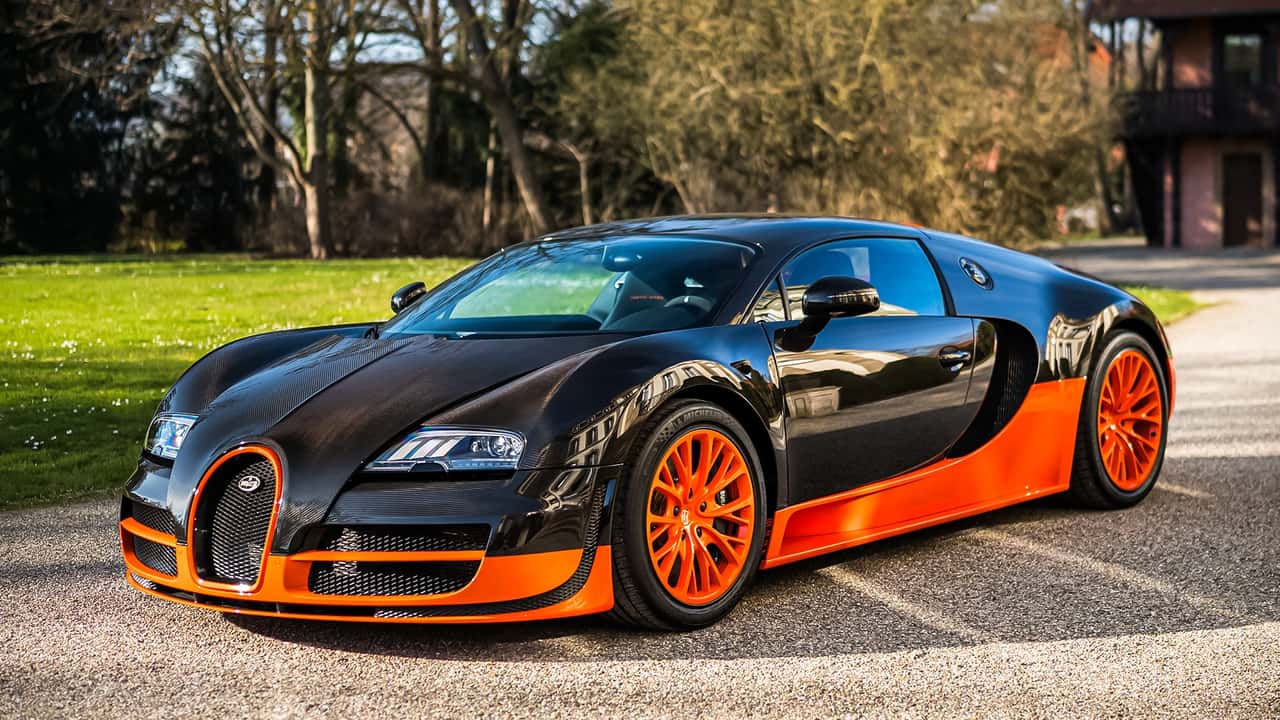


A Bugatti Veyron Super Sport that helped the company hit 431.072 km/h in 2010 and claim the production-car top speed record has been restored at the factory and quietly sold to a private collector. The car wasn’t a standard customer delivery. It was a pre-series development vehicle, one of the engineering mules that helped Bugatti refine the Super Sport before it reached production.
That distinction matters more than the orange paint.
La Maison Pur Sang, Bugatti’s in-house heritage and restoration division in Molsheim, spent six months bringing the car back from 70,800 hard kilometers of media launches, customer demonstrations, photo shoots, and development work spread across more than a decade. This was a car that had been used exactly the way factory prototypes get used — relentlessly.
The restoration touched everything a buyer would notice. Leather was rejuvenated, seats reshaped, the steering wheel fully serviced. Outside, the exposed carbon fiber bodywork was refinished and clear-coated, and the signature Bugatti orange accents were resprayed to recreate the contrast that defined the World Record Edition’s visual identity.
The more interesting work happened underneath. Several pre-series components were swapped out and upgraded to final production specification, including updated electronics and radiator systems. The W16 engine and gearbox, however, remain original — the same units that were in the car during its development role alongside the record-breaking program.
This is Bugatti threading a needle. Swap too much and you lose provenance. Swap too little and you’re selling a car with prototype-grade cooling systems to a collector who might actually drive it.
They kept the powertrain authentic and modernized the supporting hardware. It’s the right call for a car with this kind of mileage and history.
The new owner receives a Bugatti certification book documenting the car’s provenance, its development history, and the restoration process. Bugatti didn’t disclose a price, and nobody expected them to.
There’s a broader play here. La Maison Pur Sang isn’t just a workshop — it’s a profit center disguised as heritage stewardship. Bugatti has been steadily building this division’s profile, taking in aging Veyrons and Chirons, restoring them to factory condition, certifying their histories, and either returning them to existing owners or facilitating sales to new ones.
Every restoration reinforces the idea that these cars hold value, that Bugatti stands behind them long after the warranty expires, and that the brand’s history is worth investing in.
Selling a factory prototype through this channel is a step further. Development cars have always occupied an awkward space in the collector market — more historically significant than production examples, but sometimes less desirable because of their non-standard specifications and hard lives. Bugatti is arguing that this particular car, with its direct link to the speed record program, is more valuable precisely because of its role behind the scenes.
The Veyron Super Sport World Record Edition was already a limited car. Only a handful were built for customers, finished in that distinctive carbon-and-orange livery. This one predates all of them. It’s the car that helped make those customer cars possible.
Whether it ever turns a wheel again under its new ownership is another question. But Bugatti has done what it needed to: taken a tired development mule with a remarkable story and turned it into a certified, sale-ready artifact. The factory that built it also restored it, documented it, and endorsed it.
That’s a closed loop very few manufacturers can offer, and it’s becoming one of Bugatti’s quieter competitive advantages in a market where provenance is currency.

Share this Story