
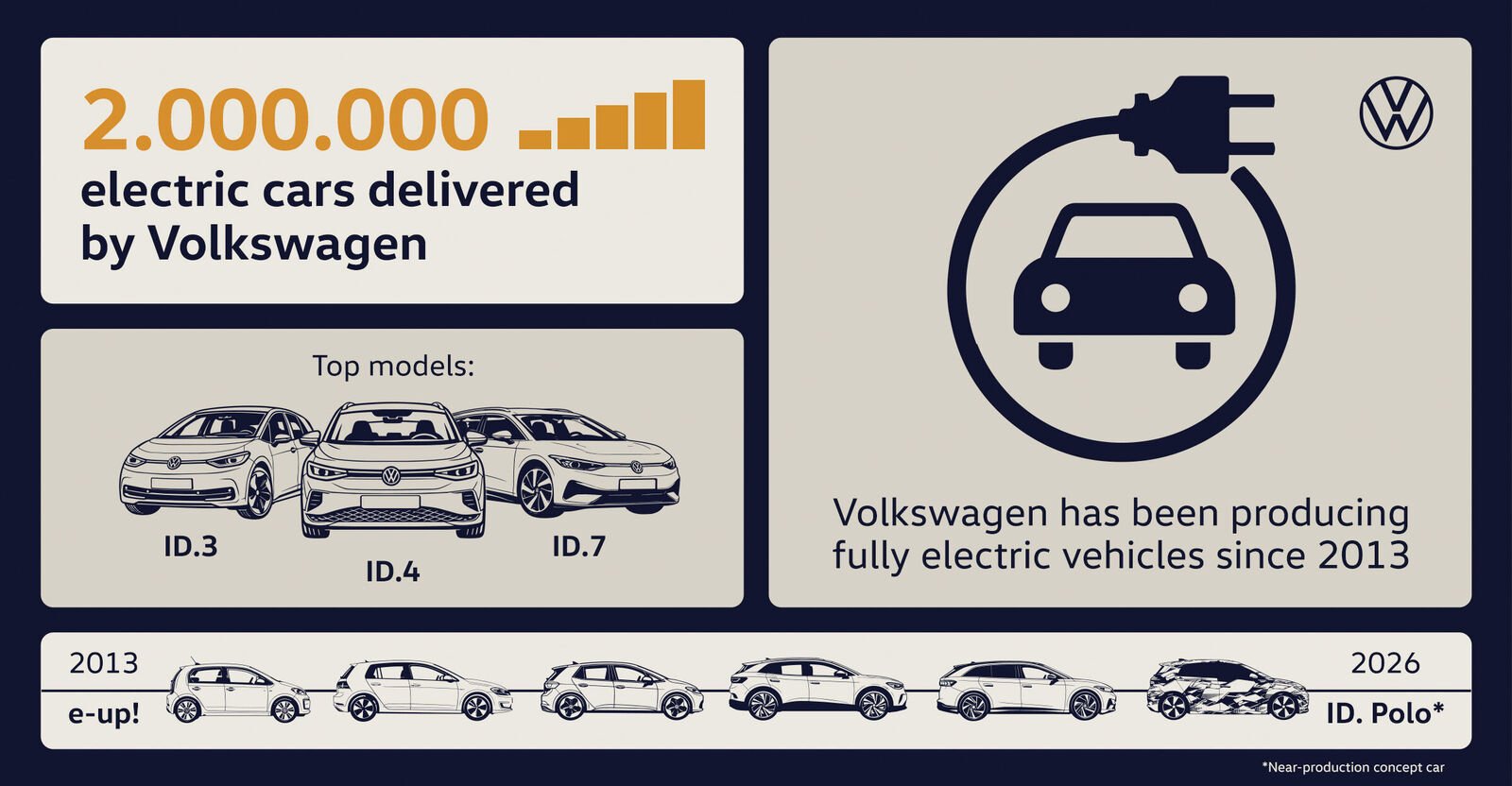


Volkswagen has delivered its two-millionth all-electric vehicle, marking a landmark moment in the German automaker’s ongoing shift toward battery-powered mobility. The milestone car was an ID.3 built at the Zwickau plant in Germany. It was handed over to customer Kirsten Vormbrock at the Transparent Factory in Dresden.
The achievement stretches back to the 2013 launch of the e-up!, Volkswagen’s first modern battery electric vehicle. Since then, the brand has expanded its lineup from the compact ID.3 hatchback all the way to the long-range ID.7 saloon and tourer.
Three models have done the heavy lifting to get here. The ID.4 SUV leads with approximately 901,000 units delivered globally, making it the brand’s best-selling electric vehicle by a wide margin. The ID.3 follows with around 628,000 deliveries, while the ID.7, launched in 2023, has reached approximately 132,000 customers.
Martin Sander, Volkswagen’s Board Member for Sales, Marketing and After Sales, said the achievement validates the brand’s long-term strategy. We laid the foundations for electromobility early on and are driving our transformation to an all-electric future with clear strategic priority,” Sander said. “Our strong market position, particularly in Germany and Europe, confirms the attractiveness and competitiveness of our electric portfolio.”
Volkswagen now ranks among the highest-volume electric vehicle providers in Europe. That position has been built incrementally since the first e-up! rolled out more than a decade ago.
The brand shows no sign of slowing down. The newly revealed ID. Polo is set to be the first of four new electric models launching throughout 2026, all targeting the high-volume small car and compact segments. The goal is straightforward: bring affordable electric mobility to buyers who have so far been priced out of the EV market.
“These new models make electromobility accessible to even more customers,” Sander added. “Our aim is to introduce attractive, affordable electric vehicles for everyday use into the high-volume small car segment and, in so doing, take the next growth steps in our transformation.”
The Transparent Factory in Dresden continues to play a meaningful role in the brand’s customer experience strategy, even though series production there has ended. Around 3,500 vehicles were handed over at the Dresden facility in 2025, with more than 90 percent being all-electric or plug-in hybrid models. That volume makes it Volkswagen’s second-largest national delivery center behind Autostadt Wolfsburg.
The Zwickau plant, just a short drive from Dresden, remains the manufacturing heart of Volkswagen’s electric operation. Approximately 212,000 electric cars rolled off its assembly line in 2025 alone, cementing Zwickau’s place as one of Europe’s most significant EV production facilities.
With two million in the rearview mirror and four new affordable models on the horizon for 2026, Volkswagen is gathering serious momentum. Not bad for a transformation that started quietly with a small city car more than a decade ago.

Share this Story