


Ferrari spent months telling the world its first electric car would shatter expectations. The Luce was going to redefine what a cabin could be. The usual pre-launch vocabulary deployed when a brand needs to justify a price tag that hasn’t been announced yet.
Then the doors opened, and it was caramel leather, toggle switches, and some very nice glass.
Car and Driver’s Elana Scherr put it best after the reveal: the earth was not broken. Ground-footprinted, maybe. The Luce interior is pleasant, minimal, tactile, and completely recognizable as a car interior. A driver from 1901 would squint at it for about three seconds before saying, “Ah, yes, one of these.”
That’s not necessarily a knock. The cabin was designed by Jony Ive and Marc Newson, the duo behind the Apple Watch, and it reflects their instinct for restraint. No multiplex screens. No overwrought carbon fiber.
The shifter and console use a new glass composition engineered by Corning — harder and more scratch-resistant than Gorilla Glass, yet perfectly clear. It’s clever material science deployed in service of something that looks and feels like a very expensive automobile interior. Which it is.
Ive himself acknowledged the tension after the reveal. “New is really easy,” he told Scherr. “We could do something new in half an hour. Make it pink and fluffy.” His point: shock value isn’t design. Discipline is.
Fair enough. But Ferrari didn’t promise discipline. Ferrari promised revolution. And the gap between those two things is where the Luce’s real challenge lives.
The company is asking its clientele — collectors, enthusiasts, people who define their identity partly through the sound of a flat-plane-crank V-12 — to accept a battery-electric Ferrari. That is, by itself, the most radical thing the brand has attempted in decades. The interior needed to either lean all the way into that radicalism or wrap the unfamiliar powertrain in something so deeply, confidently Ferrari that loyalists would feel at home.
The Luce cabin lands in a strange middle ground. It’s too restrained to feel like a statement and too new to feel like tradition. The toggle switches nod to analog charm, but they sit alongside glass surfaces that read as consumer electronics.
It’s an Apple Store crossed with a Maranello showroom. It works on paper, but paper isn’t where $400,000-plus cars are sold.
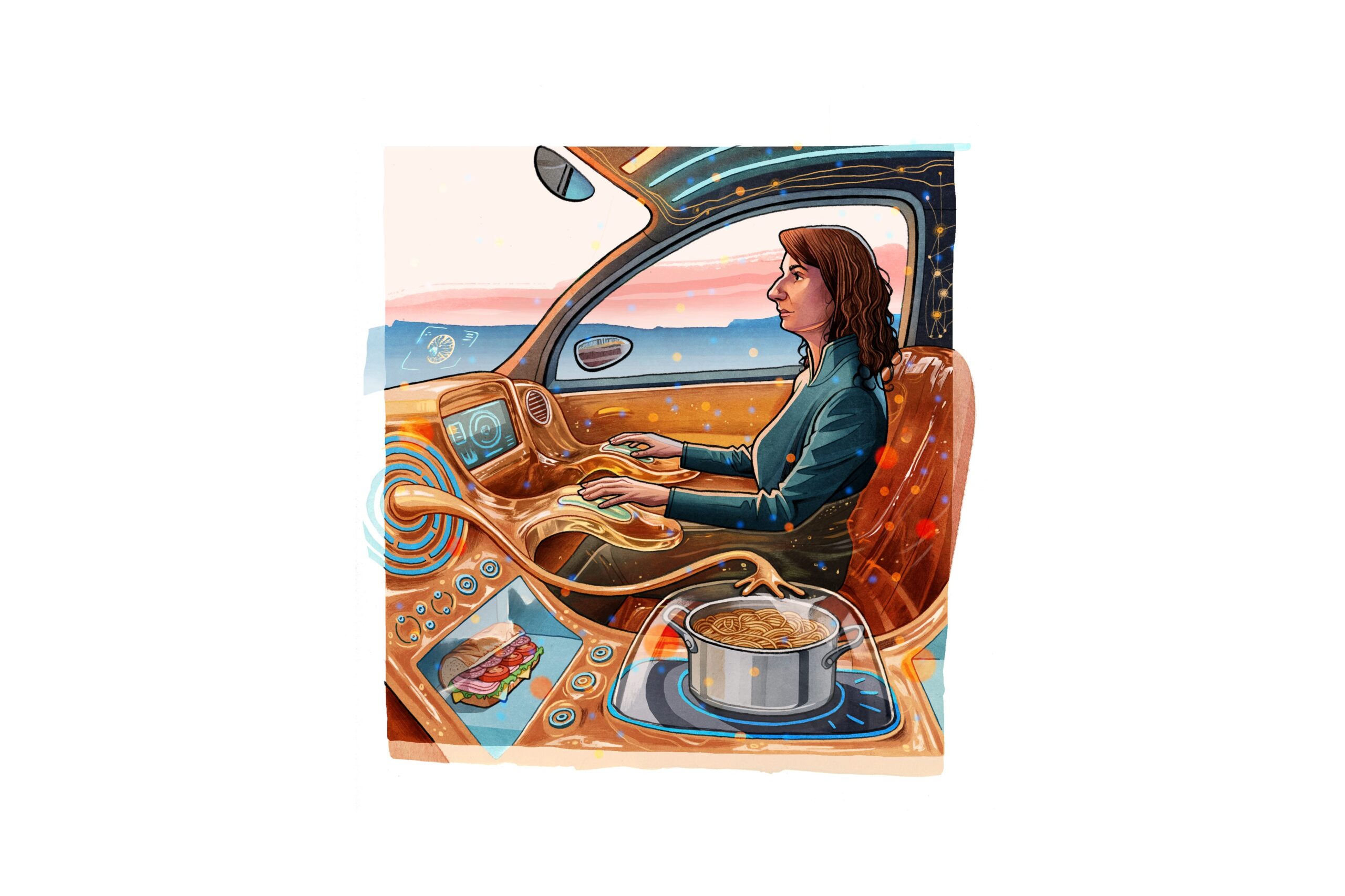
Scherr spent an hour before the reveal brainstorming genuinely wild cabin concepts — bioelectric gel pods, horse-saddle controls, a cooktop — and landed on the obvious conclusion that truly revolutionary interiors don’t exist because human bodies, safety regulations, and manufacturing constraints demand familiar forms. She’s right. A steering wheel is a steering wheel because nothing better has replaced it.
But the disappointment isn’t about the Luce failing to deliver a goo car. It’s about Ferrari’s marketing writing checks the design team chose not to cash. Ive and Newson made a polished, thoughtful, deliberately quiet interior. That’s a valid design philosophy. It’s just not the one Ferrari advertised.
The real surprise of the Luce, as Scherr notes, isn’t anything inside the cabin. It’s the idea that Ferrari’s customers will buy an electric car at all. Everything else — the Corning glass, the leather, the toggles — is window dressing around that single enormous bet.
And if you’re going to bet the brand on electrification, the interior of that car probably shouldn’t be described as “fine.
Nice is a dangerous word for a Ferrari. Nice is what you say about a Lexus. Maranello has spent seven decades building cars that provoke stronger reactions than that.
The Luce will ultimately be judged by how it drives, not how its console reflects light. But first impressions matter, and Ferrari’s first electric impression is a cabin that whispers when the moment called for something louder.


Share this Story