
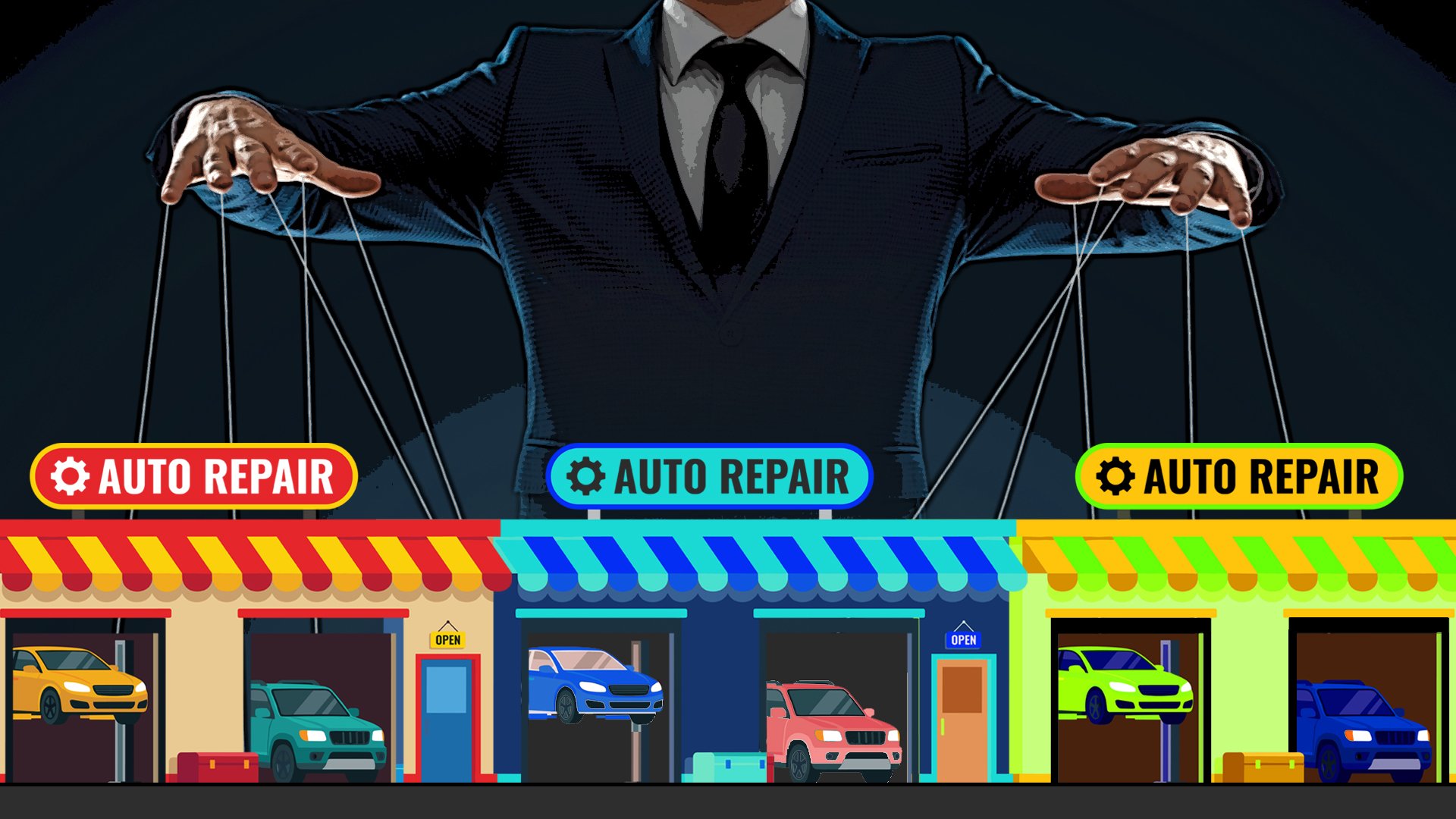


Mavis Tire just wrote a $700 million check to buy Pep Boys from Carl Icahn’s holding company. That deal, on its own, is routine industry news — one big chain swallowing another. But trace the money back far enough and a much sharper picture emerges.
Six parent companies now control almost every branded auto service chain in the country. And behind most of them sits the same force: private equity.
Mavis itself is backed by BayPine, Goldman Sachs’ West Street, and TSG Consumer Partners. Its empire already included NTB, Tire Kingdom, Tuffy, Town Fair Tire, Express Oil Change, Brakes Plus, and — as of last year — Midas. Adding Pep Boys’ 800 locations makes Mavis one of the largest service networks on the continent.
You may never have heard the name Mavis, but you’ve almost certainly walked into one of its shops without knowing it.
Driven Brands, the Charlotte-based company behind Take 5 Oil Change, Meineke, Maaco, CARSTAR, and 1-800-Radiator, is publicly traded but controlled by Roark Capital, the private equity titan that also runs a chunk of American franchising. Roark separately picked up Strickland Brothers in 2024.
Monro, publicly traded out of Rochester, New York, operates 16 regional brands including Mr. Tire, Tire Choice, and Free Service Tire. Each one reads like a hometown operation. Each one answers to the same corporate parent.
Bridgestone Retail Operations is the vertically integrated outlier. The tire manufacturer owns Firestone Complete Auto Care, Tires Plus, Hibdon Tires Plus, and Wheel Works. The company making the tires also owns the bays bolting them on.
Bridgestone actually tried to buy Pep Boys back in 2015 but lost the bidding war to Icahn — the same Icahn who just sold it to Mavis. Musical chairs with a $700 million ante.
Valvoline, the oil-change chain, is no longer connected to Valvoline the motor oil. The manufacturing side went to Saudi Aramco in 2023. The retail service business — Valvoline Instant Oil Change, Great Canadian Oil Change, the Express Care platform — is its own publicly traded entity now.
The brand on the sign and the oil in the jug have two entirely different owners.
Then there’s Jiffy Lube, possibly the most recognized quick-lube name in America. Shell owned it for two decades. In March 2026, Shell agreed to sell the roughly 2,000-location franchise network to Monomoy Capital Partners for about $1.3 billion.
Two of the most familiar names in American car care — Pep Boys and Jiffy Lube — both changed hands within months of each other, and both moved from strategic corporate parents to financial ones. That is not coincidence. That is a pattern with momentum.
The playbook is the same every time. Buy a regional chain that spent 40 years earning trust. Do not repaint the building.
The local name stays up because the local brand equity is the asset. Rebranding would be lighting money on fire. The fragmentation consumers see on the street — a dozen different familiar names — is engineered.
It lets these companies reach enormous scale without ever looking like the Walmart of brake jobs.
Thousands of independent, single-location shops still exist, and they still do great work. But the branded chains most Americans default to — the ones with national ad budgets and locations near every highway exit — increasingly answer to a very small number of boardrooms.
Scale brings real advantages. Better parts availability, more consistent warranties, tighter supply chains. A shop plugged into a national distribution network can get a part overnight in ways a true independent sometimes cannot.
But consolidation is a one-way ratchet. Fewer competitors means less pressure to compete on price or service quality. The signs out front still say a dozen different things.
Behind them, six companies — most steered by private equity — keep tightening their grip. The local shop on your corner might still feel local. The check it deposits every night tells a different story.
Share this Story