
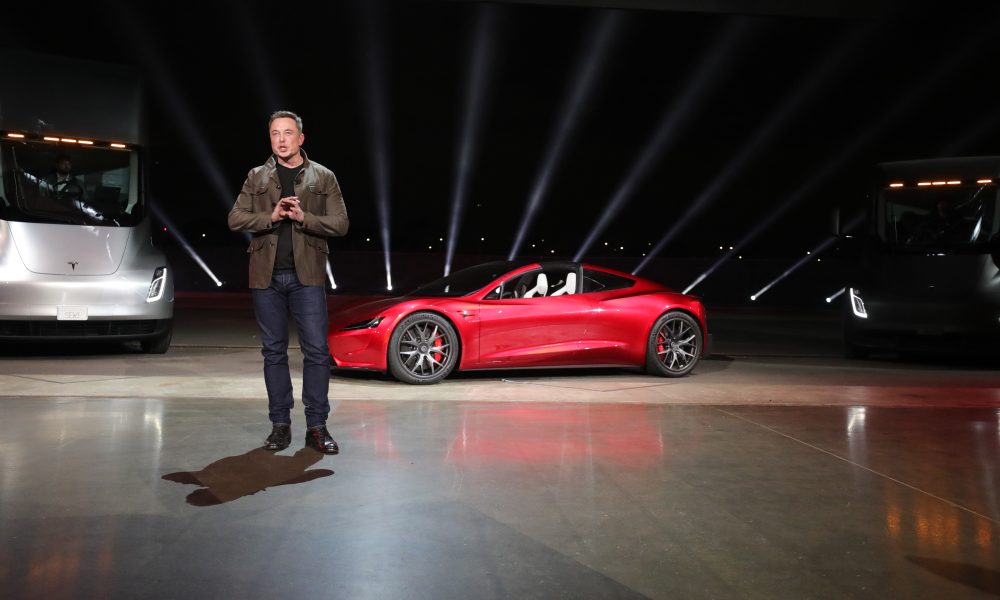


Tesla pushed its Roadster unveiling back two weeks, blaming high winds. For a car demo. On the ground. With four wheels.
That contradiction is the whole story. Every new detail leaking out of the delayed October 15 event points toward a vehicle that will, in some form, leave the pavement. The question is no longer whether the Roadster will incorporate SpaceX thruster technology. The question is how high.
Start with the FAA filing. The agency granted Tesla a Temporary Flight Restriction over SpaceX’s McGregor, Texas facility at 10,000 feet above ground level. Standard TFRs at McGregor run about 2,000 feet, typically enough to keep local air traffic clear of rocket tests. Tesla got five times that ceiling for a car event.
Some observers suggested the extra altitude is simply to block drones from filming. That theory crumbles under scrutiny: drone restrictions do not require 10,000 feet of cleared airspace.
Then came Elon Musk’s postponement post on X. “Due to high winds, the new Roadster demo is postponed by 2 weeks,” he wrote. One reply cut right to the bone: “What’s strong wind got to do with a car demo with four grounded wheels?” Musk did not respond. He did not need to.
Tesla had already said the event “can only be held outdoors,” which is an odd requirement for a vehicle unveiling. Indoor auto shows have managed just fine for over a century. Cold-gas thrusters borrowed from SpaceX, the kind that would enable hovering or brief flight, would explain both the outdoor mandate and the wind sensitivity. You cannot safely demonstrate thrust vectoring in a crosswind, and you cannot do it inside a building.
A freshly granted patent adds another layer. Filed under the bland title “Electric Car Fan,” the September 29 patent describes a ducted-fan system embedded in the rear diffuser. Four axial fans pull air from beneath the car to generate downforce independent of vehicle speed.
The design solves a real engineering problem: electric motors deliver maximum torque instantly, but tires cannot use that force without grip. Passive aero only works at speed. These fans would press the car into the road from a standstill, giving it traction for the sub-two-second 0-60 time Tesla has promised.
The concept has racing lineage and racing baggage. Brabham’s BT46B fan car was banned from Formula 1 in 1978 after a single race because it was simply too fast. Tesla apparently studied the same physics and decided a production car does not answer to the FIA.
What makes the patent interesting alongside the thruster rumors is the duality. One system pins the car to the ground. The other lifts it off. Tesla seems to be engineering for both extremes: a road car that generates massive downforce for cornering and braking, and a demonstration vehicle that can go airborne when the thrusters fire. Whether both modes ship to customers or the flight package remains an option is unknown.
Musk’s proximity to the Trump administration adds a regulatory dimension. He sat at the president’s left hand last week during a White House AI lunch and has traveled with Trump to China. Getting FAA clearance for a road-legal vehicle with aerial capability would be an entirely different fight, one where having the president’s ear matters.
The Roadster was first promised in 2017. It has been delayed so many times that skepticism is practically a reflex. But patents get granted based on technical merit, the FAA does not issue airspace restrictions as marketing stunts, and wind does not postpone car launches.
October 15 is three weeks away. McGregor’s weather forecast is not yet available that far out.
Share this Story