
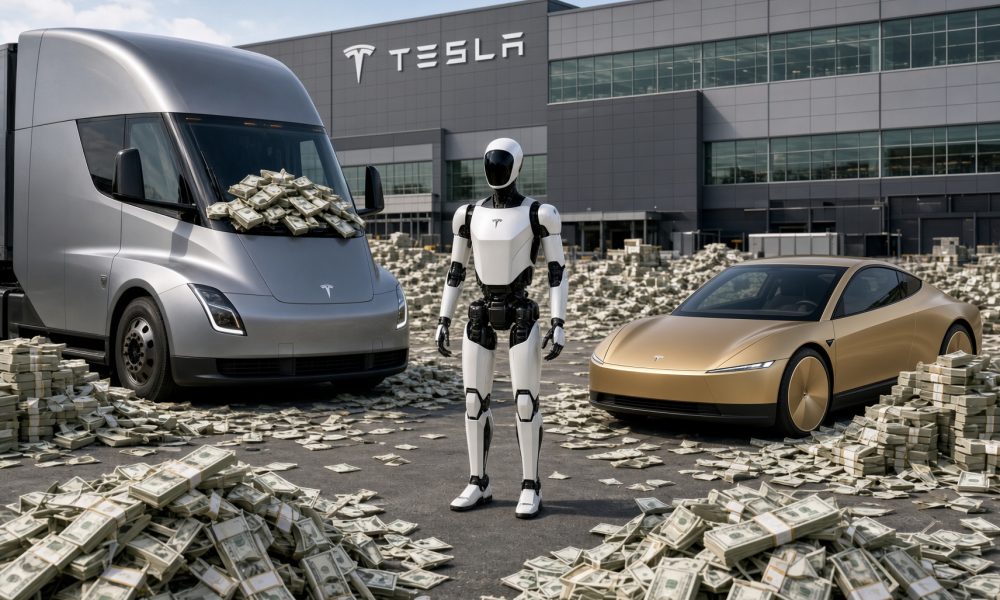


Tesla just lined up $30 billion in fresh credit, the kind of borrowing that signals a company sprinting toward something enormous or bracing for impact. In this case, it looks like both.
The company disclosed Tuesday that it secured a $20 billion delayed-draw term loan from Citibank and a combined $10 billion in revolving credit facilities from Wells Fargo. Tesla says it won’t tap any of the money this year. But with capital expenditures forecast to exceed $25 billion, up from roughly $8.5 billion last year, the cash runway is clearly being built for 2027 and beyond.
Three products are swallowing that capital: Cybercab, Semi, and Optimus. Each one demanded new manufacturing infrastructure. Each one is either freshly launched or still deep in development. None of them are printing money yet.
Cybercab entered production at Gigafactory Texas earlier this year and has barely crossed 100 units in its fleet. Semi got a dedicated factory in Sparks, Nevada, next to the original Gigafactory. Optimus, the humanoid robot, displaced Model S and X production entirely at the Fremont plant, ending the two vehicles that originally put Tesla on the map.
That last detail deserves a beat. Tesla killed its flagship sedans and SUVs to make room for a robot that hasn’t shipped. That’s a capital allocation decision that would get most CEOs dragged before their board.
The loan structures tell their own story. The Citibank facility allows draws “no more than ten times” over 18 months and matures in 2029. The Wells Fargo revolving line runs five years with optional extensions. The short-term $2 billion facility comes due in just a year. Tesla built itself a tiered system, flexibility to pull money when projects hit inflection points rather than drawing it all at once.
Meanwhile, the core car business appears healthy enough to support the borrowing. Showrooms across the U.S. were reportedly stripped bare ahead of the third quarter’s close. Model 3 and Model Y inventory has been picked clean, with most trims pushed into late 2026 or early 2027 delivery windows.
Tesla delivered 480,126 vehicles in Q2, blowing past Wall Street’s consensus of 408,000. Analyst estimates for Q3 range from Goldman’s 435,000 to JPMorgan’s 482,000, a spread wide enough to suggest nobody really knows.
That vehicle revenue is what backstops the $30 billion credit line. Lenders aren’t extending this kind of money on Optimus prototypes and a robotaxi fleet you can count on your fingers. They’re betting that the Model Y cash machine keeps running long enough for at least one of Tesla’s moonshots to reach escape velocity.
The timing also coincides with Elon Musk’s restored proximity to the White House. He sat at President Trump’s left hand during last week’s AI industry lunch and has been a fixture at state functions since reconciling with Trump last September. Federal autonomy rules and NHTSA oversight for driverless vehicles all flow through an administration Musk can now reach directly.
Tesla’s CapEx tripling in a single year is not a sign of a company coasting. It is a company leveraging everything it has, its balance sheet, its political access, its willingness to sacrifice proven products, on the belief that cars are just the beginning. The $30 billion buys time. Whether it buys results is a question the next three years will answer, and the lenders at Citibank and Wells Fargo are now along for the ride.
Share this Story