
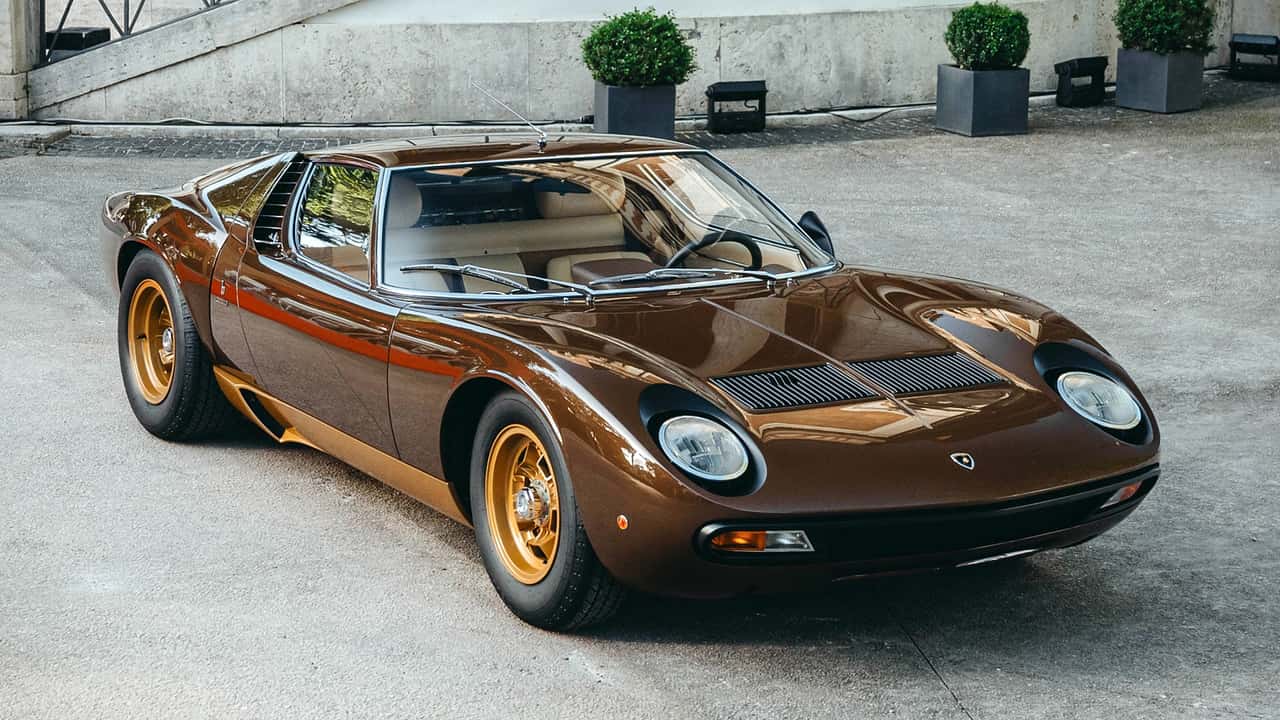


A 1972 Lamborghini Miura SV rolled into Sant’Agata Bolognese at the end of 2023 in a configuration that didn’t match its birth certificate. Three years later, Lamborghini’s heritage department, Polo Storico, wheeled it out in Rome looking exactly as it left the factory. We’re talking down to the shape of its fender grilles, the rounded edges on its door handle fins, and a shade of brown paint so specific it required its own archaeological dig through company records.
The car was unveiled at the inaugural Anantara Concorso Roma, held April 16-19 against the backdrop of Casina Valdier. It’s the kind of event Rome was born to host — classic iron parked among centuries-old architecture, collectors sipping something expensive while arguing about matching numbers.
The Miura SV restoration tells a quieter, more interesting story about what happens when a car drifts from its original spec over decades of ownership and well-meaning modifications. Polo Storico started with the production sheet, the car’s DNA record, and worked backward through every deviation. Octagonal center-lock hubs were restored, and the correct “Bob-type” exhaust tips — named after legendary Lamborghini test driver Bob Wallace — were fitted.
Inside, the team reinstated air conditioning preparation, added hazard lights that should have been there, swapped in a more compact steering wheel, and installed the proper extended handbrake lever. Every detail traced back to that original production sheet.
The paint alone was a project. The original color, “Luci del Bosco,” is a brown that shifted subtly across different Lamborghini models and production years. Getting the right version for a 1972 SV meant cross-referencing period documentation to pin down the exact chromatic spec.
The interior was finished in “Senape,” a mustard tone that pairs with the brown the way only early-seventies Italian design sensibility could pull off.
Giuliano Cassataro, Lamborghini’s head of after sales, framed the work as something only the factory can do. “We are proud to have completed a restoration that returns this Miura SV to its original identity,” he said, adding that only Polo Storico, “as the official custodian of the brand’s heritage, is able to guarantee” that level of historical accuracy.
He’s not wrong, and he’s not just being promotional. Independent restorers do extraordinary work on these cars, but nobody else has the production sheets locked in a filing cabinet in Sant’Agata. That access is the moat around Polo Storico’s business, and they know it.
The restored SV wasn’t the only Lamborghini drawing crowds. Three privately owned cars entered the concours, including two 1989 Countach 25th Anniversary editions and a 1968 Miura P400 with one of the best backstories in automotive cinema.
That particular P400 appeared in the opening sequence of the 1969 film “The Italian Job.” Contrary to persistent myth, the car was not destroyed during filming. Its seats were swapped to black to protect the originals, and the fixed white headrests stayed.
After years of uncertainty about the car’s fate, Polo Storico confirmed its identity, restored it, and certified it in 2019 for the film’s 50th anniversary. At the concours, the movie Miura took first place in its class and received “La vettura di Cinecittà,” a special award for cars tied to cinema.
The Miura turns 60 this year, which makes every surviving example a rolling argument that the supercar was invented in a small Italian town, not Stuttgart or Maranello.
Three years of work to undo what someone else did to a Miura SV. That’s the tension at the heart of every serious restoration — the factory asserting that authenticity isn’t a matter of opinion, it’s a matter of record. And if you want the record set straight, there’s only one place to go.



Share this Story