
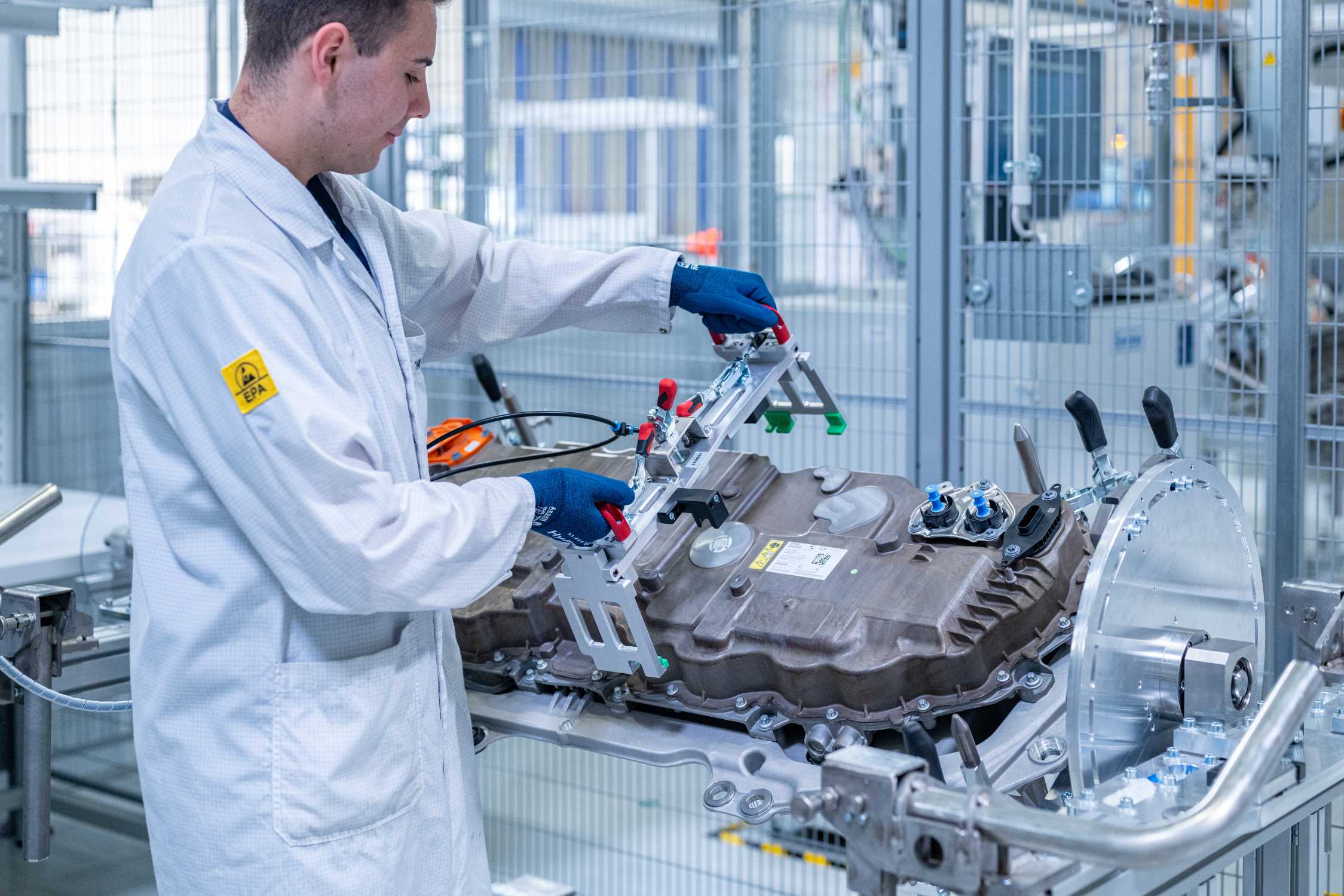


BMW’s Landshut plant has begun pre-series production of the “Energy Master,” a central control unit for the hydrogen-powered iX5 Hydrogen slated for a 2028 launch. It’s the clearest signal yet that Munich isn’t just hedging its bets on battery-electric. The company is building a parallel industrial infrastructure for hydrogen fuel cells.
The Energy Master is the brain of the high-voltage system, routing energy and data between the fuel cell, a high-voltage battery, and the electric drive motors. In battery-electric Neue Klasse models like the iX3 and i3, a version of the same unit already sits on the battery pack. For the hydrogen iX5, a modified variant mounts to what BMW calls the Hydrogen Flat Storage system, a new tank architecture that claims up to 750 kilometers of range.
That range figure alone tells you why BMW won’t abandon the hydrogen thread. No battery-electric SUV on the market comes close.
Landshut isn’t dabbling here. The plant simultaneously commissioned a second production line for the BEV version of the Energy Master, nearly doubling capacity. It already builds the media distribution plate and fuel cell stack housing for BMW’s existing hydrogen pilot fleet.
The site is becoming a dual-purpose nerve center for both electrification paths. BMW is clearly engineering its supply chain so hydrogen components share factory floors with battery-electric ones.
The financial backing is substantial and telling. Germany’s Federal Ministry of Transport is pumping EUR 191 million into the “HyPowerDrive” project covering the iX5’s powertrain and tank system development. Bavaria adds another EUR 82 million.
That’s EUR 273 million in public money propping up a technology most of BMW’s competitors have either shelved or scaled back dramatically.
The fuel cell system itself, a third-generation unit jointly developed with Toyota, will be assembled at BMW’s Steyr plant in Austria starting in 2028. That BMW-Toyota partnership has quietly endured while other hydrogen alliances have withered. Toyota remains the only major automaker still mass-producing a hydrogen passenger car, and BMW appears determined to be the second.
BMW frames this as “technological openness.” Skeptics call it expensive indecision. The truth probably sits somewhere in between.
By designing the Hydrogen Flat Storage to be compatible with the Gen6 high-voltage battery platform, BMW can theoretically build hydrogen and battery-electric X5s on the same production line. That’s smart industrial engineering regardless of which technology wins out.
Josef Hochreiter, BMW’s vice president for hydrogen vehicles, insists the iX5 Hydrogen will deliver “sheer driving pleasure,” the company’s favorite phrase since approximately forever. More relevant is his mention of “assured driving dynamics.” That suggests BMW believes it has solved the power delivery challenges that made earlier fuel cell prototypes feel sluggish compared to battery-electric equivalents.
Plant Landshut has received a “high three-digit million-euro” investment since 2020 for electromobility expansion. BMW won’t give an exact number, but that language suggests something north of EUR 500 million poured into a single components plant.
The broader context matters. Hyundai is pulling back from hydrogen passenger cars, Honda’s efforts remain niche, and Stellantis has focused hydrogen work on commercial vans. BMW is swimming against a powerful current, armed with German and Bavarian government money and a stubborn conviction that battery-electric alone won’t serve every customer.
Whether the hydrogen refueling infrastructure materializes by 2028 remains the billion-euro question BMW cannot answer by itself. You can engineer a 750-kilometer hydrogen SUV down to the last control unit. But if drivers can’t fill it up, the Energy Master is just an expensive circuit board managing nothing.
Share this Story