
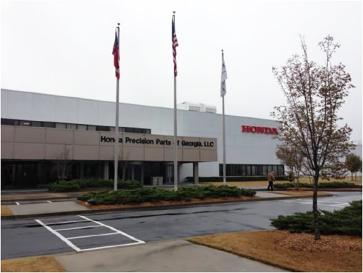


A small plant in Tallapoosa, Georgia, just quietly passed a milestone that says more about Honda’s American manufacturing strategy than any press conference ever could. Five million transmissions built since 2006, every single 10-speed automatic in a U.S.-assembled Honda or Acura rolling out of one facility with fewer than 500 workers.
Honda Transmission Manufacturing Plant in Georgia, or TMP-G, celebrated its 20th anniversary on May 12. The math alone is striking: $485 million in cumulative investment, a workforce that has more than doubled from its original headcount to nearly 500 associates, and annual capacity now at 375,000 units. That’s a lot of gearboxes from a town of about 3,000 people in west Georgia.
The plant started life building 5-speed automatics, then moved to 6-speeds, and in 2017 became the first Honda facility on the planet to produce the company’s 10-speed automatic. Five years ago it converted its original line entirely to 10AT production. Today the transmission goes into the Pilot, Passport, Odyssey, and Acura MDX — Honda’s highest-margin North American products.
There’s a pattern here worth paying attention to. Honda doesn’t scatter its transmission production across multiple sites the way some competitors do. It bets on one plant, invests deeply, and lets institutional knowledge compound.
Tallapoosa is the sole global lead for the 10AT. If that line hiccups, there’s no backup. It’s a calculated concentration of risk that only works if your workforce is exceptionally reliable.
Our facility has evolved greatly over the last 20 years and will play an important role in the future supporting our North American production,” said Arturo Valdes, TMP-G’s plant lead. The word “future” is doing heavy lifting in that sentence. Honda is in the middle of an electrification push, but the 10-speed automatic isn’t going anywhere soon.
The Pilot and MDX remain core profit drivers, and hybrid variants still need transmissions. The plant itself has grown beyond simple assembly. TMP-G now casts and machines its own transmission cases in-house, a vertical integration move that reduces supply chain exposure and keeps quality control tight within a 575,000-square-foot footprint.
Honda also made a point of highlighting community investment — more than $950,000 in funding to Georgia nonprofits last year, plus 3,200 volunteer hours from associates. In a rural county where a plant this size is an economic anchor, those numbers aren’t just corporate social responsibility padding. They’re the cost of maintaining a stable, skilled workforce in a region that doesn’t have a deep bench of alternative employers.
What makes Tallapoosa interesting in the broader industry context is its scale of output relative to its size. Nearly 500 people producing 375,000 transmissions a year means each associate is connected to roughly 750 units annually. That’s lean by any standard, and it reflects the kind of automation and process discipline Honda has refined across its 12 North American manufacturing sites.
Twenty years in, TMP-G is the quiet workhorse of Honda’s U.S. powertrain strategy. No flashy ribbon cuttings for EV battery plants, no joint ventures with Silicon Valley partners. Just a factory in rural Georgia that does one thing, does it at scale, and does it well enough that Honda trusts it with every 10-speed it makes.
Sometimes the most important plants are the ones nobody talks about.
Share this Story