
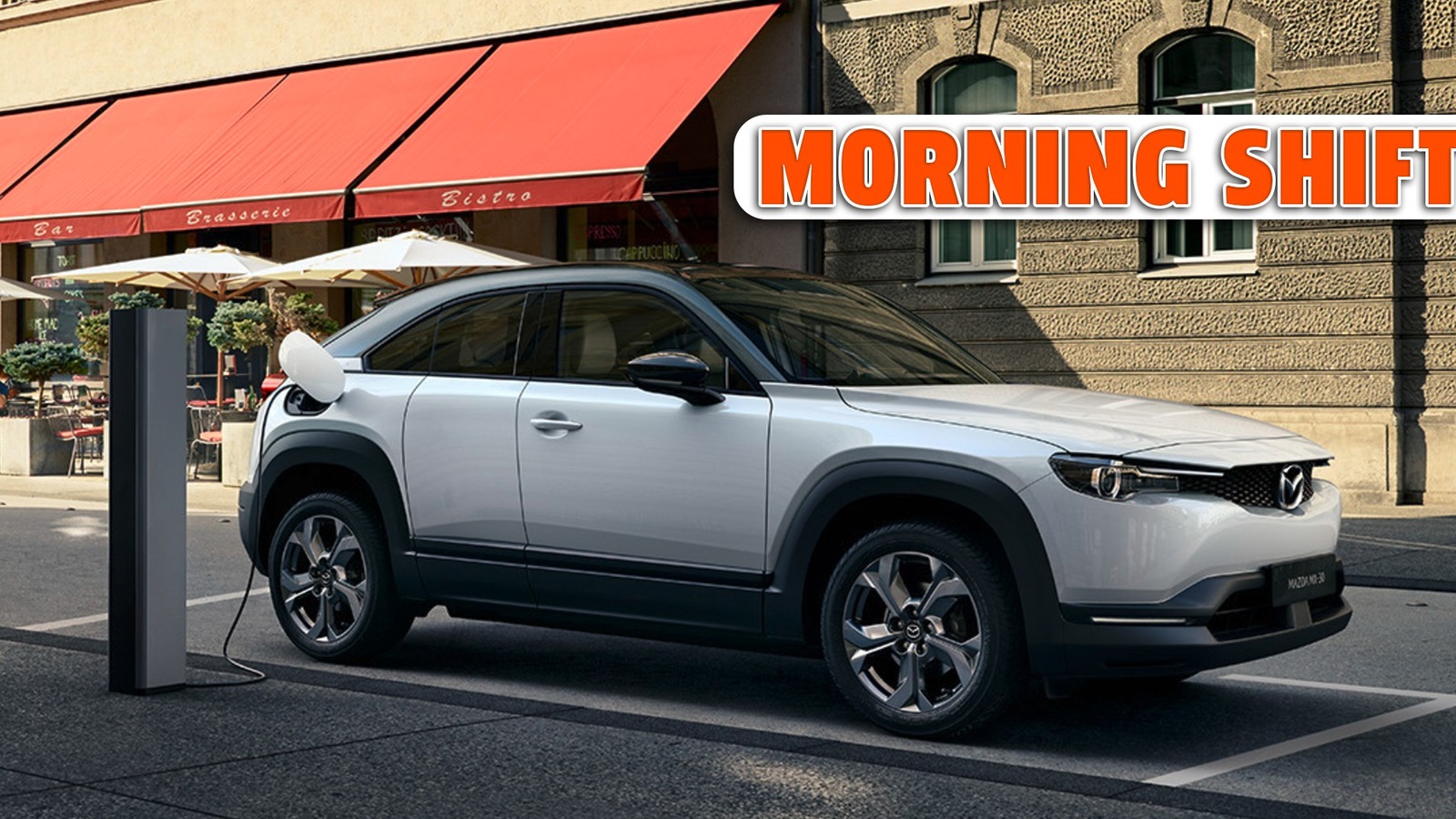


Mazda just slashed its electric vehicle investment by nearly half, delayed its first dedicated EV by two years, and somehow came out looking smarter than everyone else in the room.
The Japanese automaker announced it will push back its first purpose-built EV to 2029, cut its electrification budget from $12.53 billion to $7.52 billion through 2030, and pivot hard toward hybrids. CEO Masahiro Moro cited loosened fuel economy standards, U.S. tariffs, vanishing EV incentives, and demand that never showed up. The usual suspects.
Here’s the twist: Mazda won’t take a single dollar in writedowns. Not one. The company was so far behind on EVs that its funding hadn’t been deployed yet. It simply changed direction before the money left the building.
Compare that to the wreckage elsewhere. General Motors has absorbed $8.7 billion in EV-related writedowns and is now cutting 500 to 600 IT jobs to scrape together savings. Ford bled billions on its Model e division.
Stellantis is being sued — again — over its 4xe plug-in hybrid Jeeps, whose Samsung-sourced batteries have a nasty habit of catching fire. The company killed the entire PHEV program rather than fix it. Honda took its lumps too.
Mazda called itself an “intentional follower” on EVs. That’s corporate-speak for “we couldn’t afford to lead,” but it turned out to be the right call for the wrong reasons. A limited R&D budget and natural caution kept Mazda from pouring concrete on a foundation the industry is now jackhammering apart.
The plan going forward leans heavily on combustion expertise. Three new hybrids arrive between 2028 and 2030, built around Mazda’s own Skyactiv-Z lean-burn four-cylinder — not the Toyota hybrid tech currently borrowed for the CX-50. A hybrid version of the redesigned CX-5 is expected next year, and internal engineering resources are being pulled off EV projects and reassigned to ICE and hybrid work.
For markets that still want battery-electric vehicles, Mazda will lean on its Chinese partner Changan Automobile to supply models like the EZ-60 crossover and EZ-6 sedan. Those China-built EVs will ship to Europe, Australia, and Southeast Asia as part of what Moro calls a “lean-asset” strategy. Translation: let someone else eat the manufacturing cost.
Mazda now expects EVs to account for roughly 15 percent of global sales by 2030, with production capacity of 200,000 to 250,000 units. That’s a dramatic retreat from earlier projections of 25 to 40 percent EV sales by the same date.
The broader pattern is impossible to ignore. Automaker after automaker is backpedaling from aggressive electrification timelines, and the ones who moved fastest are bleeding the most. GM’s $8.7 billion in writedowns dwarf Mazda’s entire revised EV budget.
Stellantis didn’t just lose money on 4xe — it lost customer trust, with serial recalls over battery separator damage leading to fire risks in more than 320,000 Wrangler and Grand Cherokee plug-in hybrids. The company’s response was to discontinue the vehicles entirely.
Mazda had nothing to discontinue. It had nothing to recall. It had nothing to write down. Being small and slow and perpetually underfunded turned out to be a shield.
The irony is thick enough to cut. For years, analysts dinged Mazda for dragging its feet on electrification, warning the company risked irrelevance. Now the automakers who sprinted ahead are the ones scrambling to restructure, laying off workers, and explaining to shareholders where the billions went.
Mazda didn’t outsmart anyone. It just showed up late enough to watch everyone else step on the landmines first. Sometimes the best strategy is the one you stumble into by accident.
Share this Story