
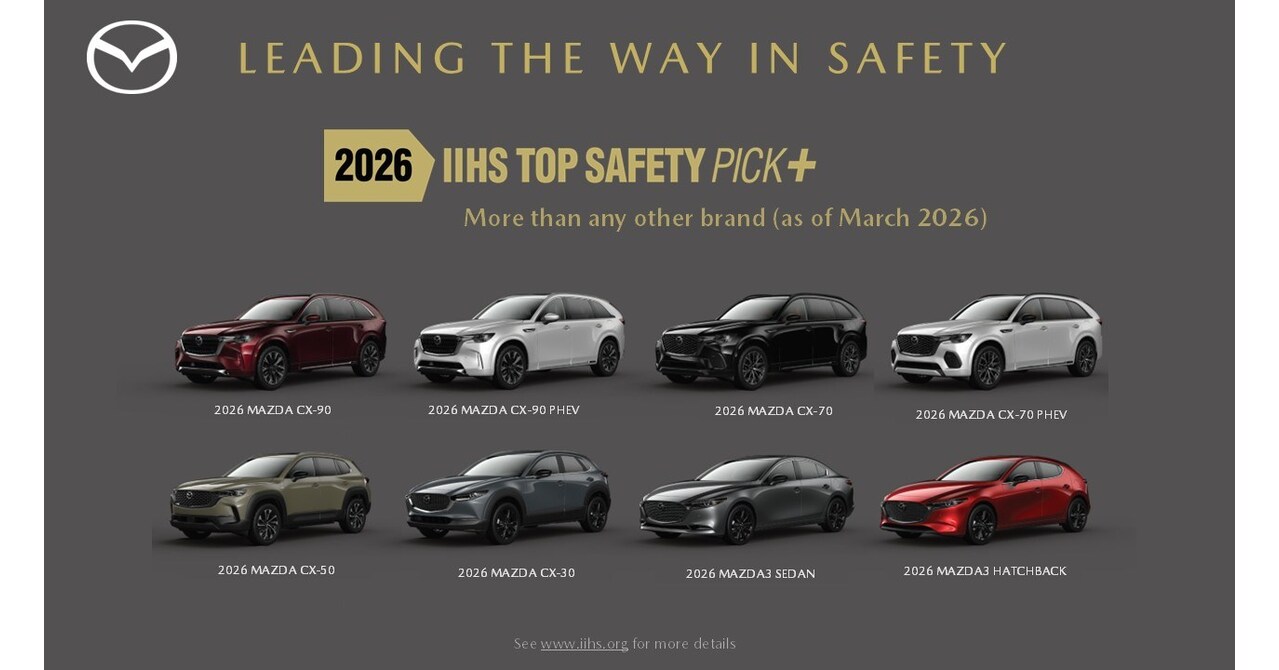


Eight vehicles. Eight TOP SAFETY PICK+ awards. For the third straight year, Mazda has collected more of the Insurance Institute for Highway Safety’s highest honors than any other brand, a streak that looks less like luck and more like quiet strategy paying off in public.
The 2026 winners span nearly the entire Mazda showroom: the Mazda3 sedan and hatchback, CX-30, CX-50, CX-70, CX-70 PHEV, CX-90, and CX-90 PHEV. That’s everything from a $24,550 compact to a three-row plug-in hybrid, which is the part worth paying attention to.
IIHS didn’t make it easy this year. The 2026 criteria added tougher pedestrian crash-prevention benchmarks, stricter rear-seat protection standards, and higher bars for crash-avoidance technology. Every cycle, the goalposts move. Mazda keeps clearing them.
Mazda continues to excel in safety with eight IIHS TOP SAFETY PICK+ models this year,” said IIHS President David Harkey. They are providing consumers with the best in safety features at a range of prices.”
That last phrase, “at a range of prices,” is the quiet bombshell. Luxury brands have long padded their safety résumés by loading $60,000-plus vehicles with every sensor and camera available. Mazda does it on a Mazda3 that stickers under $25,000.
The all-new 2026 CX-5, starting at $29,990 in the U.S., comes standard with blind-spot monitoring, rear cross-traffic alert, automatic emergency braking, and lane-departure warning. No option packages. No up-charges.
Since 2008, Mazda has racked up 99 IIHS safety awards, 73 of them at the TOP SAFETY PICK+ level. That’s not a campaign. It’s a pattern baked into how the company engineers cars.
While competitors chase headlines with autonomous driving features and over-the-air software updates, Mazda has been grinding away at the fundamentals: crash structures, occupant protection, and the kind of active-safety systems that actually prevent the wreck in the first place.
Jennifer Morrison, Mazda’s Director of Vehicle Safety Strategy, put it plainly. “We agree with IIHS that safety does not have to be expensive,” she said. “Earning eight TOP SAFETY PICK+ awards shows what happens when you stay true to your philosophy.”
Philosophy is a word Mazda loves, and it can sound like marketing gloss until you look at the scoreboard. The company’s “human-centric engineering” approach means designing around how real people actually drive and crash, not just optimizing for test scenarios. That distinction matters because IIHS keeps evolving its tests to reflect real-world conditions, and Mazda keeps passing them without scrambling.
The Canadian arm tells the same story with slightly different price tags. North of the border, the Mazda3 starts at $25,250 CAD and the CX-5 at $36,300 CAD, with the identical standard safety suite. The lineup there swaps in mild-hybrid CX-70 and CX-90 variants alongside the PHEVs, and every one of them earned the top award.
Three consecutive years leading the industry is the kind of consistency that should make bigger automakers uncomfortable. Toyota, Honda, and Subaru have all traded IIHS bragging rights over the years, but none has put together a streak like this under increasingly demanding criteria. Mazda sells a fraction of the volume those brands move, yet its engineering output punches well above its market share.
The real story here isn’t that a small automaker won some safety awards. It’s that Mazda has figured out how to deliver top-tier crash protection as standard equipment on cars ordinary people can actually afford, and has done it three years running while the tests got harder each time. In an industry obsessed with electrification timelines and software-defined vehicles, the company from Hiroshima keeps reminding everyone that the most important technology in any car is the kind that keeps you alive.

Share this Story