
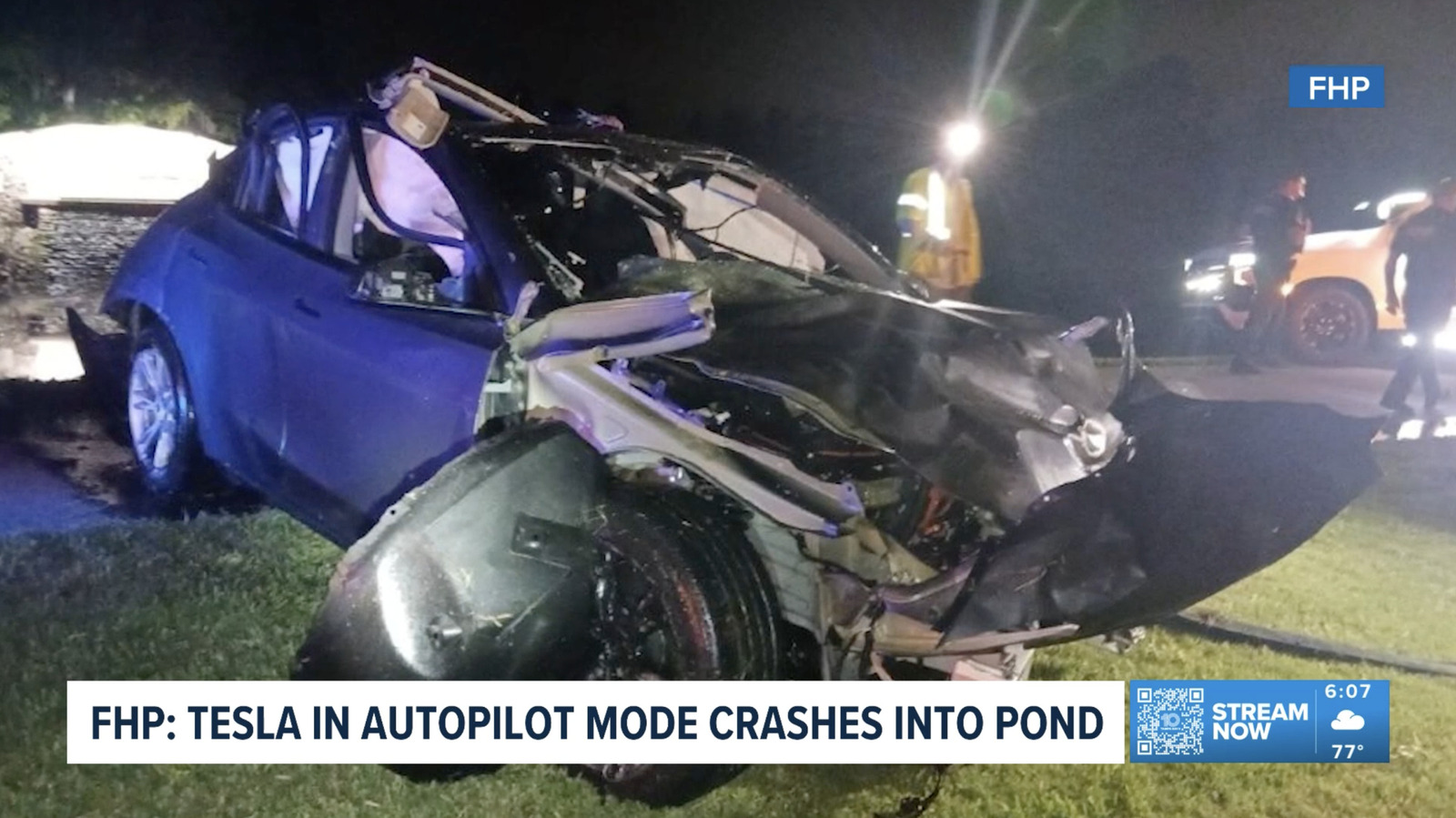


An 87-year-old Florida man is dead after his Tesla Model Y left the road, struck an electrical box, and plunged into a pond near Tampa last week. The car was reportedly running Tesla’s Autopilot system. His 75-year-old passenger survived with non-life-threatening injuries.
The crash happened around 8 p.m. in an area with a 30-mph speed limit. Photos show a Model Y so thoroughly destroyed its front end is unrecognizable, the car submerged nearly to its roofline. Police don’t know how long the two occupants were trapped before rescuers reached them.
Florida Highway Patrol says the vehicle was operating on Tesla’s Level 2 advanced driver assistance system, the one that still requires hands on the wheel and eyes on the road. But FHP hasn’t determined what caused the car to leave the roadway. Speed, a medical event, or a system malfunction all remain possibilities while the investigation continues.
Here’s where it gets absurd. Nobody can say with certainty which Tesla system was actually active.
Tesla has quietly scrubbed the “Autopilot” name from its U.S. website. Vehicles built before 2026 now carry the label “Traffic-Aware Cruise Control and Autosteer” in Tesla’s own listings. It’s entirely possible this Model Y hadn’t been updated to reflect the rebrand. It’s equally possible the car was running Full Self-Driving software and first responders simply didn’t know the difference.
And why would they? Tesla has created a naming scheme so convoluted that trained investigators, journalists, and the general public are left guessing which semi-autonomous feature was driving the car when someone died. Autopilot, Full Self-Driving, Traffic-Aware Cruise Control and Autosteer — three names for systems with overlapping capabilities and wildly different implications, all sold by the same company on the same cars.
This matters because when a crash kills someone, the first question regulators ask is what the car was doing and why. If the people writing the accident report can’t accurately identify which system was engaged, the data that feeds federal investigations is compromised from the start.
NHTSA already has an open investigation into how Tesla’s system performs in low-visibility conditions. The agency has tracked dozens of crashes involving Autopilot and FSD over the past several years. Tesla has settled multiple lawsuits stemming from fatal and serious incidents. Just recently, a Cybertruck running driver-assistance software reportedly tried to steer itself off an overpass.
The pattern is well established. A Tesla with some form of automation engaged does something catastrophic. The driver is blamed for not paying attention. Tesla points to its terms of service. The naming shell game makes it harder to pin down exactly which product failed and how.
Meanwhile, a man who survived 87 years on this planet didn’t survive a drive through a 30-mph zone in a car that was supposedly helping him stay safe.
Tesla has never held a traditional press conference about Autopilot safety. The company dissolved its public relations department years ago. Elon Musk occasionally posts on X about how autonomous driving is statistically safer than human driving, leaning on aggregated data that independent researchers have questioned for its methodology.
The rebrand from Autopilot to that mouthful of a new name was supposed to set clearer expectations. Instead, it’s just added another layer of confusion to a system that keeps showing up in crash reports and courtrooms. Changing the name on a product doesn’t change the product. It just makes it harder to talk about when something goes wrong.
And something keeps going wrong.
Share this Story