
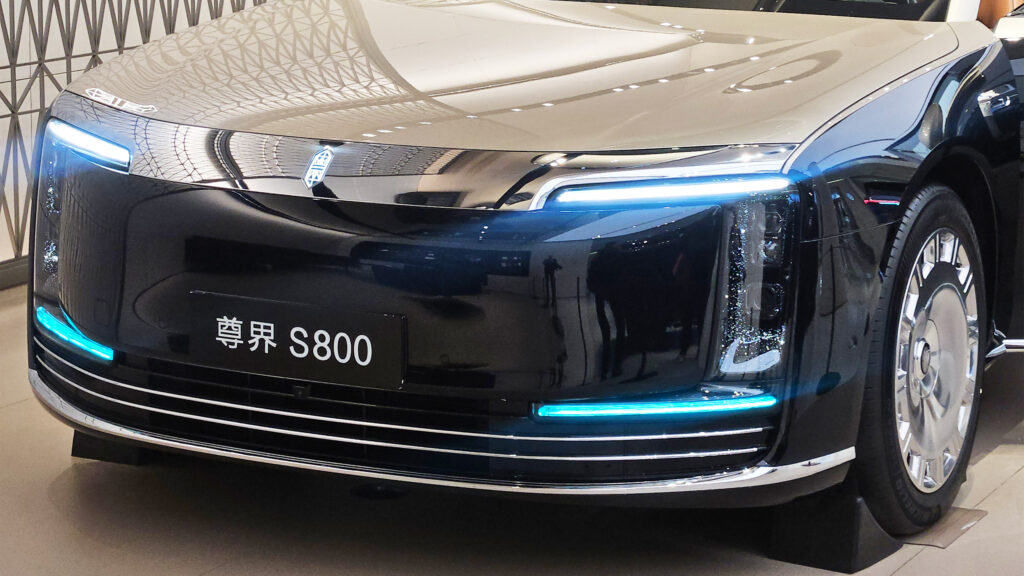


Mercedes-Benz picked turquoise. Not blue, not green, not white. Turquoise.
That oddly specific choice, made years ago in a German engineering lab, is now becoming the global standard for telling the world a car is driving itself.
The logic was simple. Turquoise doesn’t collide visually with brake lights, turn signals, traffic lights, or the flashing reds and blues of emergency vehicles. Mercedes cited research showing the color outperformed alternatives in both physiological and psychological response tests.
It cuts through visual clutter. People notice it fast and don’t confuse it with anything else on the road.
Mercedes first deployed turquoise LEDs while testing its Level 3 autonomous system in California and Nevada. Level 3 means the driver can legally take their eyes off the road. That’s a serious threshold, and it needed a visible, unmistakable signal to the outside world.
Now GM is adopting the same color for the Escalade IQ’s forthcoming eyes-off system, including lights integrated into the wing mirrors. Two of the world’s largest automakers converging on the same visual language isn’t a coincidence. It’s a consensus forming in real time.
The real momentum, though, is in China. The number of Chinese-market vehicles launching with turquoise autonomous-mode lighting is accelerating fast, and Beijing is moving to make it mandatory. Not just for Level 3 or Level 4 vehicles, but for Level 2 systems — the kind of advanced driver-assistance tech already flooding Chinese roads today.
Leapmotor CEO Zhu Jiangming claims 30 percent of Chinese customers already use ADAS for daily commuting. His prediction: turquoise lights will eventually glow on every car in traffic. That’s a staggering mental image, and it raises questions nobody has clean answers to yet.
The intended purpose is transparency. Other drivers, pedestrians, and police can see at a glance that software is in control. A cop pulling over a turquoise-lit vehicle knows immediately that the car, not the occupant, was making driving decisions.
Liability shifts. Expectations shift.
The unintended consequence is just as obvious. Human drivers will exploit the signal. A turquoise-lit car is a car that won’t road-rage, won’t accelerate aggressively, won’t play chicken.
It will yield. Every time. Some drivers will treat that glow as an invitation to cut in, knowing the algorithm will flinch first.
That’s not speculation. It’s already happening with Waymo robotaxis in San Francisco, where human drivers routinely bully the cautious machines. Turquoise lighting will simply make it easier to identify the target.
Still, the regulatory direction is clear. China is writing the rules first. When the world’s largest auto market mandates something, the supply chain follows, and so do other regulators.
Europe and the US will face pressure to standardize or risk a patchwork of incompatible visual cues — the last thing anyone wants on roads shared by humans and software.
Mercedes started this with a color swatch. China is finishing it with a mandate. And somewhere between the engineering elegance and the messy reality of human behavior, turquoise is becoming the universal flag for a car that thinks for itself.
The only real question left isn’t whether the rest of the world adopts it. It’s whether drivers will respect what it means — or treat it like a target on wheels.
Share this Story