
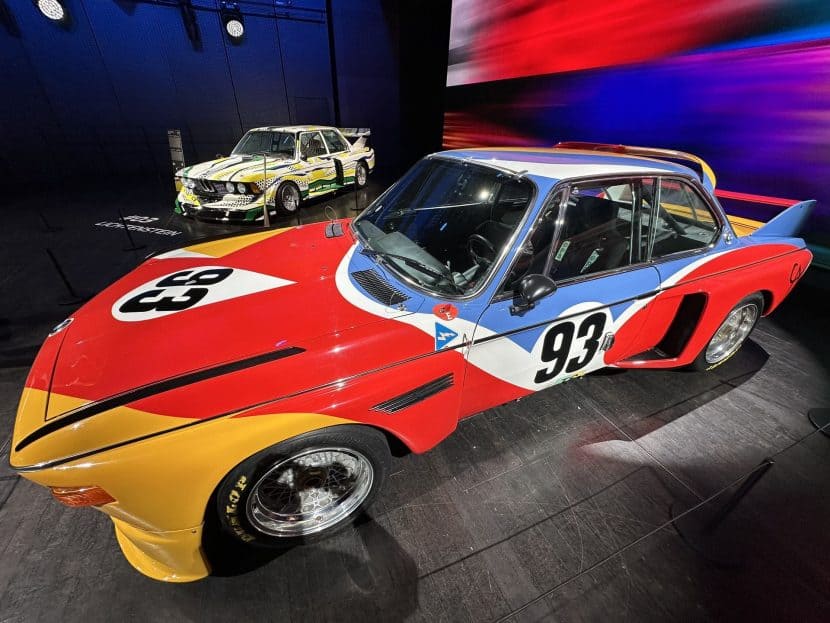


Fifty years after a French auctioneer talked Alexander Calder into painting a 3.0 CSL, all 20 BMW Art Cars sat together under one roof at BMW Welt in Munich for the first time. The exhibit runs through August 31, 2026, and the full collection tells a story the press releases rarely emphasize: most of these cars were never driven at all.
The origin story is well rehearsed. Hervé Poulain and BMW Motorsport Director Jochen Neerpasch dreamed up the idea in 1975. Get a famous artist, paint a race car, then actually race it.
Calder obliged, covering a CSL in broad swaths of red, yellow, blue, black and white. Poulain took it to Le Mans with Sam Posey and Jean Guichet. A driveshaft killed it after seven hours, and the car never raced again.
Frank Stella’s graph-paper CSL followed in 1976 with 750 turbocharged horsepower. It retired at Le Mans too, then again at Dijon with Ronnie Peterson and Gunnar Nilsson behind the wheel. Roy Lichtenstein’s 320 Group 5 was the first to bring home hardware, finishing ninth overall and first in class at the 1977 running.
Andy Warhol painted the M1 himself in 28 minutes, brushstrokes and all. That car finished sixth overall at Le Mans in 1979 and remains the collection’s most recognized piece. It is also the last Art Car that truly lived on a racetrack as both art and competitor at the same time.
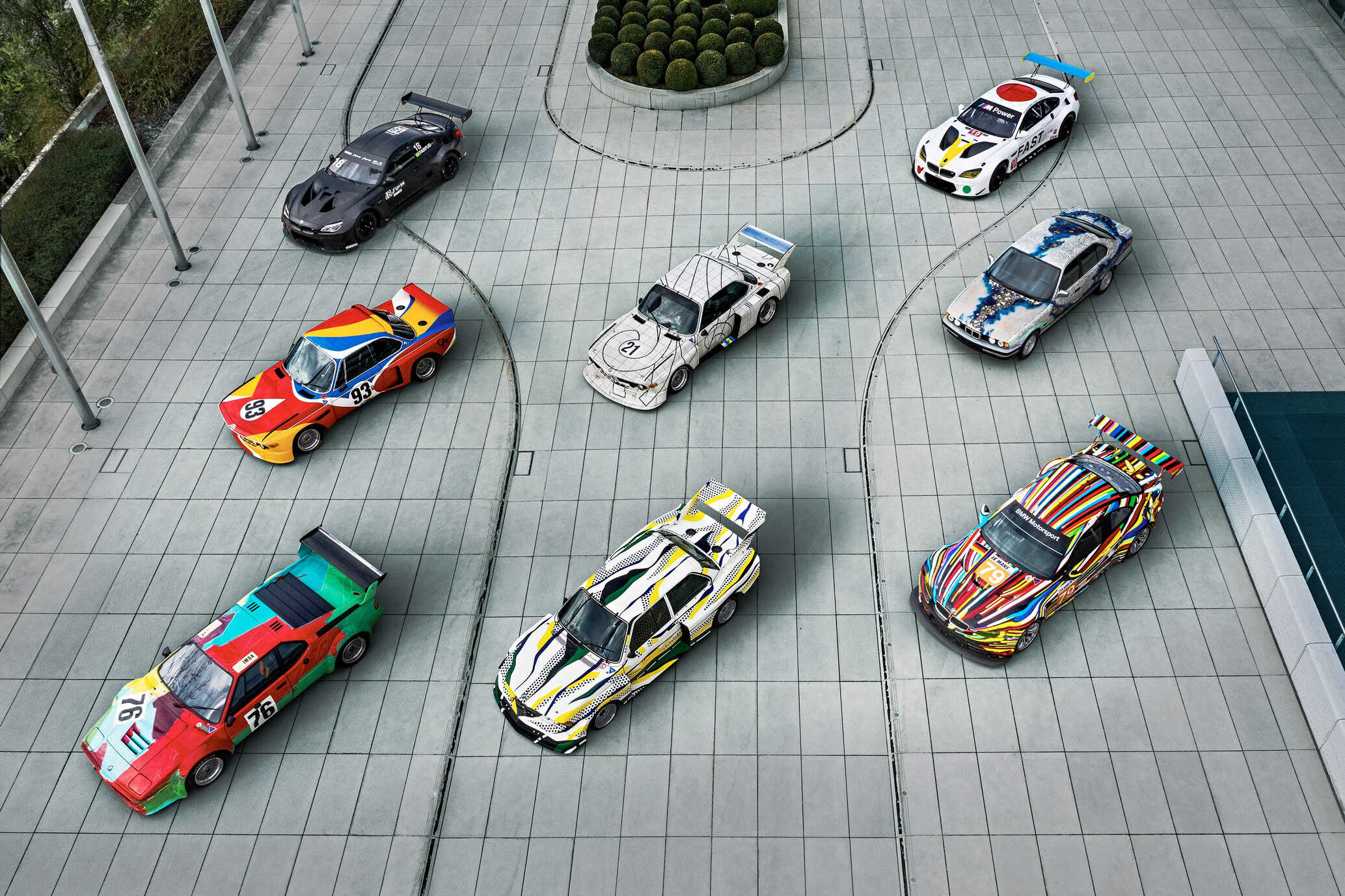
After Warhol, the program changed. Ernst Fuchs got a production 635CSi in 1982 and created a flaming allegorical spectacle he titled “Fire Fox on a Hare Hunt.” The car has never been driven.
Robert Rauschenberg’s 1986 635CSi became a rolling collage of Bronzino, Ingres and swamp grass photography. It too has never turned a wheel, despite Rauschenberg’s stated dream of “drivable museums.”
Two 1989 M3 Group A cars painted by Australian artists Michael Nelson Jagamara and Ken Done at least had racing pedigrees before they became art. Jagamara’s M3 had won the 1987 AMSCAR Championship under Tony Longhurst and was later raced by Peter Brock. Done’s M3 carried Jim Richards to the 1987 Australian Touring Car Championship. Both were retired racers repurposed as canvases, not active competitors.
From Matazo Kayama’s 1990 535i onward, the collection settled into its permanent identity as exhibition pieces. Jenny Holzer, Olafur Eliasson, Jeff Koons, John Baldessari, Cao Fei, Julie Mehretu. Each contributed work that ranged from provocative to technically dazzling, but none of those cars went anywhere near a starting grid.
The Koons M3 GT2 from 2010 is the exception that nearly proves the rule. It was built to race at Le Mans and did start, but retired early. Koons spent a reported 18 months on the design, and BMW spent considerably more on the logistics.
Julie Mehretu’s 2024 M Hybrid V8, the 20th and most recent Art Car, raced at Le Mans as well. That gives the collection a bookend that at least nods at the original intent.
What started as a gritty motorsport stunt has become a traveling exhibition program with a racing alibi. The early cars were built to compete, and some of them suffered for it. The later cars were built to be photographed, transported in climate-controlled containers, and displayed behind ropes.
Walking through BMW Welt and seeing all 20 together forces a question the anniversary celebration does not quite answer. Is this still an Art Car program, or a branding exercise that borrows the credibility of artists and the nostalgia of a few racing stories from the 1970s?
BMW has not announced a 21st car. The display ends August 31, and after that the collection scatters again to museums and storage facilities around the world, waiting for the next anniversary.

Share this Story