
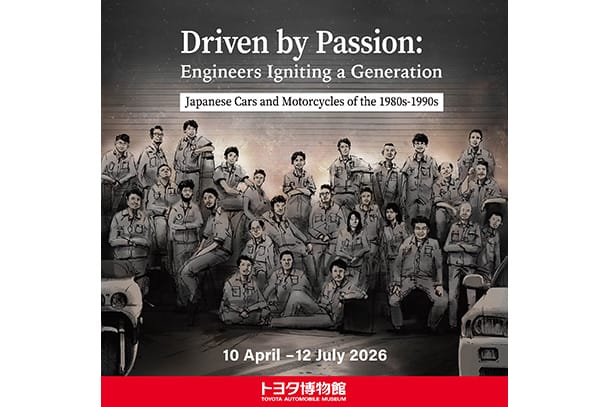


Seventeen machines from eight competing Japanese manufacturers will share one roof starting April 10, when the Toyota Automobile Museum opens “Driven by Passion: Engineers Igniting a Generation,” a three-month exhibition dedicated to the cars and motorcycles of the 1980s and 1990s. It is the museum’s first-ever exhibition mixing two- and four-wheeled vehicles. Getting Honda, Nissan, Mazda, Subaru, Mitsubishi, Kawasaki, Suzuki, and Yamaha to all loan hardware to a building with Toyota’s name on it is no small diplomatic feat.
The lineup reads like a JDM fantasy garage. On the four-wheeled side: a 1985 Mazda Savanna RX-7, a 1990 Eunos Cosmo, a 1991 Honda NSX, a 1993 Toyota Supra, a 1996 Mitsubishi GTO, a 1997 Subaru Legacy Touring Wagon GT-B, and a 2000 Nissan Skyline GT-R V-spec II. Every one of those cars was born from an era when Japanese engineers weren’t just building appliances — they were throwing haymakers at Stuttgart, Munich, and Maranello.
The motorcycle roster is equally ruthless. Kawasaki’s GPZ900R — the original Ninja — sits alongside Suzuki’s Katana, Honda’s RC30, and a 1999 Hayabusa. Yamaha sends the RZV500R, VMAX, and first-generation YZF-R1. Two additional bikes, a Kawasaki ZXR400R and a Suzuki RG400 Gamma, will stand guard at the gallery entrance. These weren’t polite commuter bikes. They were land-based missiles that rewrote speed records and terrified insurance adjusters.
The exhibition, running through July 12 at the museum’s Cultural Gallery in Nagakute, Aichi Prefecture, is the second installment in a series examining Japan’s 1980s and 1990s output. This chapter shifts focus from the metal to the people who shaped it — the engineers who worked in obscurity while their creations became icons.
That human thread runs through the programming. Museum director Yasuhiro Sakakibara will sit down with Kozo Watanabe, the man behind the R33 and R34 Skyline GT-Rs, on May 16. On June 6, Nobuhiro Yamamoto, who led development of the current Mazda MX-5 Miata, takes the interview chair.
These aren’t celebrity designers doing victory laps. They’re the people who fought corporate budgets, emissions regulations, and physics to deliver machines that still command irrational devotion decades later.
A classic car meeting on May 16 will flood the museum parking lot with period-correct Japanese metal and two-stroke exhaust fumes, complete with ride-alongs and food trucks.
Then there’s the sideshow that no press release can gloss over quietly. From late April through late May, the museum will display a Toyota Supra formerly owned by Sanae Takaichi — donated to a Nara Toyota dealership before she became Prime Minister. Putting a politician’s personal sports car on a pedestal inside a corporate museum is a choice, and it tells you something about how deeply these machines are woven into Japanese cultural identity, regardless of who held the keys.
Separately, the museum marks the 90th anniversary of the Toyoda Model AA with demo runs of a replica alongside a 1938 Model AB Phaeton and a 1937 Datsun Model 16 Sedan on April 18. It’s a neat bit of context — a reminder that Toyota’s entire empire traces back less than a century, and that the wild engineering confidence of the bubble era didn’t come from nowhere.
What the exhibition really preserves is a moment that cannot be repeated. The convergence of economic surplus, minimal electronic interference, analog engineering brilliance, and sheer corporate ambition that produced these machines was historically specific. Today’s Japanese automakers build excellent cars. They do not build with that particular recklessness.
Eight rivals lending their crown jewels to Toyota’s museum is an implicit acknowledgment: that era belongs to all of them, and none of them alone.


Share this Story