
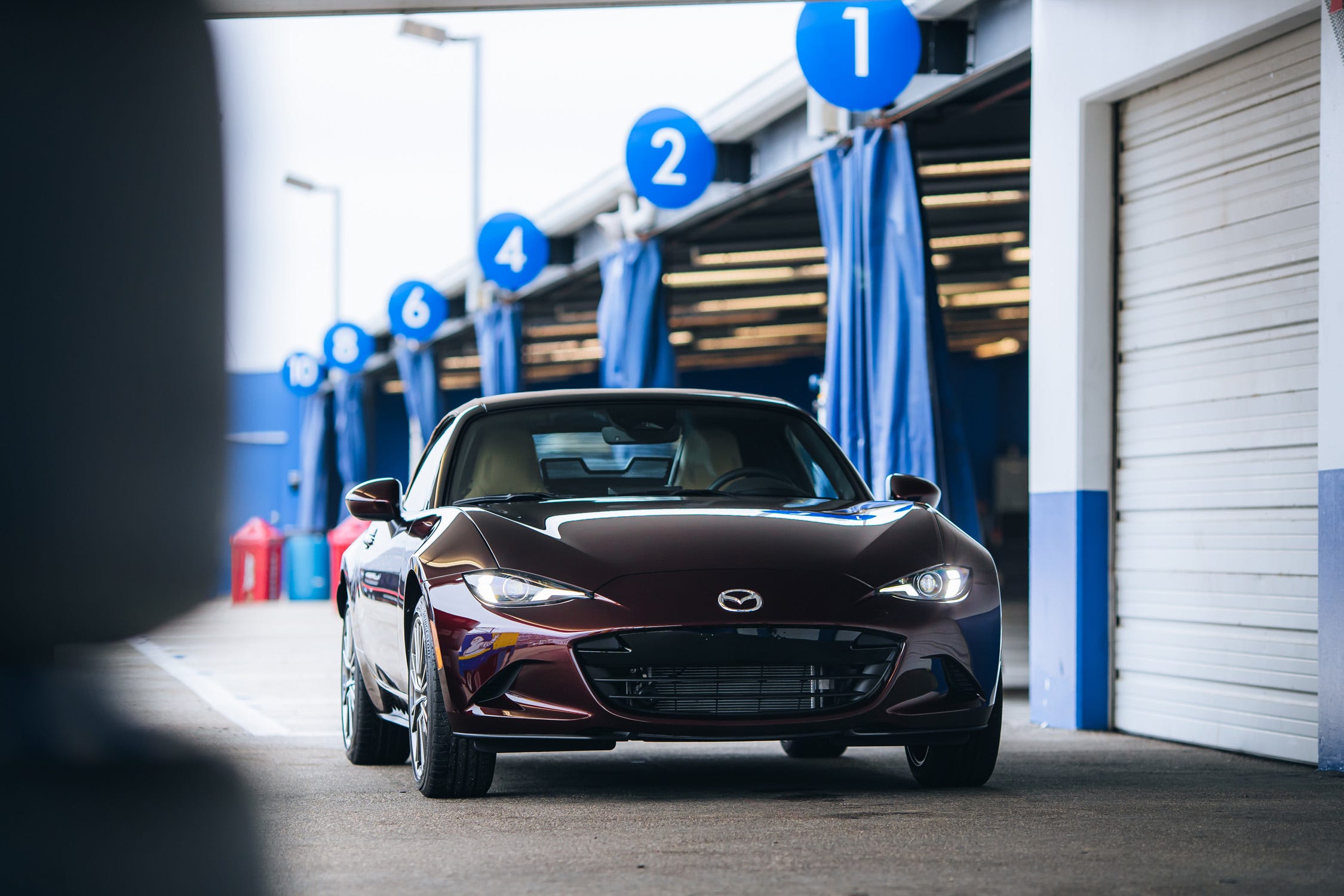


The next Mazda MX-5 Miata is coming, but nobody at Mazda seems to know exactly what it will be. That uncertainty, rare for a car this iconic, tells you everything about the impossible tightrope small automakers are walking right now.
According to a new interview with two senior Mazda executives in Europe, published by Dutch outlet AutoRAI, the fifth-generation Miata is still years away from production. The holdup isn’t styling or platform engineering. It’s the powertrain.
Mazda simply cannot decide what should sit under the hood. Jo Stenuit, Mazda’s head of design in Europe, told AutoRAI the company explored possibilities for the NE-generation Miata in a 2024 project but that “nothing is set in stone yet.” He did confirm with near certainty that the car will feature “some form of electric power assistance.
That’s a big admission for a car that has spent 35 years defined by mechanical purity. In a perfect world, Mazda would skip electrification entirely. Christian Schultze, the brand’s European R&D chief, said synthetic fuels represent “the simplest way to reduce the MX-5’s emissions.”

A carbon-neutral fuel would let Mazda keep the existing combustion engine formula intact without reinventing the car’s core philosophy. No batteries. No added weight. No compromise.
But the world isn’t perfect. Synthetic fuel infrastructure barely exists. Porsche started producing limited quantities of eFuel back in 2022 and has gone mostly quiet on the subject since.
For a company Mazda’s size, without the financial cushion of a massive parent corporation, betting the Miata’s future on fuel that has no distribution network would be reckless. That leaves hybridization as the pragmatic path forward. And here’s where Mazda’s engineers start sweating.
“The MX-5 stands above all for fun, light weight, and affordability,” Stenuit explained. “If any of those three aspects are missing, it’s not an MX-5.” Batteries are heavy. Full stop.
Even a mild 48-volt hybrid system, which assists the engine without providing standalone electric propulsion, adds mass that a car weighing around 2,300 pounds can ill afford. Stenuit described the mild hybrid option as “the least of the options” Mazda is considering, suggesting the company may pursue a more substantial electrified setup despite the weight penalty.

Meanwhile, Mazda has been flirting with bolder ideas. The Iconic SP concept, unveiled at the 2023 Japan Mobility Show, showcased a range-extended electric powertrain featuring a twin-rotor Wankel engine acting as a generator. At a claimed 3,196 pounds and 365 horsepower, it was heavier than today’s Miata but represented a genuinely creative approach.
Designer Masashi Nakayama insisted the concept “is not just one of those empty show cars” and was built with real production intent. Whether the NE Miata draws from the Iconic SP’s architecture or charts a different course remains an open question. Mazda committed back in 2021 to electrifying its entire lineup by 2030, and a U.S. spokesperson confirmed at the time that the MX-5 was included, promising the company would “work hard to make it a lightweight, affordable, open two-seater sports car.
The current ND Miata has been on sale for over a decade, and it’s showing its age against tightening global emissions standards. Mazda cannot stall forever. Schultze framed the challenge bluntly: “We’re looking for a technically sound solution with the right performance, the right weight, and full regulatory compliance.”

He’s underselling it. What Mazda faces is perhaps the most consequential engineering decision in the Miata’s history. Get it wrong and the car loses its soul.
Get it right and the world’s best-selling two-seat roadster lives to see another generation. The stakes are that clean, that simple, and that enormous.
Share this Story