
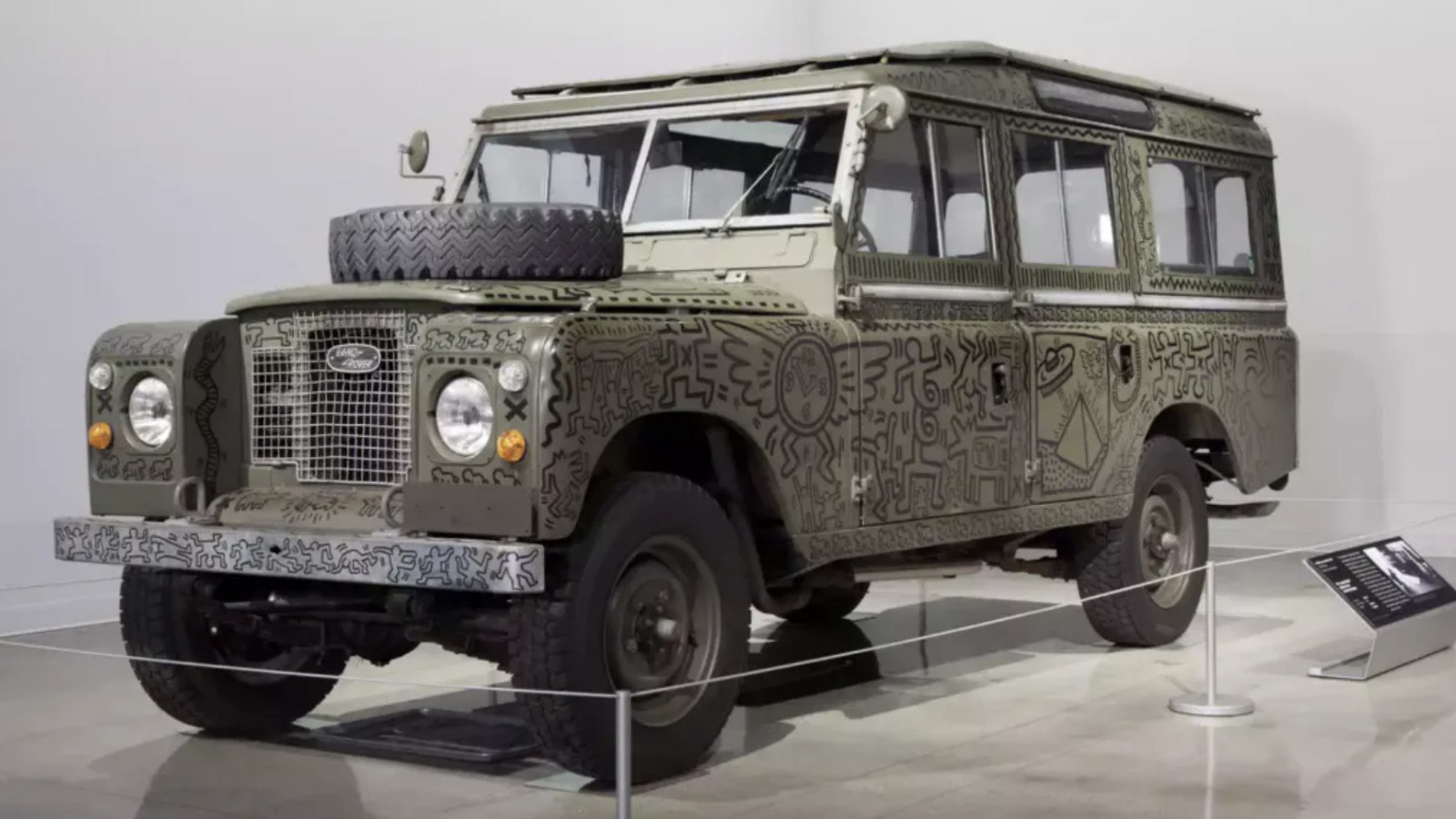


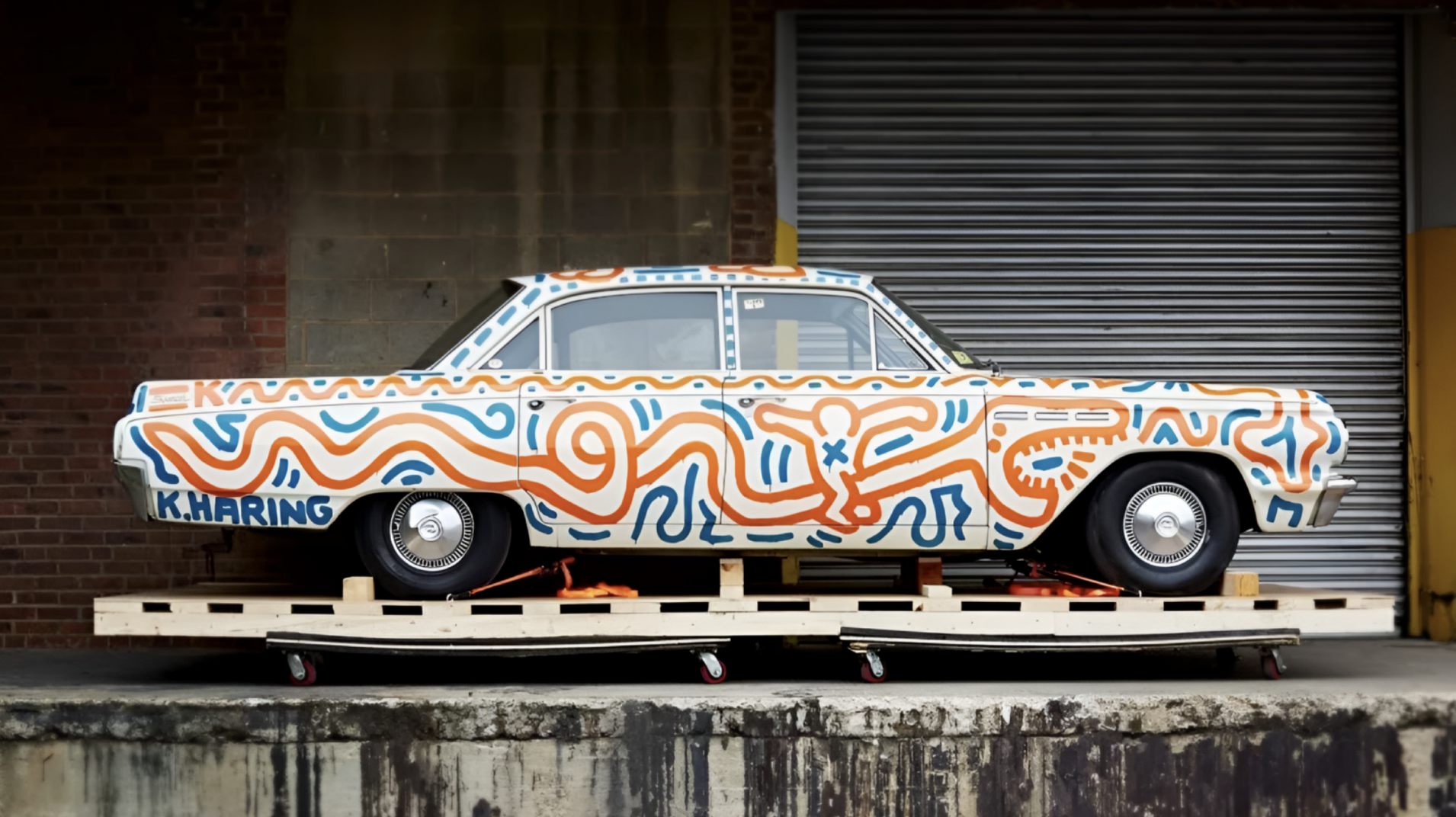
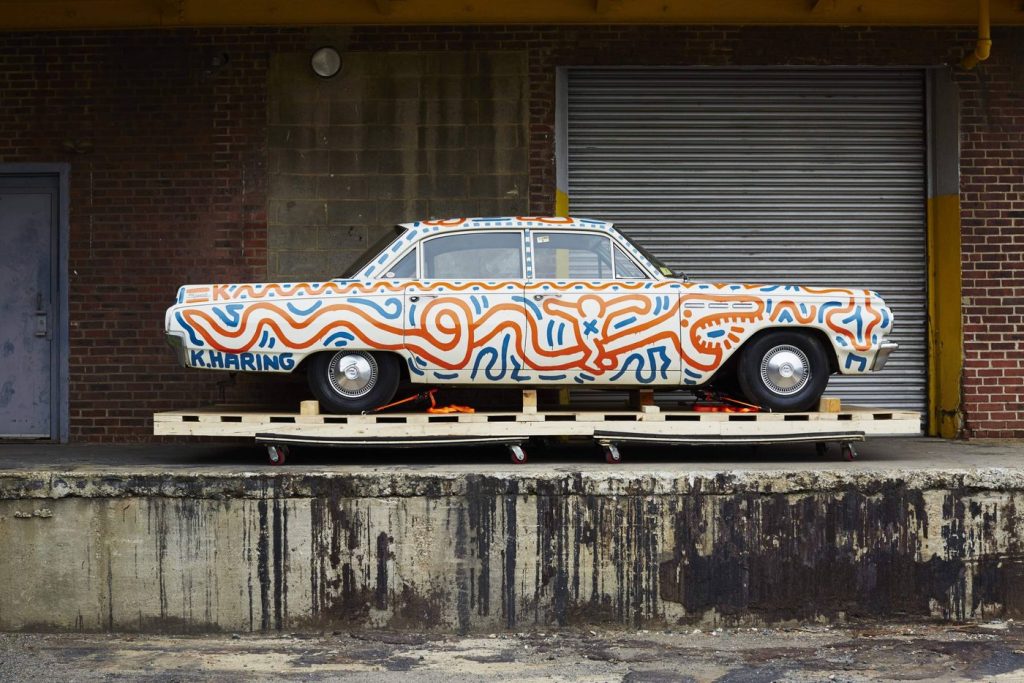
A 1963 Buick Special and a 1971 Land Rover Series III, both covered bumper to bumper in Keith Haring’s unmistakable dancing figures and barking dogs, are sitting together in a West Village gallery right now. It’s the first time either car has been shown in New York City. And it’s already almost over.
The exhibition, “Keith Haring: In The Street,” opened April 10 at Free Parking, a new gallery space on Morton Street operated by CART Department, a platform founded by collector Larry Warsh that treats the automobile as art object. The Buick left on April 14, bound for Crystal Bridges Museum of American Art in Bentonville, Arkansas. The Land Rover stays through April 19. Nine days. That’s all New York gets.
Warsh owns both vehicles. He bought the Land Rover directly from the producers of Switzerland’s Montreux Jazz Festival, where Haring painted it in 1983. The festival’s name is still visible, threaded through the dense visual language Haring layered across every panel.
The Buick came later — Haring’s first-ever art car, painted as a gift for the architect of his legendary Soho Pop Shop, believed to be Moore & Pennoyer. It spent decades hidden from public view before surfacing at the Petersen Automotive Museum in Los Angeles a decade ago.
Haring painted four cars and one motorcycle in his lifetime. The BMW Z1, arguably the most famous of the group and one of his final works, isn’t here. Neither is the Ferrari-shaped children’s car he created for the 24 Hours of Le Mans, nor the Honda Hurricane superbike. Two out of five is still a remarkable gathering, given how scattered these objects have become across private collections and institutions.
The timing is no accident. The show launches a new Phaidon book, “Keith Haring in 3D,” edited by Warsh and Glenn Adamson, which doubles as the catalog for the Crystal Bridges exhibition opening June 6 and running through January 2027. Panels at Free Parking feature choreographer Muna Tseng, cultural critic Carlo McCormick, muralist Marka27, and Haring biographer Brad Gooch — the kind of downtown roster that feels appropriate for an artist who made his name in the subway.
New York is swimming in Haring this spring. The Brant Foundation has his foundational works on view through May 31. The auction market has been running hot, with pieces fetching millions.
His estate has licensed collaborations with Polaroid, Converse, Swatch, Casetify, and Uniqlo, keeping his imagery circulating at every price point from five dollars to five figures.
None of that commercial momentum changes the raw facts of Haring’s biography. He was diagnosed with HIV in 1987 and dead by 1990, at 31. In those final three years, he worked with a ferocity that borders on incomprehensible — sometimes finishing 40 paintings in a single day.
He used his visibility to fight for LGBTQ rights, to confront the AIDS crisis head-on, and to challenge apartheid and nuclear proliferation. The volume of late work he produced is so vast that authentication remains a headache for collectors to this day.
The cars distill something essential about Haring’s project. He started underground, literally, chalking figures across blank advertising panels in MTA stations where millions of commuters couldn’t avoid them. When the city started pulling painted subway cars, he pivoted to other moving surfaces. A Buick. A Land Rover. Objects designed to travel.
Warsh typically keeps both vehicles in a warehouse outside the city. Bringing them to a street-level gallery in the West Village, even briefly, puts them back where Haring’s work always belonged — in front of people, on the ground, surrounded by traffic and noise and life. The show closes Saturday. Free admission, free parking. No excuses.
Share this Story