
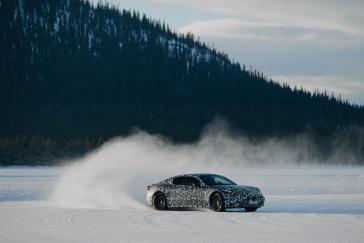


Three axial flux electric motors, a directly cooled battery, and over 500 individual validation tests on frozen Swedish lakes. That’s what Mercedes-AMG just put the new GT 4-Door Coupe through before its world premiere later this spring. The details reveal an electric performance car that wants to bury any remaining doubt about AMG’s post-combustion future.
The testing wrapped up in Arjeplog, Sweden, AMG’s longtime Arctic proving ground in Lapland, where near-production prototypes ran on bare ice, snow-covered roads, and 20-percent gradient hill climbs. This wasn’t a photo op. It was the final sign-off on a car that represents the most radical technical departure in AMG’s history.
At the center of everything is what AMG calls the RACE ENGINEER, a driving dynamics system built around three physical rotary controllers. One governs throttle response. One adjusts cornering behavior from understeer to neutral to controlled oversteer.
The third dials traction control across nine stages. The last two unlock their full range only with ESP off, a clear signal this car is aimed at people who actually know what to do with 1,000-plus horsepower on a track.
The all-wheel-drive system is AMG Performance 4MATIC+, but the execution here is new. Three axial flux motors, a first for an all-electric AMG, can decouple independently, enabling smooth transitions between rear-wheel and all-wheel drive. Torque vectoring between the rear wheels happens in real time.
On ice, sensors detect slip instantly and redistribute power motor by motor. That’s not a party trick. That’s the kind of granular control that makes the difference between a fast lap and a hedge.
AMG’s battery architecture deserves attention too. Individual cells sit in laser-welded modules with direct liquid cooling, a high-tech non-conductive oil that flows around each cell. The system heats or cools the pack depending on conditions, which AMG says enables repeatable high performance. In sub-zero Sweden, that claim got a real workout.
The braking system is a hybrid approach: carbon ceramic discs up front, steel in the rear, integrated with regenerative braking. AMG engineered for a consistent pedal feel regardless of whether the car is recuperating energy, using friction brakes, or blending both. Getting that right is notoriously difficult in EVs, and the fact that they’re calling it out suggests confidence.
Underneath, AMG ACTIVE RIDE CONTROL air suspension replaces conventional anti-roll bars with active hydraulic elements connecting all four corners. An 8.2-liter pressure accumulator handles rapid ride-height changes, including speed-dependent lowering for aerodynamic efficiency and range. The system adjusts roll stiffness continuously, soft and compliant on straight roads, stiff through corners.
AMG says the interconnected hydraulics deliver higher camber stiffness, which translates directly to cornering precision.
None of this exists in a vacuum. Porsche’s Taycan redefined what a four-door EV could do on a track. BMW’s upcoming electric M cars are lurking, and Audi has its own plans.
AMG is not arriving first to this party, but the level of adjustability here, letting drivers independently tune response, agility, and traction, suggests Affalterbach isn’t interested in building a comfortable electric sedan that happens to be quick. They’re building a weapon that happens to have four doors.
The world premiere is expected this spring. When it arrives, the conversation will inevitably turn to horsepower numbers and lap times. But what AMG revealed in Sweden is arguably more important: the control philosophy.
Three motors, three rotary dials, nine stages of traction management, and a suspension system that rewrites its own rules corner by corner. The V8 is gone. AMG doesn’t seem to miss it.

Share this Story