
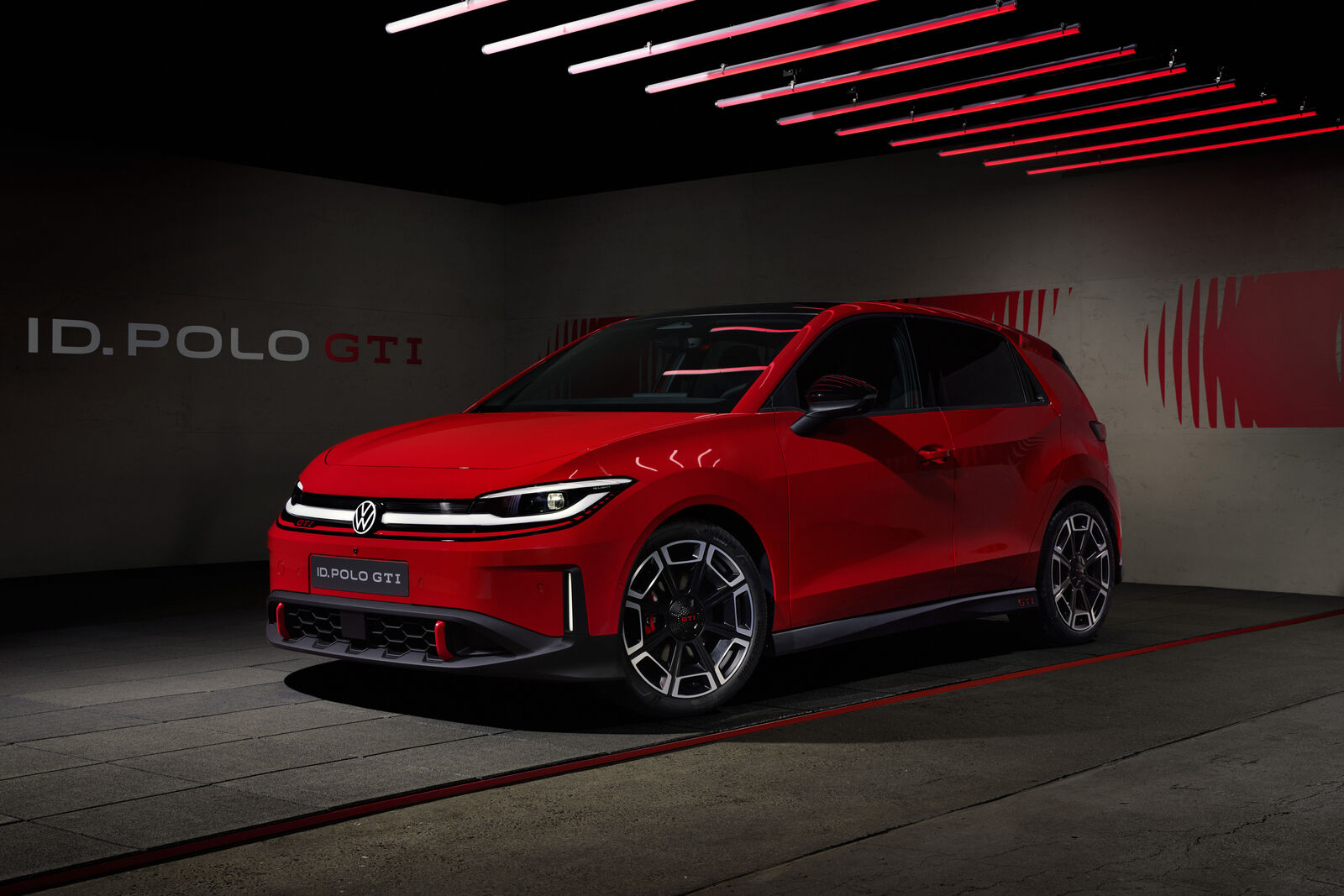


Fifty years after the original Golf GTI rewrote the rules for affordable performance, Volkswagen just unveiled its successor — and it plugs in. The ID. Polo GTI, revealed Friday at the Nürburgring 24-hour race, is the first all-electric car to wear the GTI badge. Pre-sales open in Germany this autumn at just under €39,000.
The numbers tell a familiar GTI story dressed in new clothes. A front-mounted electric motor delivers 166 kW (226 PS) and 290 Nm of torque, all of it available instantly. Zero to 100 km/h takes 6.8 seconds, with front-wheel drive, just like the 1976 original.
But there’s a catch embedded in that heritage play. Volkswagen is asking nearly €39,000 for what is essentially a souped-up supermini — a car occupying the same segment the Polo has dominated for decades as an accessible, everyman machine. The original Golf GTI cost roughly the equivalent of a well-equipped family sedan. This one costs more than a base Tesla Model 3 in most European markets.
The hardware, at least, justifies some of the premium. Standard kit includes an electronically controlled front differential lock, adaptive DCC suspension, progressive steering, 19-inch alloys, IQ.LIGHT LED matrix headlights, and premium sport seats with a modern take on the classic tartan check upholstery. A new GTI driving profile, activated by a button on the steering wheel, switches every dynamic system to its sharpest setting and changes the cockpit display to match.
Underneath sits a 52 kWh nickel-manganese-cobalt battery offering up to 424 km of WLTP range. DC fast charging tops out at 105 kW, with a 10-to-80 percent fill taking roughly 24 minutes. Those are competitive numbers for the segment, though nothing that will make a Hyundai Ioniq 5 owner sweat.
The design follows Volkswagen’s new “Pure Positive” language but keeps the GTI totems intact. The iconic red stripe stretches across the front with a 3D GTI logo embedded on the left. A split roof spoiler at the rear is unique to the GTI variant, and the C-pillar deliberately echoes the original Golf — a visual anchor Volkswagen clearly doesn’t want anyone to miss.
Volkswagen is careful to label this a “near-production concept vehicle.” But the level of specification detail — down to luggage capacity (1,240 litres with seats folded) and energy consumption figures (16.4–14.4 kWh/100 km) — suggests the production car will look almost identical.
The real tension here isn’t whether the ID. Polo GTI is a proper GTI. By every measurable standard — the differential lock, the tuned chassis, the front-drive purity — Volkswagen has done the engineering homework. The tension is whether the GTI badge can carry a €39,000 price tag on a car smaller than a Golf.
For context, the current combustion Polo GTI starts around €30,000 in Germany. The ID. Polo GTI asks roughly 30 percent more, and buyers lose the exhaust note, the simplicity, and the fuel-and-go convenience. What they gain is instant torque, zero tailpipe emissions, and a piece of history — the moment the GTI lineage went electric.
Volkswagen is betting that the badge itself has enough gravitational pull to make the math work. Five decades of brand equity is being asked to do heavy lifting against sticker shock and an EV market that has taught European buyers to be ruthless about value.
Whether the ID. Polo GTI becomes this generation’s defining hot hatch or an expensive curiosity will depend entirely on how it drives. The Nürburgring reveal was a statement of intent. The showroom will be the verdict.
Share this Story