
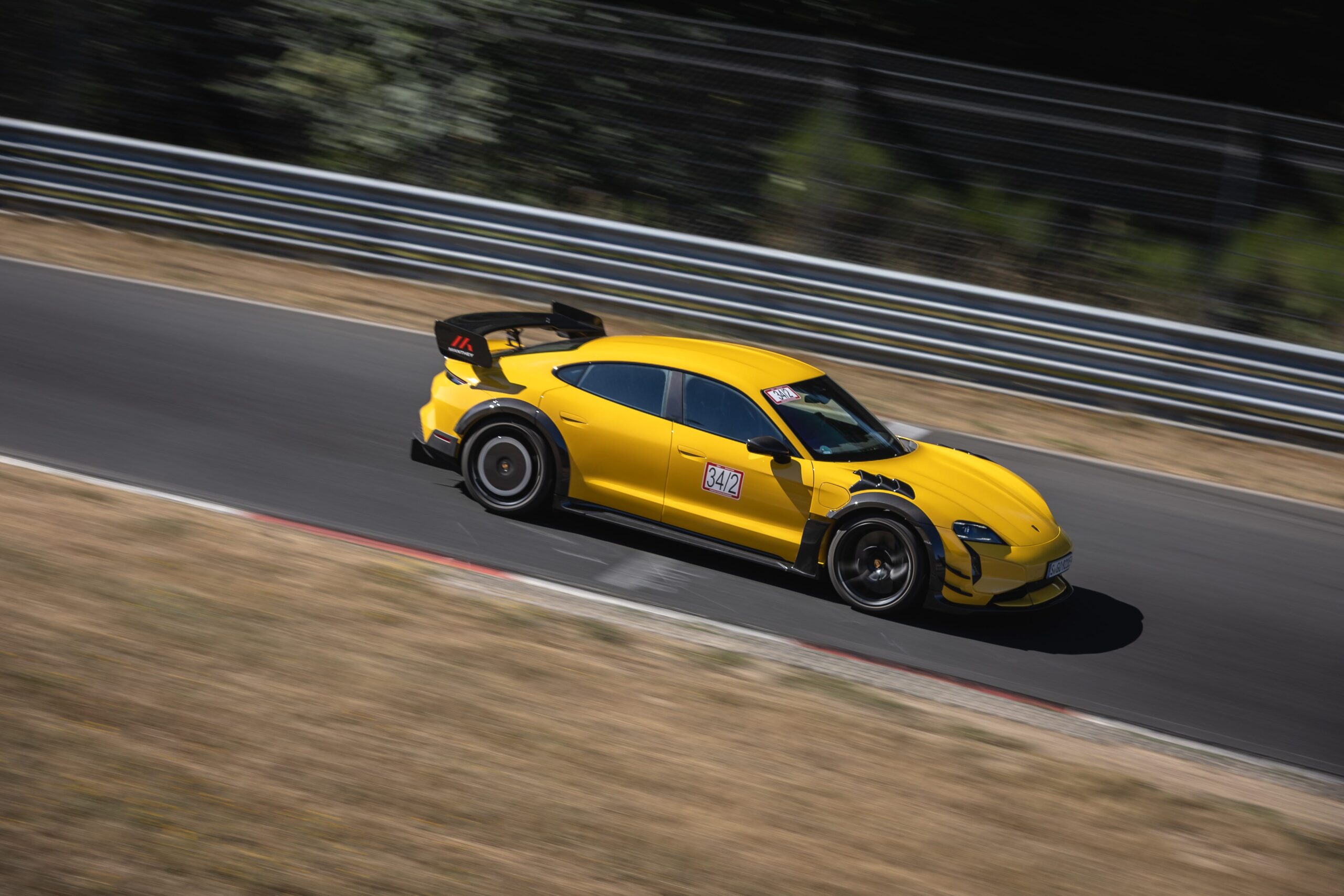


The sticker for the Manthey Racing kit alone would buy you a nicely equipped Porsche 911. At $125,510, it bolts onto a Taycan Turbo GT that already starts at $246,050, pushing the total to $371,560 before you tick a single other option box. Porsche is betting there are buyers who want a two-seat electric sedan tuned to chase purpose-built supercars around a racetrack, and the bet appears to be paying off.
The 2027 Taycan Turbo GT Manthey sliced 12 seconds off the standard Turbo GT Weissach’s lap around the 12.9-mile Nürburgring Nordschleife. Twelve seconds on that circuit is not an incremental improvement. It is a generational leap, the kind of gap that separates entirely different classes of machinery.
What earns those seconds is the most comprehensive Manthey upgrade Porsche has ever offered. A massive adjustable rear wing generates up to 1,631 pounds of downforce at top speed. Carbon-fiber fender flares push the body 1.9 inches wider per side, covering Pirelli P Zero Trofeo RS tires mounted on wider wheels.
Up front, a larger splitter works with a redesigned rear diffuser and full underbody ground effects to glue the car to the pavement. The mechanical changes go deeper than aero, though. A more powerful pulse inverter bumps the electric powertrain’s output from 777 to 804 horsepower.
That is not a huge number on paper, but Porsche says the real gain is in how consistently that power reaches the ground. More grip, more downforce, and more usable thrust create a package that drivers describe as vastly more planted and confidence-inspiring at the limit.
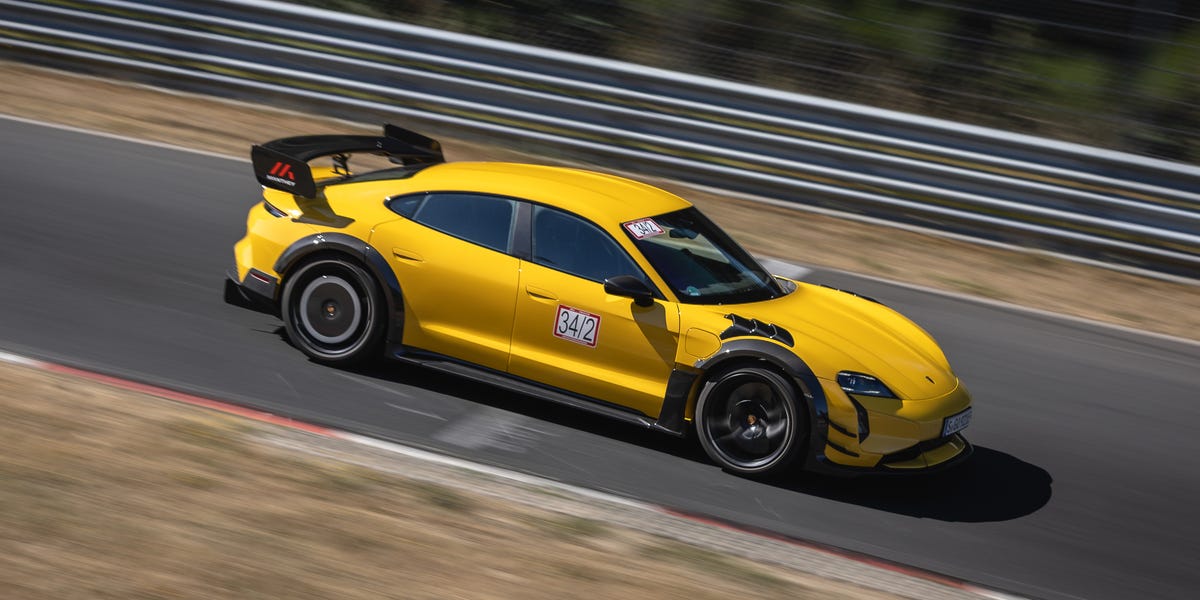
This Taycan Manthey is also a first for Porsche. Previous Manthey kits for the 911 GT3 and GT2 RS were dealer-installed or aftermarket retrofits. The Taycan version is assembled at the factory, built as a complete package from the start, and that distinction matters for build quality, warranty coverage, and the kind of integration you cannot achieve bolting parts onto a finished car.
Like the Weissach package it builds upon, the Manthey Taycan ditches the rear seats entirely. Two seats, 804 horsepower, and a quarter-million-dollar accessories bill. This is not a family EV.
It is Porsche’s declaration that electric performance cars belong on the same hallowed asphalt as their combustion predecessors. The broader context here is a luxury EV market struggling to find buyers willing to pay six figures for battery power. Porsche’s answer is not to discount.
It is to push further upmarket, turning the Taycan into something so specialized, so track-focused, that the powertrain becomes almost irrelevant to the conversation. Nobody shopping a $372,000 two-seat track weapon is cross-shopping a Tesla.
Whether enough customers exist at that price to justify the engineering investment is a question Porsche has answered before with cars like the 918 Spyder and the Carrera GT. Low volume, high margin, massive halo effect.
The Taycan Turbo GT Manthey is now the fastest four-door Porsche has ever sent around the Nordschleife, electric or otherwise. The next question is how long that record stands before Stuttgart decides to push even harder.
Share this Story