
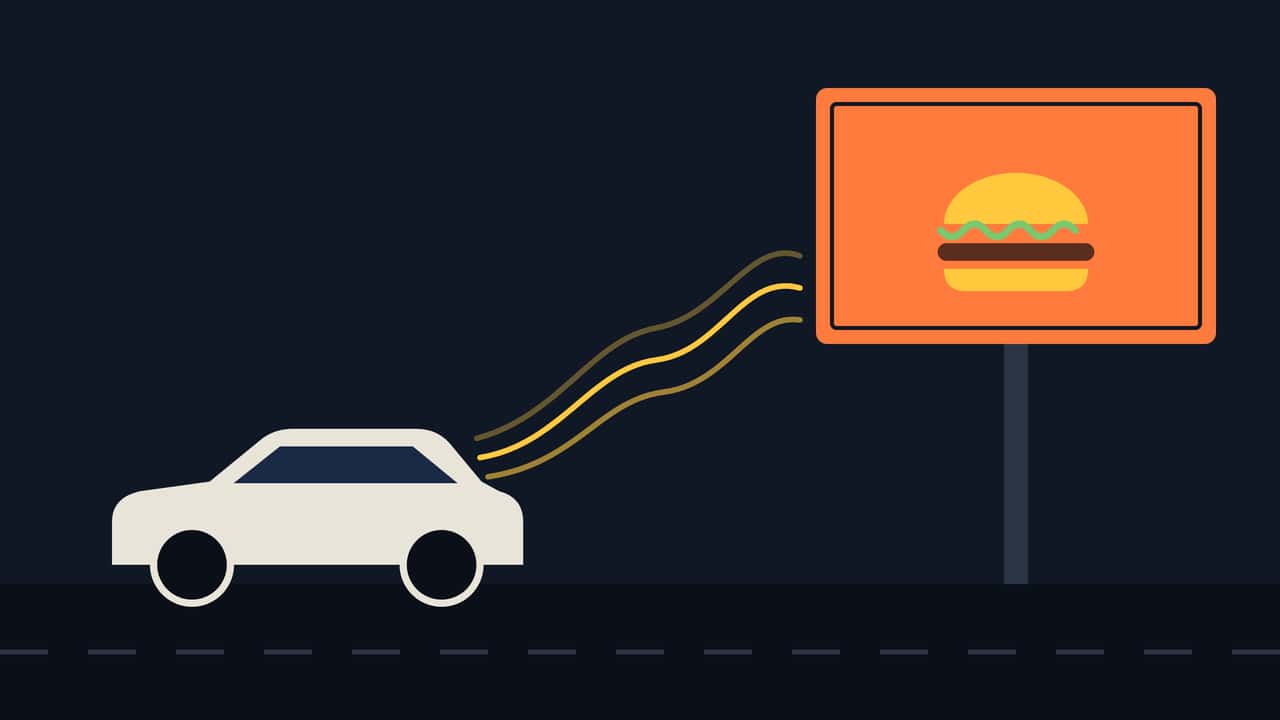


Drive past a burger billboard, and your cabin starts to smell like grilled beef. That’s the scenario in a Sony patent published by the United States Patent and Trademark Office on November 5.
The filing, first spotted by Patentlyze, describes an in-car scent system tied directly to advertising. Cameras, GPS, an online database, and fragrance cartridges all work together to turn a roadside ad into something you can smell.
This is more complicated than a novelty air freshener. An exterior camera scans for billboards, signboards, and digital displays. When it recognizes one, the car checks a scent database to see whether that campaign has been registered.
That database holds what advertisers care about: the fragrance assigned to the ad, its location, the direction it faces, how long the campaign runs, and when the scent should be released.
GPS then confirms the car is actually passing the registered display. Only then does the system fire.
Sony doesn’t stop there. A second camera inside the cabin would study the occupants and estimate their age and gender.
That data decides who gets the smell. Under the filing, an advertiser could target only passengers who fit certain demographics, with blowers aiming the scent at individual seats instead of flooding the whole cabin.
Timing is adjustable too. The patent describes capping a release at a set window, such as 30 seconds, and suggests the scent could intensify as the car gets closer to the billboard.
Roadside signs are only half the plan. The filing also covers commercials on TV, radio, and connected devices like smartphones, including ads on the car’s own infotainment screen.
In those cases, the car would identify the ad by broadcast channel, website, or time slot, then pull the matching fragrance. A chocolate commercial on the center display could come with the smell of chocolate.
The hardware is simple by comparison. It’s just scent cartridges, blowers, and a few possible layouts for placing dispensers around the cabin.
Sony does sketch out some friendlier uses. The patent mentions a signature fragrance when the car starts, and a passenger’s preferred scent waiting when they climb into a taxi.
But those aren’t what the filing is really built around. A campaign registration database, demographic targeting through cabin cameras, location checks, and seat-by-seat delivery are the tools of an ad network, not a comfort feature.
That leads to the privacy question the patent never answers. Interior cameras guessing the age and gender of people in a private vehicle, so a third party can decide who smells what, is a long way from a dashcam.
Cars are already crowded with screens fighting for attention. This filing would hand advertisers a way into the one sense drivers still had to themselves.
Still, a patent isn’t a product. Companies file on ideas they never build, and only a fraction ever reach production.
Making this one real would take an unusual amount of cooperation. Automakers would have to install the hardware, and advertisers and billboard operators would have to register campaigns in Sony’s scent database.
Sony hasn’t said it plans to sell the system. But the plan, complete with demographic filters and a 30-second release window, is now on public record.

Share this Story