
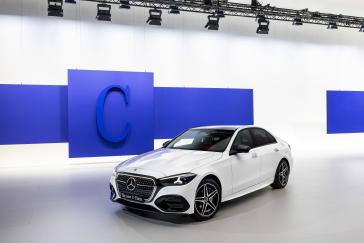


Twelve million sold since 1982, and Mercedes-Benz still isn’t ready to let the C-Class go electric. The automaker on Tuesday unveiled the most sweeping update in the model’s 43-year history, doubling down on a combustion powertrain at a moment when rivals are sprinting toward battery power.
The new C-Class, due at U.S. dealerships in the first half of 2027, arrives with a reworked 2.0-liter turbocharged four-cylinder paired with a second-generation integrated starter-generator. That 48-volt mild-hybrid setup adds up to 23 horsepower and 151 pound-feet of torque at low revs, enabling coasting with the engine off and nearly invisible start-stop transitions. Mercedes calls it an “electrified high-tech combustion engine,” which is a very polished way of saying this car still burns gasoline.
The timing is telling. Mercedes has spent the past two years quietly retreating from its aggressive EV-only timeline, and the C-Class refresh reads like a public admission that the midsize luxury sedan buyer isn’t crossing over to batteries anytime soon. Rather than replace the C-Class with an electric equivalent, Stuttgart chose to pour resources into making the internal combustion version smarter, more connected, and harder to argue against.
The tech story centers on MB.OS, Mercedes’s proprietary operating system, now running the entire vehicle. Over-the-air updates cover the full software stack. The fourth-generation MBUX infotainment system pulls AI from ChatGPT, Microsoft Bing, and Google Gemini at the same time, a multi-agent approach Mercedes hopes will make the voice assistant feel less like a parlor trick and more like a co-pilot.
It can handle multi-turn conversations, remember context, find a half-remembered song, and report ski slope conditions. Navigation leans on Google’s cloud-based Automotive AI Agent for points-of-interest queries.
The multifunction steering wheel gets a rocker switch for adaptive cruise control and a roller for volume, both capacitive with haptic feedback. These are features trickling down from the S-Class, and their presence in a car that starts well below six figures tells you where Mercedes sees the real volume fight.
Inside, the 11.9-inch portrait central display and 12.3-inch driver display carry over the floating design language. An optional Burmester 3D Surround Sound System with Dolby Atmos runs 15 speakers and 710 watts, with an automatic function that detects which seats are occupied and adjusts the sound stage. Ambient lighting spans 64 colors, ten preset worlds, and four dimming zones.
When Blind Spot Assist detects a vehicle alongside, the door handles flash red. That kind of detail matters more than it sounds like it should.
Two new exterior colors, Miami Silver Metallic and Moody Sky Grey Metallic, join the palette. A new AMG Line Plus package adds a gloss black spoiler lip, Night Package, sports seats with red contrast stitching, and red seat belts. New wheel options range from 18 to 19 inches, including two AMG designs.
Mathias Geisen, who oversees sales and customer experience on Mercedes’s board, framed the update with careful language. “The new C-Class proves that continuity and innovation are not mutually exclusive,” he said.
That sentence carries more weight than it appears to. Mercedes is telling its loyal C-Class buyers, and the broader market, that the combustion car isn’t going anywhere. The company is investing in this platform like it expects to sell it for years, layering in the same AI and connectivity architecture that underpins its electric models.
Whether that confidence holds depends on how regulators, fuel prices, and competitor lineups shift between now and 2027. BMW’s 3 Series faces its own identity question. Audi’s A4 successor has already gone electric in some markets.
Mercedes is betting the C-Class customer wants evolution, not revolution. Twelve million buyers built a lot of momentum, and Stuttgart is clearly not finished spending it.
Share this Story