
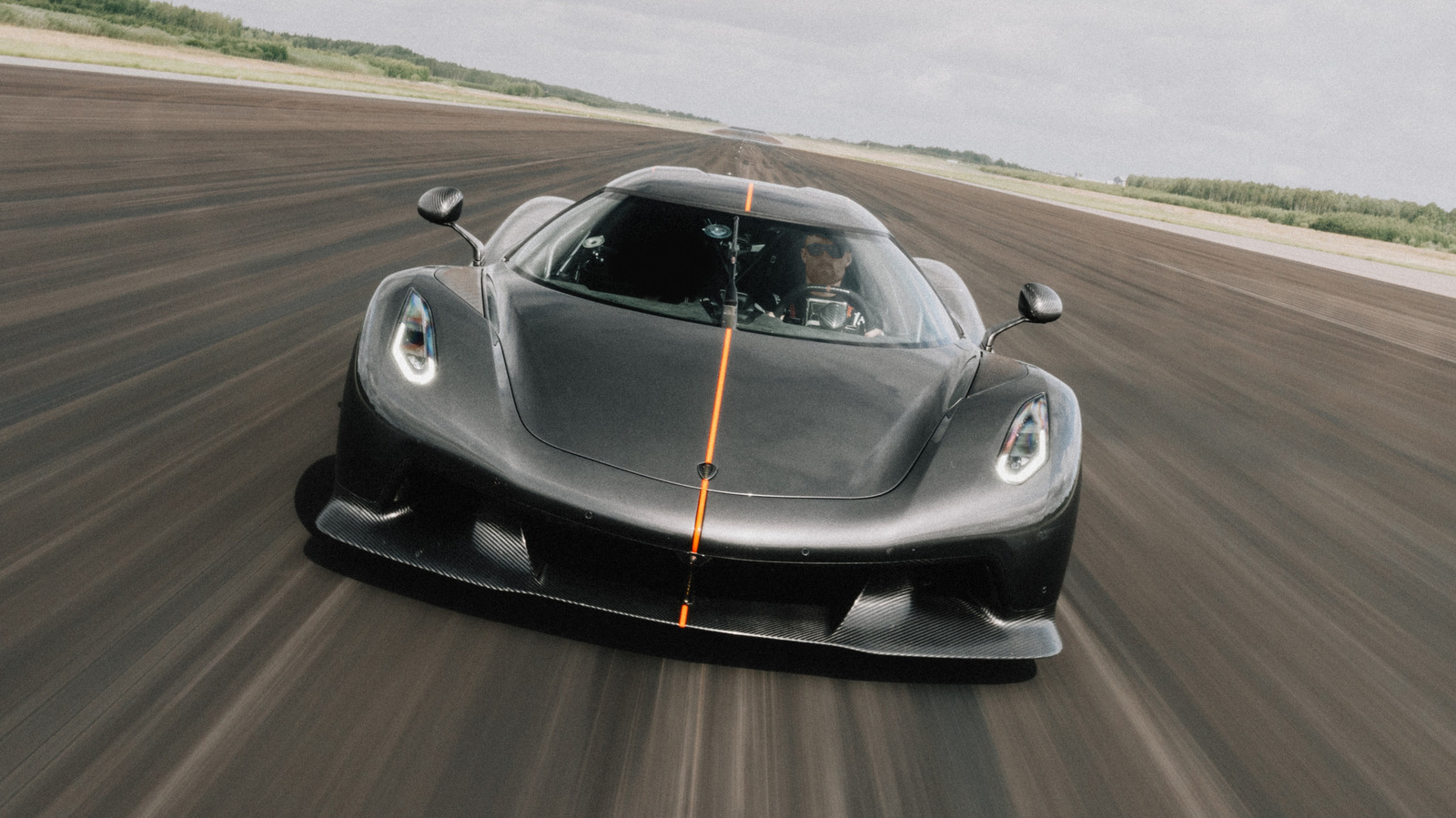


A software update just made the Koenigsegg Jesko Absolut the fastest-accelerating non-EV production car ever to cover a quarter-mile. The 1,600-horsepower Swedish hypercar clocked an 8.54-second pass at 190 mph — numbers that would have been science fiction a decade ago for anything burning gasoline.
The half-mile fell even harder: 12.76 seconds at 232 mph. Both terminal speeds are records for combustion-powered production cars. Zero to 60 took 2.26 seconds, and 200 mph arrived in 9.38.
And here’s the kicker — Koenigsegg factory test driver Markus Lundh did the whole run holding his phone in one hand to film it.
The performance gains came not from new hardware but from over-the-air software refinements to traction control tuning, shift logic, and launch control. Koenigsegg says the update will roll out to every Jesko Absolut owner, meaning the car you bought last year just got meaningfully faster while sitting in your garage. That’s the kind of capability automakers have promised for years but rarely delivered with this level of impact.
What makes the numbers genuinely staggering is context. The Jesko Absolut is rear-wheel-drive. It runs no hybrid assist, no electric motors, no instant-torque cheat codes.
This particular run happened on an unprepped surface at Koenigsegg’s test track in Ängelholm, Sweden — not a sticky drag strip with a mile of VHT coating baked into the concrete.
The car itself is a monument to obsessive engineering. Its twin-turbocharged 5.0-liter V8 produces 1,600 horsepower on E85 fuel, dropping to 1,280 on pump gas. The engine spins to 8,500 rpm using what Koenigsegg claims is the world’s lightest V8 crankshaft at 27.5 pounds.
Power feeds through the company’s proprietary nine-speed “light speed” transmission, and the whole package weighs just 3,064 pounds.
The Absolut variant is purpose-built for straight-line velocity. Where the Jesko Attack wears a massive rear wing, the Absolut substitutes twin shark fins for reduced drag. The front splitter is more streamlined, aero covers shroud the wheels, and a longer rear section smooths airflow.
This achievement arrives two years after the Absolut broke the 0-250-0-mph record with a time of 28.27 seconds, a run that already cemented the car’s reputation as the most violently accelerating and decelerating combustion vehicle on Earth. The new quarter-mile number only widens the gap.
Christian von Koenigsegg isn’t resting on it. At the end of the demonstration video, he pointed toward the Gemera, the company’s four-seat grand tourer packing 2,300 horsepower and a claimed 249-mph top speed through a hybrid all-wheel-drive system. The Gemera is heavier and more comfort-focused than the Jesko, but it has the advantage of electric torque filling the gaps.
“We still see room for improvement,” von Koenigsegg said. “This is just the beginning. Watch this space.”
In an industry increasingly defined by electric powertrain dominance in acceleration metrics, a turbocharged V8 with no electrification just posted numbers that challenge the Rimac Nevera’s territory. The Jesko Absolut didn’t need a battery pack or a new set of tires. It needed better code.
That a car already two years into its production life can unlock this kind of performance through a wireless update says something about how much capability Koenigsegg originally left on the table. Or more accurately, how much the software had yet to catch up with the hardware. The machine was always this fast — the algorithms just hadn’t figured it out yet.


Share this Story