
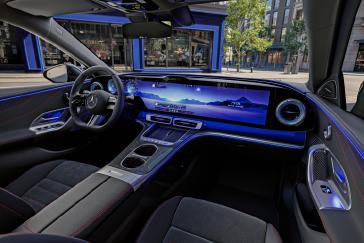


The C-Class has been Mercedes-Benz’s bread and butter for decades, the volume seller that quietly funds the company’s grander ambitions. Now Stuttgart is sending it into the deep end of electrification with a full redesign on a purpose-built EV platform, set for its world premiere on April 20 in South Korea.
No hybrid hedging. No combustion fallback. The new C-Class is electric, period.
That’s a massive gamble. The C-Class segment — compact luxury sedans — is precisely where EV adoption has been slowest, where BMW’s 3 Series still prints money with internal combustion, and where Tesla’s Model 3 owns the electric conversation. Mercedes is walking away from the gas engine in the one nameplate it can least afford to get wrong.
Ola Källenius, Mercedes-Benz’s CEO, calls it “the most spacious and most intelligent C-Class ever.” The company is leaning hard into interior quality as its differentiator, flooding the cabin with features that read more like an S-Class options sheet than anything you’d expect in this price bracket.
An optional MBUX Hyperscreen with nearly ten million backlit pixels. A 162-star illuminated panoramic roof. Electro-pneumatic lumbar support with full-surface massage. A Burmester 4D surround system that pipes sound through the seats themselves.
The vegan interior option, independently certified by The Vegan Society, returns after debuting on the electric GLC. Mercedes remains the only automaker with that particular credential.

None of this is accidental. Mercedes knows it can’t win EV buyers on range and charging speed alone — not when Chinese competitors are flooding the market with capable electric sedans at aggressive prices. The play here is sensory experience, the argument that a Mercedes cabin justifies its premium even when the powertrain underneath is no longer exclusive technology.
The thermal comfort claims are particularly telling. Mercedes says the new C-Class heats its cabin twice as fast as a combustion-engine model in 19-degree Fahrenheit weather while using half the energy, thanks to a multi-source heat pump. That’s the kind of engineering detail that signals real investment in making EVs livable in cold climates — a persistent weak point across the industry.
Acoustic isolation gets similar attention. Laminated safety glass comes standard on the front windows. Decoupled elastomer mounts separate the suspension from the body. The electric motors themselves were specifically designed for noise reduction. Mercedes is clearly aware that without engine sound to mask road noise, an EV cabin exposes every engineering shortcut.
The timing matters. This premiere arrives amid what Mercedes calls its biggest product launch program in company history, which already includes the electric GLC and CLA. The company is celebrating its 140th anniversary by driving three new S-Class sedans to 140 locations worldwide — a heritage play that underscores how much Stuttgart needs its future products to match the mythology.
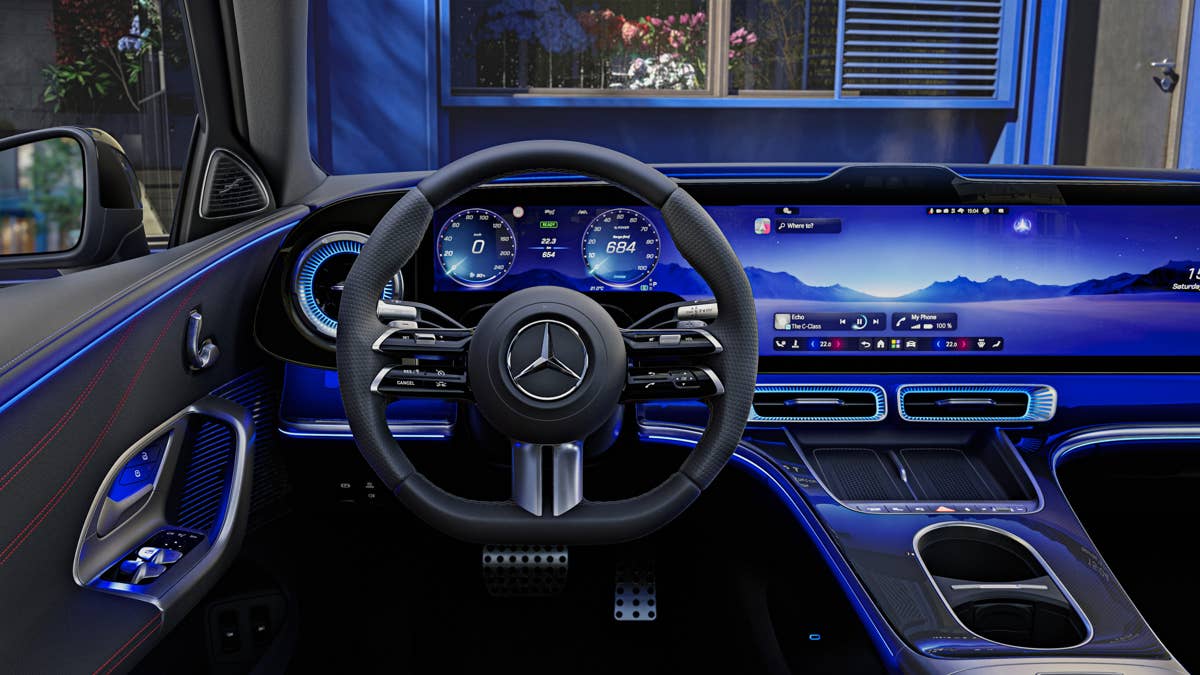
But heritage doesn’t sell cars to a 35-year-old buyer cross-shopping a Tesla Model 3 or a BMW i4. What sells cars is whether the thing feels worth it when you sit inside, close the door, and the world goes quiet.
Mercedes is betting everything that this cabin — this “sanctuary,” as they insist on calling it — answers that question. The C-Class has never carried this much strategic weight. If it connects with buyers, it validates Mercedes-Benz’s entire EV transition playbook. If it doesn’t, the company will have electrified its most important nameplate into irrelevance.
The livestream goes live April 20 at 6:30 a.m. Eastern. The real verdict comes when the first customers sit down, reach for the door handle, and decide whether a compact Mercedes without an engine note still feels like home.


Share this Story