
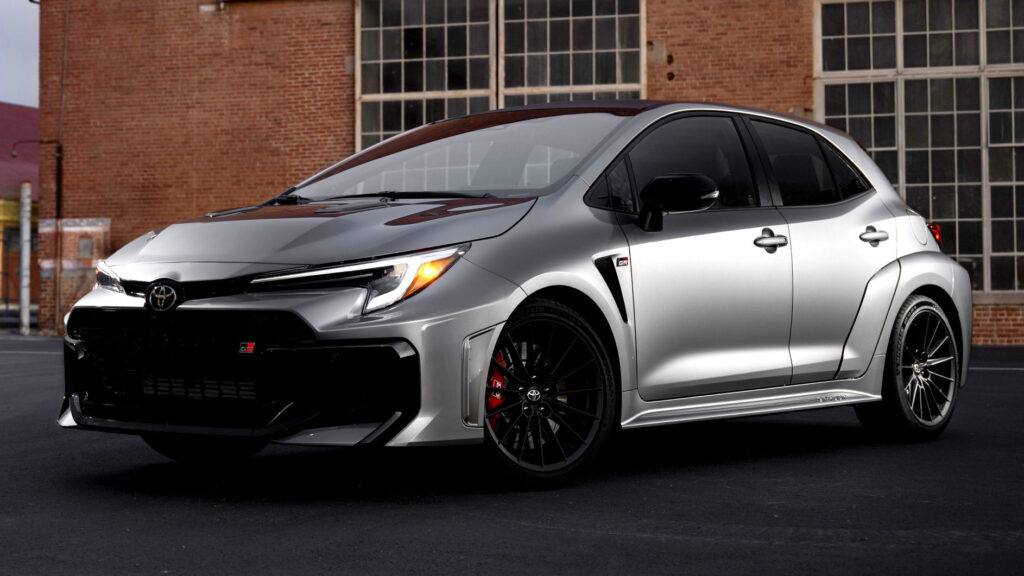


The first British-built Toyota GR Corollas are already landing at American dealerships, and unless you check the VIN, you’d never know. For 2026, Toyota has quietly shifted all U.S.-bound GR Corolla production from its Motomachi plant in Japan to the Burnaston factory near Derby, England. Until now, that facility cranked out nothing more exciting than hybrid Corollas for the European market.
The irony is thick. Burnaston will build roughly 10,000 GR Corollas a year, every single one earmarked for North America. British buyers can’t have one.
Toyota’s official explanation is production optimization — getting cars to customers faster. But there’s a convenient financial tailwind. Cars built in the U.K. enter the United States at a 10 percent tariff for the first 100,000 units annually, a meaningful discount compared to the rate on Japanese imports.
Toyota insists the tariff advantage was recognized only after the production decision was made. Believe that or don’t.
What Toyota clearly wants buyers to focus on is that nothing about the car has changed. “For the customer, there should be no change at all,” said Naohiko Saito, Gazoo Racing’s chief engineer, during a factory visit. The turbocharged 1.5-liter three-cylinder engine is still built in Japan and shipped to England.
Body panels are modified to accept the carbon fiber roof and wider body kit. The bones are the same.
The assembly process tells an interesting story about how seriously Toyota takes this car. The GR Corolla gets its own dedicated 20-station line inside Burnaston, entirely separate from the mainstream Corolla operation. Where the regular car breezes through each station in 142 seconds, the GR spends 21 minutes at each one.
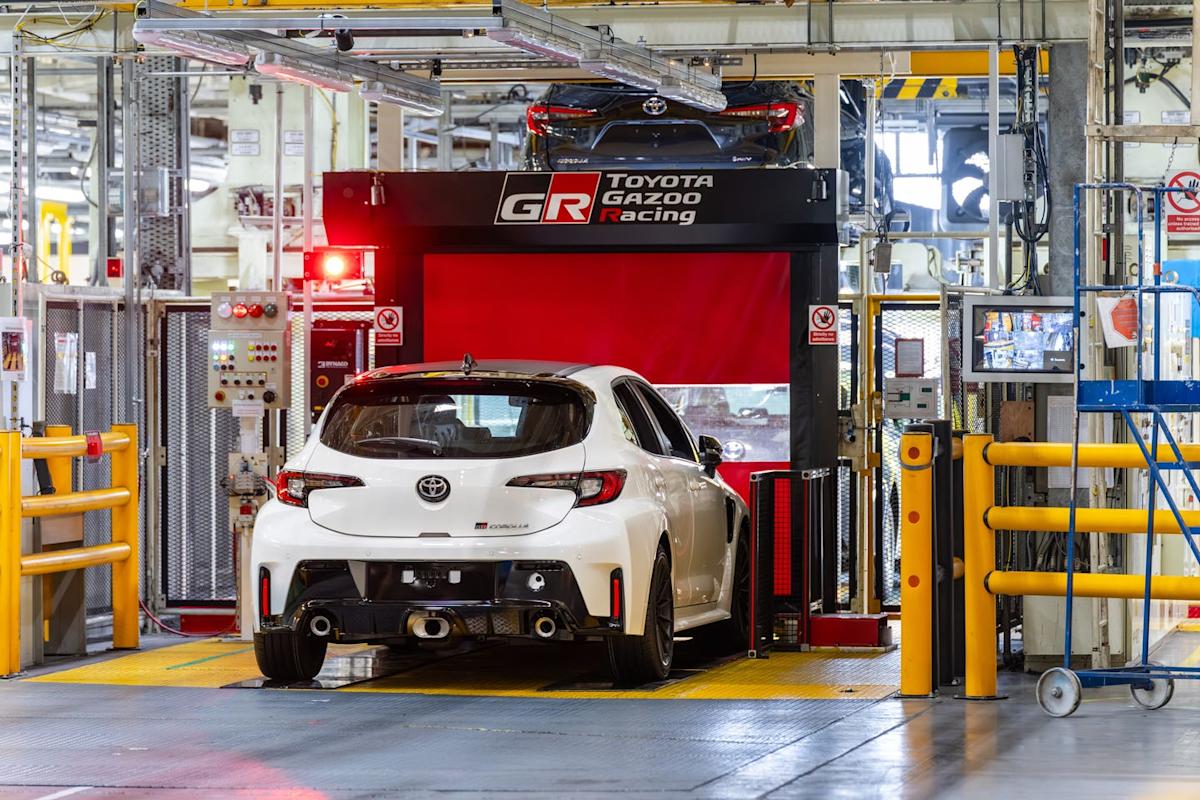
Precision is the obsession. The standard Corolla’s suspension alignment tolerance is 0.75 degrees. For the GR, the target is 0.25 degrees, and most cars reportedly come off the line at 0.05 degrees.
The bodyshell is lowered onto the powertrain and subframes rather than the other way around — a reversal of the typical process that Toyota says improves accuracy. Front suspension geometry is set in a special jig before installation. Wheel nuts get torqued by hand with a wrench before the car rolls off the line.
Every worker on the GR line is a full Toyota employee, not agency staff. They wear GR-branded uniforms. It’s not quite Morgan-style handcrafted, but for a car at this price point, it’s an unusual level of human attention in an era of relentless automation.
The Burnaston plant opened in the 1980s, part of a wave of Japanese investment in British manufacturing designed to gain lower-tariff access to European markets. Nissan still runs its massive Sunderland operation for similar reasons. Now Toyota is using that same geographic logic in reverse — building in Britain to access America more cheaply.
The deeper story is why Europe won’t get the GR Corolla even though it’s built on European soil. Toyota executives point to the cost of meeting European compliance standards, but the real killer is the continent’s fleet-average CO2 emissions targets. Selling a non-hybrid, turbocharged hot hatch wrecks the math.
For years, American enthusiasts lamented the “forbidden fruit” performance cars Europe kept to itself. The GR Corolla has flipped that script entirely. A 300-horsepower, manual-transmission hot hatch, assembled with obsessive care in the English Midlands, shipped exclusively to the country that supposedly doesn’t appreciate small cars.
British VINs start with an S instead of a J. That’s the only tell. Everything else — the snap of that six-speed shifter, the bark of that triple — should be exactly as it was.

Share this Story