


Toyota’s experimental smart city at the base of Mount Fuji just got its nerve center. The Inventor Garage, a development hub inside Woven City, officially opened on April 3, and the company wasted no time filling it with AI demos, new partner announcements, and a freshly minted corporate philosophy it calls Kakezan — invention through multiplication.
The term, borrowed from the Japanese word for multiplication, is Woven by Toyota’s way of saying no single company or technology can solve the problems it’s chasing. At the KAKEZAN 2026 event, CEO Hajime Kumabe and Senior Vice President Daisuke Toyoda laid out a vision that stretches far beyond building cars.
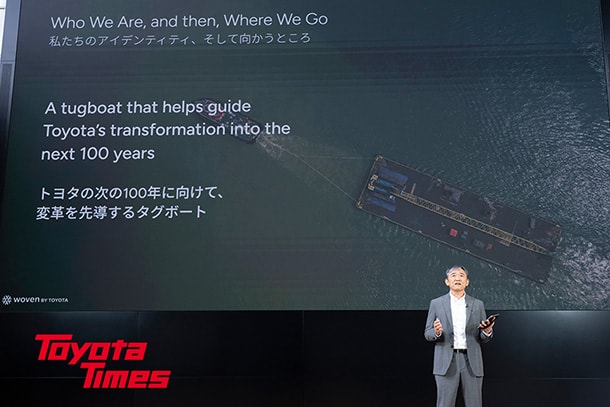
Kumabe framed WbyT as a “tugboat” — small but powerful enough to pull the massive Toyota mothership into unfamiliar waters. It’s a carefully chosen metaphor. Toyota is a $275 billion company that still makes most of its money selling internal combustion vehicles. Calling your innovation arm a tugboat is either refreshingly humble or a quiet admission of how hard it is to redirect something that large.
The technologies on display inside the Inventor Garage covered four pillars. Arene is a vehicle software platform designed to speed up automotive software development. Automated driving systems are powered by what WbyT calls Physical AI combined with a proprietary Active Learning Loop. Woven City itself serves as a living testbed, and a cloud and AI infrastructure is meant to connect engineers across companies, regions, and industries.
Kumabe’s pitch for zero traffic fatalities — not as an aspirational tagline but as an engineering mandate — is the thread tying these pillars together. His argument is straightforward: improving the car alone cannot eliminate crashes. People, vehicles, diverse mobility technologies, and infrastructure must all be networked.
That’s a decades-old idea in automotive safety circles, but Toyota is among the few companies actually building a physical city to prove it out.
The Akio Toyoda AI also made an appearance. Yes, that’s an artificial intelligence modeled on Toyota’s chairman. Details were thin, but the fact that Toyota is experimenting with a digital version of its most recognizable leader signals how deeply the company is leaning into AI as both tool and spectacle.
WbyT also unveiled a new logo — a hexagonal design with intersecting lines representing people, mobility, and infrastructure, rendered in Toyota red, gray, and black. Kumabe said employees collectively drew individual threads that were woven together to create it. Whether the symbol carries weight beyond branding will depend entirely on what comes out of Woven City in the next few years.
Daisuke Toyoda’s contribution leaned into the cultural side. His message: start by trying, embrace failure. For a company historically associated with kaizen — continuous, incremental improvement — endorsing failure as a feature rather than a defect is a notable pivot, at least rhetorically.
The partner announcements, though light on specifics at this stage, reinforce that Woven City is positioning itself as an open platform rather than a closed Toyota lab. That’s critical. A smart city populated only by Toyota engineers testing Toyota products would be an expensive echo chamber.
Woven City broke ground in 2021, and Phase 1 launched last year. The Inventor Garage marks another step, but the project remains in its infancy relative to the grand ambitions Kumabe outlined. Zero traffic deaths, a software platform that transcends vehicles, AI infrastructure spanning industries and borders.
Toyota has the money, the patience, and now the physical space. The tugboat is in the water. The question is whether the ship it’s pulling actually wants to turn.
Share this Story