
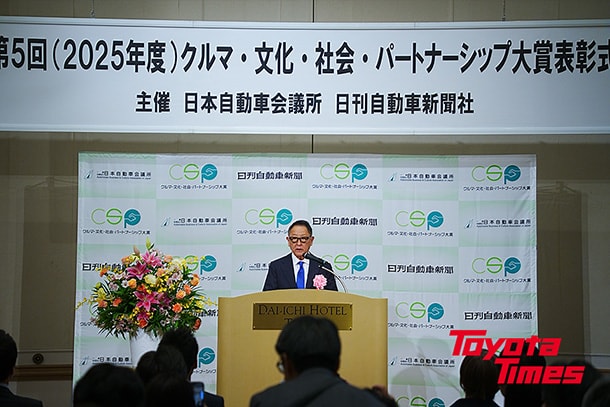


A ridesharing service for underserved rural towns, a motorcycle tourism project that took two decades to build, and a dashcam system that feeds live footage to fire departments. These were the top winners at the fifth Cars, Culture & Society Partnership Awards in Tokyo on March 16. Together they tell you exactly where Akio Toyoda is trying to steer Japan’s auto industry conversation.
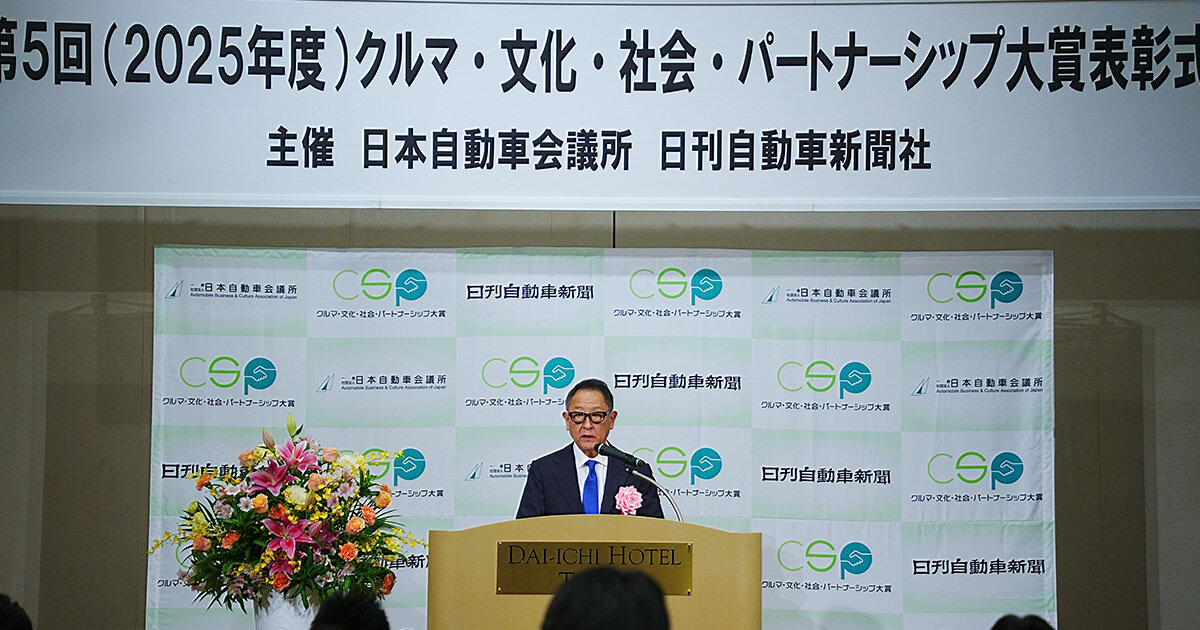
The ceremony, organized by the Automobile Business & Culture Association of Japan, honored initiatives from across the country’s 5.5-million-strong automotive workforce. Toyoda, who took over as ABAJ chairman last year, used the occasion to hammer home a message he’s been sharpening since stepping back from Toyota’s CEO role: cars aren’t just products. They’re cultural infrastructure.
This year the awards formally added the word “culture” to their name. That’s not cosmetic. It’s a deliberate reframing by Toyoda, who told the audience he wants to “make cars the pride of Japanese culture.”
The top prize went to Aisin’s Choisoko, a ridesharing service deployed in collaboration with local governments across Japan. Choisoko targets communities where public transit has withered, a growing crisis in a country whose rural population is aging fast and shrinking faster. The selection committee praised the service not just for moving people from point A to point B, but for giving isolated residents a reason to leave the house.
That choice is revealing. Aisin is a Toyota Group supplier, a parts maker. Now it’s being celebrated for a mobility service that has nothing to do with selling vehicles.
The two Special Awards were equally telling. Ogano, a small town in Saitama Prefecture, earned recognition for a nearly 20-year effort to attract motorcyclists as a regional revitalization strategy. The municipal government partnered with local police and businesses to make the town rider-friendly while keeping roads safe. It’s a model of patience, the opposite of a flashy tech rollout, and it worked.
The other Special Award went to Toyota’s Drive Recorder 119, a system that lets fire department dispatchers access dashcam footage from vehicles near an emergency when phone calls alone can’t paint a clear picture. It turns millions of existing dashcams into a distributed emergency response network without requiring anyone to buy new hardware.
Toyoda’s speech leaned on a single Japanese character he’d chosen for his New Year’s calligraphy: “ba,” meaning “place.” Not the compound “genba,” the factory floor, the front line, but something broader. Places where people challenge themselves, sustain each other, sharpen their skills.
It was abstract in a way that Toyoda’s public remarks often aren’t, and it framed the awards as more than a trophy ceremony. He positioned them as a stage for amplifying grassroots work that would otherwise stay invisible.
Additional awards were handed out across categories including Mobility Solutions, Regional & Community Revitalization, Environmental Contribution, and Car Fan Creation. Some recipients were visibly emotional. “This award is proof that our efforts have been recognized by society,” one winner said.
The CSP Awards remain a relatively small affair, five years old, organized by an industry association most consumers have never heard of. But they function as a precise instrument of Toyoda’s post-CEO agenda. Every winner reinforces the same argument: that Japan’s auto industry creates value far beyond sheet metal and powertrains, and that its cultural contribution deserves the same reverence the country gives to its cuisine, craftsmanship, and design traditions.
Whether that argument gains traction outside the ceremony hall depends on whether initiatives like Choisoko and Drive Recorder 119 keep scaling. The awards can spotlight the work. They can’t do it.

Share this Story