
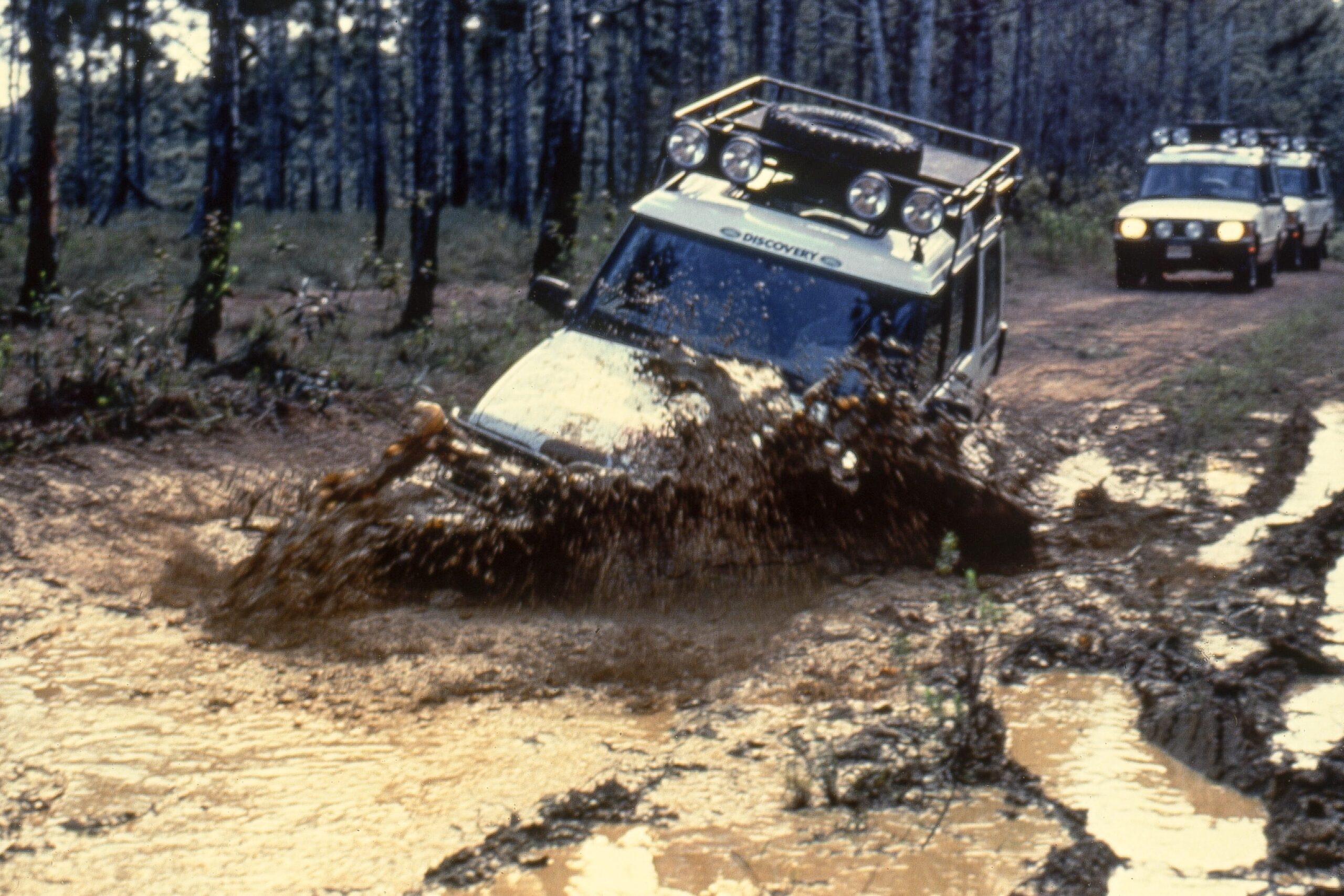


Three hundred miles of mud. Window-high waves of slop. A tarantula in someone’s shaving kit. That was Land Rover’s idea of a product launch in 1994, and it told you everything you needed to know about what the Discovery was built to do.
Car and Driver’s original coverage from June 1994 reads like a dispatch from another era of automotive journalism, one where manufacturers didn’t hand reporters lattes in a climate-controlled hospitality suite. They dropped them in the Belizean rainforest for seven days and pointed toward ancient Mayan ruins accessible only by logging paths that barely qualified as trails.
The Discovery had already been on sale in Europe for five years by the time it reached North America. Land Rover deliberately held it back, using the extra time to install dual airbags and side-impact door beams. Those features made it the first in its segment to offer both, beating the Jeep Grand Cherokee and Ford Explorer to the safety punch.
Built on the same 100-inch wheelbase platform as the short-wheelbase Range Rover, the Discovery effectively replaced that model when it went on sale in April 1994. But where the Range Rover carried an air of country-club exclusivity, the Discovery was aimed squarely at the mainstream sport-utility buyer. Its aluminum body panels looked, as the original review put it, more “Lost World” than Lexus.
Under the hood sat Land Rover’s 3.9-liter V-8, a torquey mill producing 182 horsepower. Buyers could choose between a ZF four-speed automatic or a five-speed manual transmission designed specifically for the Discovery. That manual was reportedly light and direct, a rarity in trucks of any era.
Permanent all-wheel drive with a locking center differential came standard. The suspension was pure Land Rover: long-travel coils up front, dual-rate coils in the rear, no electronic air suspension. It lacked the sophistication of the Range Rover’s setup but gained simplicity and durability, exactly the traits you want when your road disappears into a ditch somewhere between Caracol and Tikal.
On Michelin street tires, the Discovery pulled itself through yard-deep mud without drama. The slow throttle tip-in turned out to be a feature, not a flaw, letting drivers modulate power without digging ruts that would strand them. The original testers compared it favorably to the V-8 Grand Cherokee, which was the gold standard at the time.
Inside, Land Rover fitted the Discovery with an all-new dashboard designed specifically for the North American market. Dual-zone climate control, a ten-speaker stereo, cruise control, power windows, heated mirrors. Options included leather heated seats, rear jump seats, a back-seat air conditioner, and a six-disc CD changer.
Belize itself was the co-star of the story. A country the size of Massachusetts with 200,000 residents, four paved roads, and hundreds of thousands of acres of protected rainforest. It was reportedly under consideration as a host country for the 1995 Camel Trophy race, the ultimate endurance test for off-road vehicles and the humans foolish enough to drive them.
Land Rover chose Belize because it needed to prove that the Discovery could survive conditions far beyond anything a suburban buyer would ever encounter. That kind of validation mattered in the mid-1990s SUV wars. You couldn’t Photoshop credibility.
The original testers stopped short of a final verdict, promising a full road test to come. But the tone was clear enough. Anything that could handle Central American jungle trails on street tires was not going to be embarrassed by a snowy driveway in Connecticut.
Thirty years later, the Discovery nameplate is still around, though the trucks wearing it have grown softer, heavier, and far less likely to be tested anywhere near a tarantula.


Share this Story