
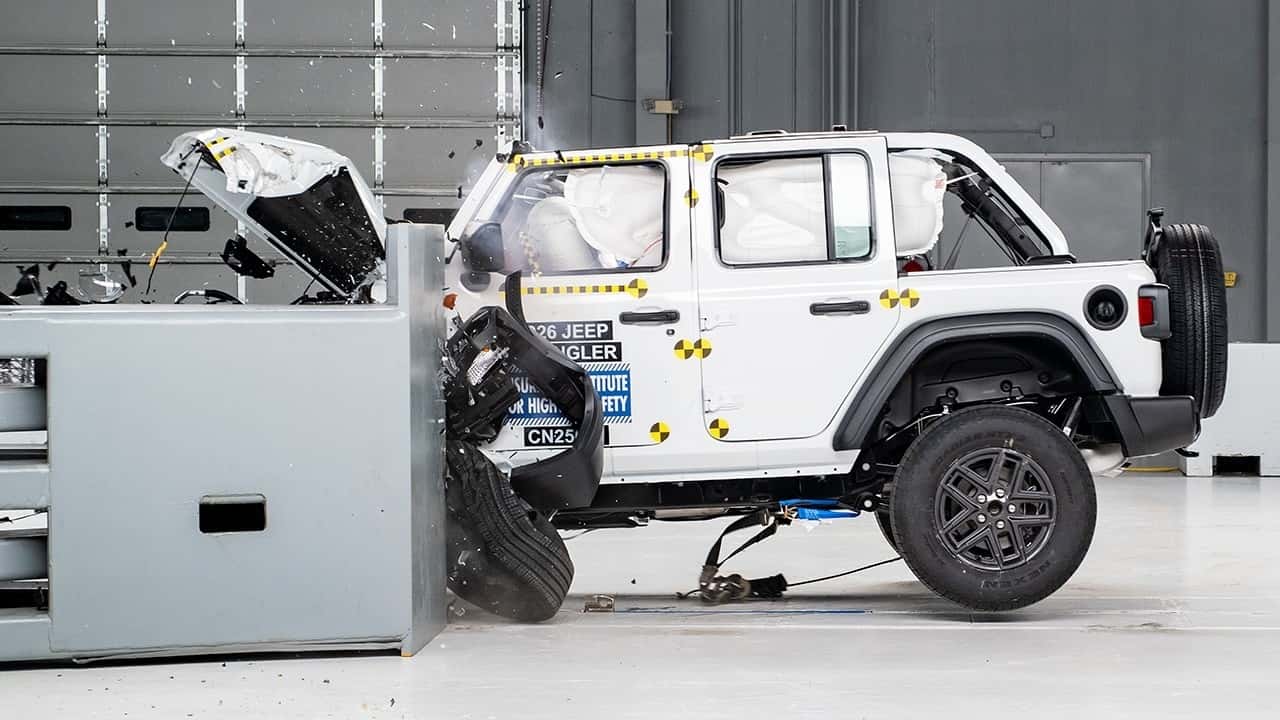


Six years. That’s how long it took Jeep to solve a problem anyone could see the moment a Wrangler hit the crash barrier: the thing tipped over like a barstool on a Saturday night.
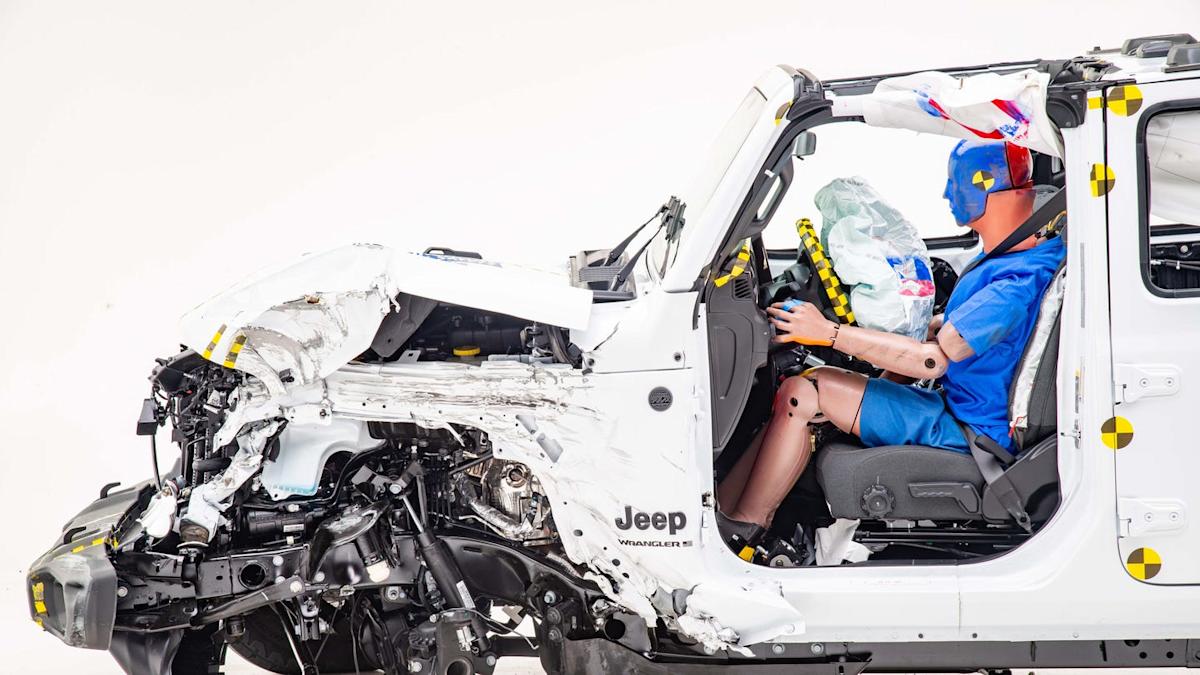
The Insurance Institute for Highway Safety confirmed this week that the 2026 Jeep Wrangler four-door stayed upright during the driver-side small overlap crash test. The fix? An updated frame rail. One structural change to address what had become the most embarrassing recurring failure in modern crash testing.
Go back and watch the footage from 2022. The Wrangler doesn’t crumple or deform in some subtle, engineer-debatable way. It flips. Immediately. On camera. For the world to see. And Jeep kept selling them by the tens of thousands.
IIHS first flagged the rollover issue in 2019. Jeep made modifications. The problem resurfaced in 2022. Now, with production changes implemented after October 2025, the agency says Wranglers finally earn an acceptable small overlap rating combining both driver-side and passenger-side results.
The National Highway Traffic Safety Administration had its own damning number: a 26.7 percent tip-over risk, assessed around 2020 for the current-generation Wrangler. That figure sits well above the average SUV, a consequence of the Wrangler’s tall stance and relatively narrow track width. Physics doesn’t care about brand loyalty.
And brand loyalty is what kept this vehicle selling despite the safety deficit. The Wrangler isn’t some niche oddity sitting on dealer lots gathering dust. It’s one of the most recognizable nameplates in the American market, a lifestyle vehicle with a devoted following that treats removable doors and trail ratings as non-negotiable features.
That popularity made the rollover problem not just a safety concern but a statistical one. More Wranglers on the road means more Wranglers in crashes.
IIHS deserves credit for staying on this. The agency didn’t let the 2022 modifications slide when they didn’t actually solve the problem. And Jeep, operating under the increasingly strained Stellantis umbrella, eventually did the structural work required.
But “eventually” is doing heavy lifting in that sentence. Three model year cycles passed between the second failed test and the fix reaching production vehicles.
The Wrangler still isn’t clean. IIHS testing revealed a high risk of injury to the front passenger’s right foot and leg during small overlap impacts. That’s not a footnote — lower extremity injuries in frontal crashes can be life-altering. So the rollover headline is good news, but the full picture remains complicated.
There’s a modest bonus buried in the announcement. Jeep confirmed the updated frame rail also applies to the Gladiator pickup, which shares the Wrangler’s platform. The Gladiator will receive the same acceptable rating for 2026, pulling both models out of what had become a uniquely unflattering crash-test spotlight.
Stellantis hasn’t disclosed the specific engineering changes beyond describing them as frame rail updates. The silence isn’t surprising — automakers rarely want to draw attention to the mechanics of fixing a problem they spent years not fixing.
What sticks is the timeline. A rollover tendency identified in 2019, a failed second attempt in 2022, and a solution finally in production by late 2025. For a vehicle that retails north of $30,000, buyers spent six years trusting that the icon on their driveway would behave in a crash the way they assumed it would.
Many of them never saw the test footage. The ones who did bought it anyway. That tells you everything about what the Wrangler means to its owners — and everything about how long an automaker can ride goodwill before the engineering catches up.
Share this Story