
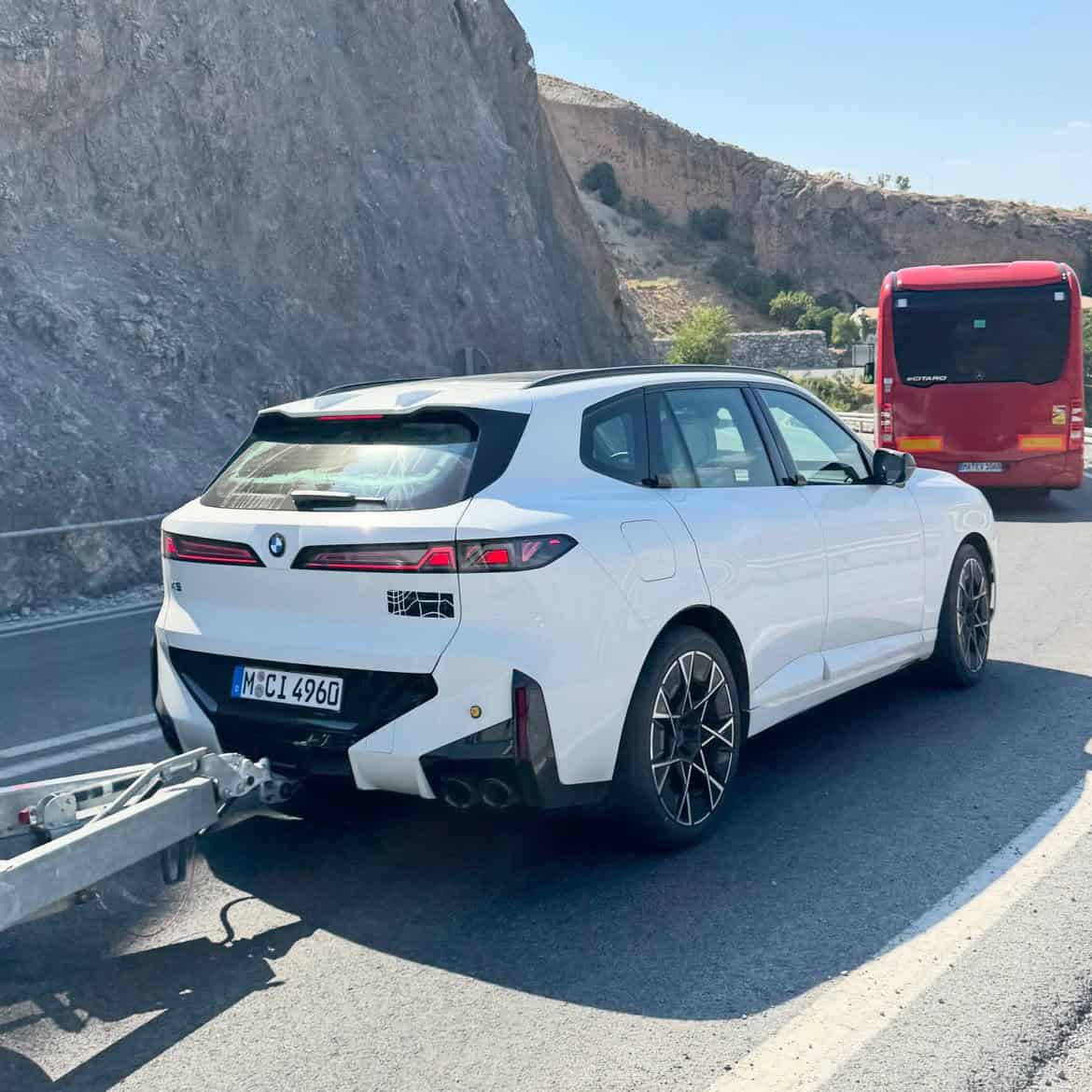


BMW announced a V8-powered version of the new fifth-generation X5 just days ago. A prototype is already running hot-weather tests across Europe, barely disguised and making no effort to hide what it is.
The giveaways are unmistakable. Quad exhaust tips out back, no charging port anywhere on the body. This is not the X5 M60e plug-in hybrid that BMW already revealed. This is the pure gasoline V8 variant, and it appears nearly production-ready.
BMW hasn’t confirmed the name, but the smart money says X5 M60. It replaces the outgoing M60i and will almost certainly pack the S68 twin-turbocharged 4.4-liter V8, possibly with mild-hybrid assistance. Power figures remain unconfirmed, but BMW’s own M60e sets the benchmark at 603 horsepower and 590 pound-feet of torque from its electrified inline-six.
That the M60e already makes 80 horsepower more than the old M60i tells you where BMW’s performance floor sits now. The V8 version can’t afford to look weak next to a six-cylinder plug-in hybrid wearing the same badge hierarchy. The power war is internal as much as external.
The S68 engine has been re-engineered to meet Euro 7 emissions standards, which effectively guarantees the V8’s survival well into the 2030s. That’s not a small thing. While competitors hedge their bets and quietly kill off large-displacement engines, BMW is doubling down.
The same V8 is headed for an M Performance version of the 7 Series in 2027, replacing the M760i. The second-generation X7 will carry it too.
BMW is building out the G65 X5 lineup with unusual breadth. The plug-in hybrid M60e is already official, the V8 M60 is coming, and a purely electric M Performance model will top the iX5 range. Sources suggest a full-fat X5 M — potentially in both V8 and electric flavors — could arrive around 2028.
That’s a staggering number of powertrain variants for a single nameplate, and it reflects BMW’s current strategy of refusing to choose a lane. Electric, electrified, and combustion all coexist under one roof, each wearing performance badges and commanding premium prices. Whether this is hedging or genuine conviction depends on whom you ask inside Munich.
The prototype caught testing wore almost no camouflage. A small strip of tape on the tailgate covered what is almost certainly the M60 badge. Everything else — the bodywork, the aggressive rear diffuser, the overall proportions — was on full display.
Hot-weather validation typically comes late in the development cycle. BMW isn’t experimenting here. It’s validating a finished product against extreme conditions, checking thermal management, transmission calibration, and cooling systems under stress.
The V8 X5 M60 is not a concept or a maybe. It is a 2027 model year vehicle on a fixed timeline.
For buyers who want the visceral character of eight cylinders without the complexity of a plug-in system, the M60 is BMW’s answer. No battery pack to charge, no electric range to manage, just turbocharged displacement and all-wheel drive in a package that weighs less than its electrified sibling.
BMW is playing every card in the deck at once. The V8 lives because the regulations allow it and because enough customers still want it. The electric versions exist because the market demands them.
The plug-in hybrid splits the difference for everyone in between. It is an expensive, complicated strategy. But the X5 prints money for BMW, and protecting that revenue stream justifies the engineering spend.
The V8 is not dying at BMW. It is getting a Euro 7 passport and a fresh assignment.

Share this Story