
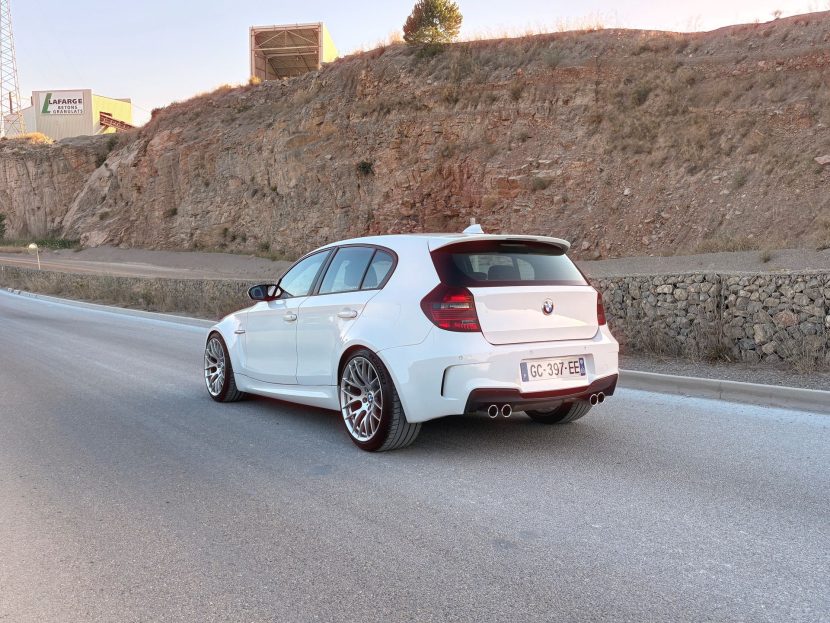


BMW sold the 1M for exactly one model year, 2011, as a two-door coupe, then killed it. No hatchback. No sedan. No version with rear doors that could serve double duty on a school run. The car became an instant collector piece, and BMW never looked back.
An owner named Zayed looked at that void and filled it himself, starting from arguably the least inspiring donor in the entire BMW catalog: a base E87 116i. Five doors, four cylinders, the car you buy when the badge matters more than the driving experience. That anonymity turned out to be the point. There was nothing sacred to ruin.
The four-cylinder is gone. In its place sits BMW’s N54B30, the twin-turbo 3.0-liter straight-six from the 335i, rated at 300 horsepower and 300 lb-ft from the factory, with a well-documented appetite for making far more on a tune. It’s paired with the N54’s own six-speed manual gearbox, not whatever transmission happened to bolt up with the least effort. That choice alone separates this from a weekend hack job.
The chassis work is where the build gets genuinely clever, because it follows BMW’s own blueprint. When Munich built the original 1M, engineers didn’t design a bespoke rear end for a car they planned to sell in tiny numbers. They raided the E90 M3 parts bin instead, pulling the rear subframe and suspension components wholesale.
This E87 does the same thing one generation forward: full E92 M3 rear subframe, control arms at both ends, M3 brakes. It’s not a shortcut. It’s the factory’s own precedent, applied to a body style BMW never bothered with.
Up front, the conversion is straightforward. The 1M fenders, bumper, and headlights bolt onto the E87’s structure with minimal drama, a swap well understood in the E8x community. The rear half of the car is a different story entirely, because no five-door 1M ever existed to supply parts.
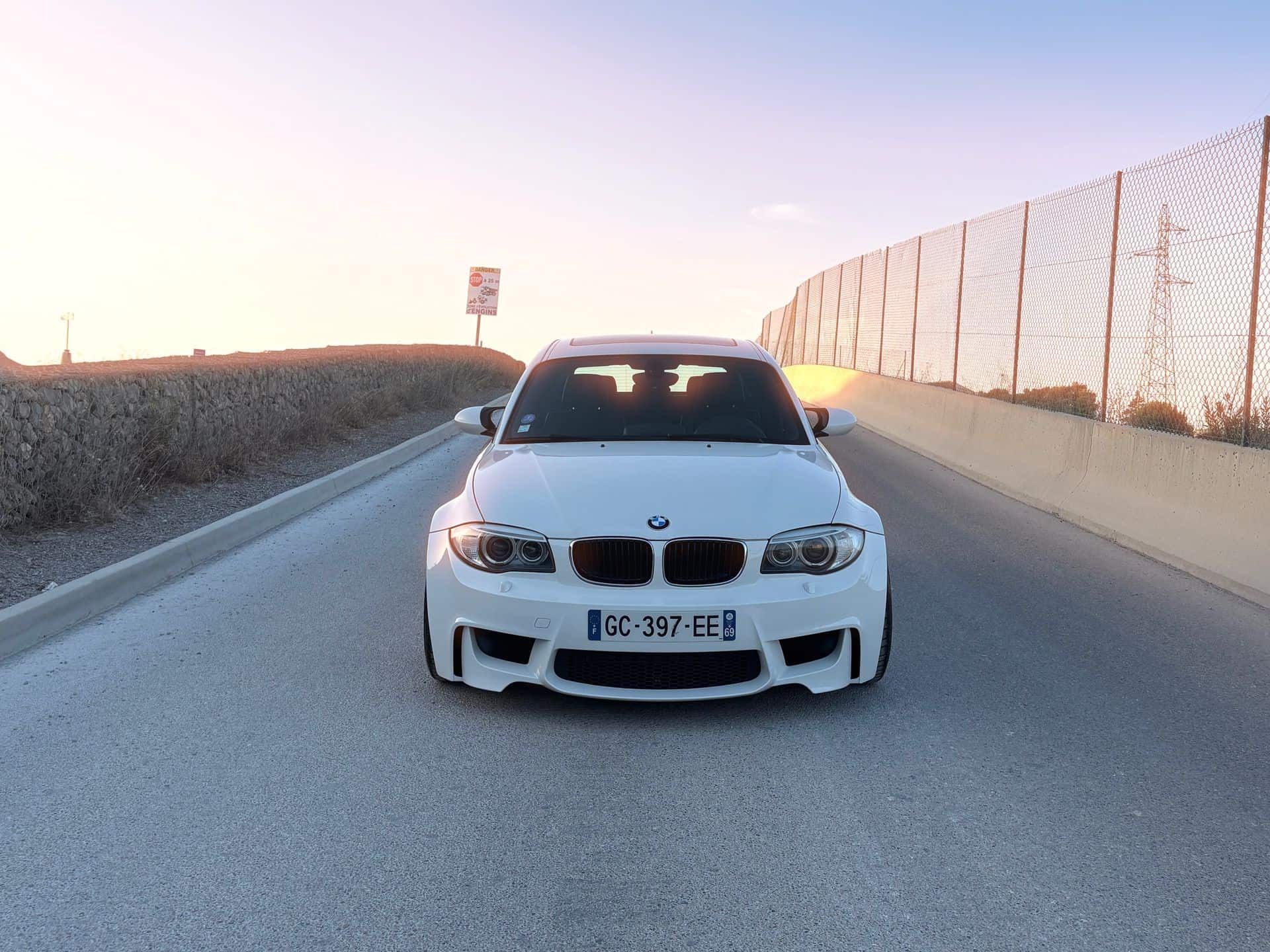
So the rear bumper was fabricated by fusing two 1M units into a single wider piece. The sideskirts came from stretching four 1M skirts into two that actually match the hatchback’s longer wheelbase. The battery got relocated out of the trunk to let a shortened OEM 1M exhaust sit flush. This isn’t parts-bin engineering anymore. It’s coachwork.
The whole thing rides on custom forged Style 359M wheels, 19×9.5 up front and 19×10.5 in the rear, wrapped in Michelin Pilot Sport 4S rubber at 255 and 275 widths respectively. That nearly inch-wider rear track is what makes the widebody functional rather than decorative.
Zayed says the finished car doesn’t drive like a 116i wearing a costume. It drives like the thing it’s mimicking: an M-division hatchback with a twin-turbo six, M3 suspension geometry, and the kind of mechanical grip that justifies the flared bodywork. The proportions land in unexpected territory, closer in spirit to the Z3 M Coupe than to anything the 1 Series lineup ever actually offered.
BMW has spent the last decade chasing crossover volume and electrification milestones. A hot hatchback built on M3 bones, with a manual gearbox and a turbo six, is precisely the kind of car the company keeps not making. The 1M was a one-year anomaly, a car that proved demand existed and then vanished before the market could absorb it.
Zayed’s build isn’t a replica. It’s an argument, assembled from BMW’s own parts, for a car the company had every reason to produce and never did. The fact that a single owner with fabrication skills and an eBay parts budget can approximate what an entire engineering department chose to leave on the table tells you everything about where BMW’s priorities landed.
Share this Story