


Toyota just became the first Japanese company to crack 50 trillion yen in operating revenue. Its reward? A forecast for a third straight year of profit decline.
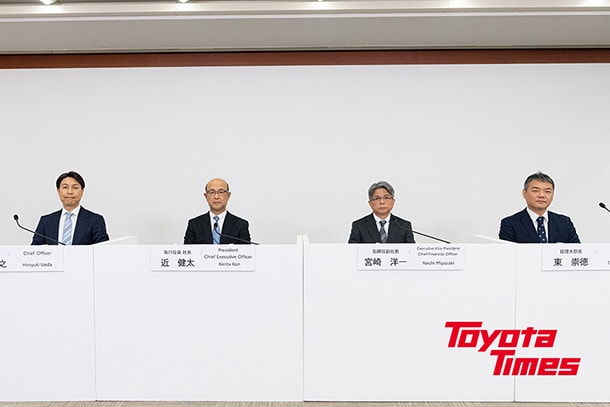
That tension sat at the center of Toyota’s fiscal year 2026 earnings briefing on May 8, where new president Kenta Kon faced questions about how the world’s largest automaker plans to keep growing. Tariffs, material costs, and Middle East instability are all eating into margins. Kon is barely a month into the job.
The headline number is staggering: 3.8 trillion yen in operating income, roughly $25 billion, delivered despite the drag of U.S. tariffs and rising input costs. Executive Vice President Yoichi Miyazaki was careful to note the company never set out to hit the 50 trillion revenue milestone. “What we have focused on every day is how to deliver our products to each individual customer,” he said.
That’s classic Toyota deflection, and it’s earned. Hybrid vehicles are doing the heavy lifting. Electrified models now account for roughly half of Toyota’s sales, and the company offers hybrid options across nearly its entire lineup.
Demand, particularly in Japan, outstrips supply. Customers are still waiting for deliveries.
Kon’s message was measured but unmistakable: Toyota will not slam the brakes. The company intends to keep investing in growth even as it restructures costs, reduces model variants, and pushes suppliers for productivity gains. “Rather than applying the brakes across the board,” Kon said, “these financial results allow us to identify unnecessary processes and inefficiencies one by one.”
The breakeven volume — the number of vehicles Toyota must sell to cover its costs — is creeping upward, and Kon acknowledged it. He was quick to add it hasn’t reached the dangerous levels seen during the 2008 financial crisis, when it ballooned past eight million units. But the trend concerns him enough to act.
Toyota plans to trim the number of vehicle variants that have multiplied under its multi-pathway electrification strategy. That strategy has the company simultaneously developing hybrids, plug-in hybrids, battery EVs, and hydrogen vehicles.
On battery EVs specifically, Kon offered little new red meat. “We want to deliver good vehicles to all customers. For customers who want battery EVs, we want to deliver high-quality battery EVs.” No acceleration timeline, no volume targets, just a reaffirmation that Toyota will let regional demand dictate its BEV pace.
That’s a deliberate posture. While rivals have poured billions into EV-only bets that are now bleeding cash, Toyota’s hybrid-first approach keeps generating enormous profit. The company is using that cash flow to fund long-term investments without borrowing against tomorrow.
Miyazaki drew a sharp line back to the pre-2009 era, before Akio Toyoda took the wheel. “We must never return to an era driven solely by volume,” he said. That period nearly broke Toyota, and the institutional memory still stings.
Kon inherits a company in arguably its strongest financial position ever, but he faces a paradox familiar to anyone who has watched Toyota for decades. The numbers are extraordinary. The outlook is cautious, and the strategy is to keep doing exactly what got them here — just tighter, leaner, and with fewer part numbers.
Toyota set no specific target for its breakeven volume reduction. Kon framed it not as a number to hit but as a structural rebuild, creating an earnings framework capable of supporting the next phase of growth. The company is also targeting a return on equity above 20 percent, a figure that would place it among the most capital-efficient automakers on earth.
Three consecutive years of declining profit at a company generating nearly $25 billion in operating income is a problem most automakers would kill to have. Toyota knows it. The question is whether discipline holds when the pressure mounts.


Share this Story