
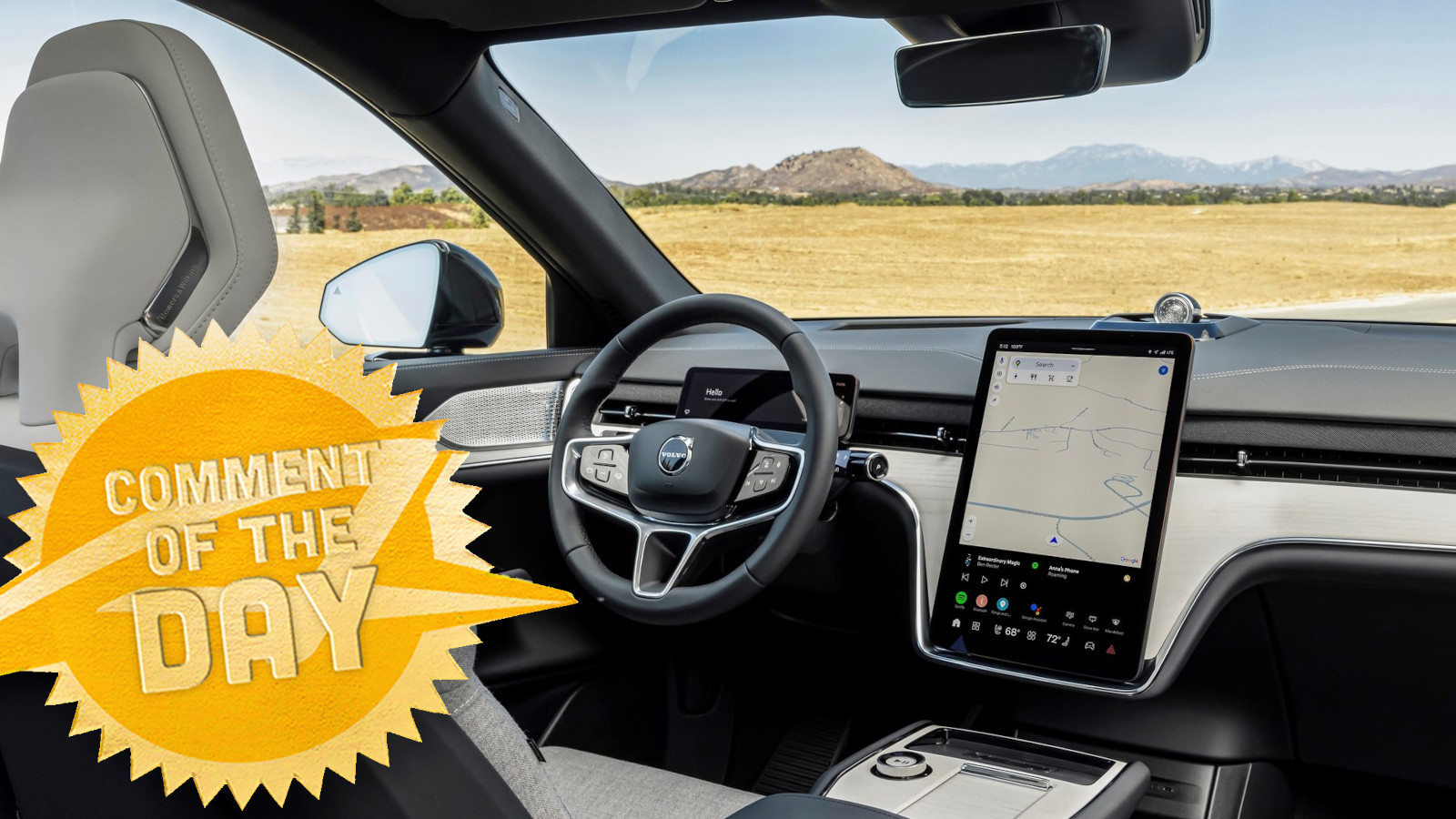


Volvo, the brand that built its entire identity on keeping people alive inside a car, has now made it harder to keep your eyes on the road. That contradiction landed with full force this week when The Autopian’s Matt Hardigree attended a Volvo press event and invited readers to submit questions for company brass. The response that lit up the comments section wasn’t a question. It was a scream.
“WHERE ARE THE INTERIOR BUTTONS, VOLVO?” wrote Stef Schrader, a well-known automotive journalist, in all caps. WHY IS THE BRAND THAT MADE ITS NAME FOR SAFETY REPLACING CONTROLS THAT YOU CAN JUST SLAP OR TWIST BY FEEL WITH ANNOYING ON-SCREEN CONTROLS WITH TINY TEXT THAT TAKE MY ATTENTION AWAY FROM THE ROAD…VOLVO???
She added, parenthetically: “I’m so tired.”
She’s not alone. The frustration over disappearing physical controls has been simmering for years across the industry, but it stings differently when it comes from Gothenburg. This is the company that invented the three-point seatbelt and then gave the patent away so every automaker could use it. Safety wasn’t a marketing angle for Volvo. It was a religion.
Now the congregation is watching its church sell touchscreens.
The timing of the outburst coincides with Volvo’s reveal of the EX60, its latest electric SUV, which reportedly features a “panini press” charging door and the same screen-heavy interior philosophy that has overtaken the brand’s recent lineup. Physical climate knobs, once a Volvo hallmark, have steadily vanished in favor of buried menus and swipe gestures that demand the one thing no driver should spare: visual attention.
There is real data behind the rage. A 2024 study by Sweden’s own Vi Bilägare magazine found that drivers using touchscreen-only controls took significantly longer to perform simple tasks like adjusting temperature or changing radio stations compared to drivers in cars with physical buttons. Some touchscreen-equipped cars required up to four times as long. The fastest car in that test was an older Volvo with traditional controls.
The entire industry shares blame. Tesla started the minimalist-screen trend. Mercedes, BMW, and Volkswagen followed to varying degrees. But most of those brands never positioned themselves as safety-first in quite the way Volvo did.
When Porsche keeps physical buttons on the Cayenne and Hyundai brings back knobs for its latest models, Volvo’s direction feels less like progress and more like capitulation to a trend that even its originators are quietly retreating from.
Euro NCAP, Europe’s vehicle safety assessment body, began factoring in interface usability in its ratings, explicitly rewarding physical controls for essential functions. That should have been Volvo’s moment to double down on what it always claimed to stand for.
Instead, here we are, reading an all-caps rant from a professional automotive journalist that perfectly crystallized what millions of car buyers have muttered under their breath in dealer showrooms for years.
The comment section at The Autopian didn’t just rally behind Schrader. It erupted with related frustrations about the industry’s direction, from Ford teasing a small electric Bronco nobody’s seen a finished version of to Nissan’s perpetual loyalty to its much-mocked CVT transmission. The thread was a snapshot of an enthusiast community that feels increasingly ignored by the companies fighting for their dollars.
Volvo hasn’t publicly responded to the criticism. The company rarely does. But when your most natural allies are the ones shouting loudest, silence starts to sound like an answer.
Schrader’s rant will fade from the internet’s short memory soon enough. The touchscreens won’t. And neither will the uneasy truth that the automaker once synonymous with protecting drivers is now asking them to look away from the road to turn down the heat.



Share this Story