
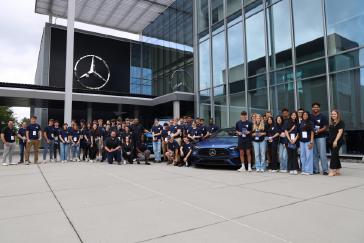


More than 43,000 car seats, helmets, and reflective gear kits handed out to families. Nearly 88,000 families touched across the country. Almost 5,000 volunteer hours logged. Mercedes-Benz USA just dropped its 2025 Corporate Social Responsibility Impact Report, and the numbers are large enough to demand a closer look at what a luxury automaker is actually doing on the ground.
The program is called “Driving Your Future,” launched in 2022, and it runs through two main partners: Safe Kids Worldwide and Junior Achievement USA. In 2025, MBUSA earned the Safe Kids Champion for Children Award for its work in childhood injury prevention. That’s not a trophy you buy with a check.
Safe Kids is one of the more credible child safety organizations in the country, and its president, Torine Creppy, specifically credited Mercedes for backing “real, life-saving action.”
The education numbers are worth sitting with. Nearly 18,000 students participated in Junior Achievement’s 3DE programming nationally, a model that integrates real-world business challenges into the high school experience. Among participating students, graduation rates climbed 27.3 percent and college enrollment jumped 29.2 percent.
Those are not vanity metrics. Those are outcomes that cost real money to produce and even more money to sustain.
Individual dealerships carried weight, too. Mercedes-Benz of Austin funded trauma-informed therapy for 1,700 children. Mercedes-Benz of Silver Spring distributed more than 190 car seats at a single event. The report frames this as a network-wide effort, and the dealership-level specifics make it harder to dismiss as corporate window dressing.
Then there’s the holiday stunt. MBUSA donated over 20 all-electric eSprinter vans to organizations including Baby2Baby and the Ludacris Foundation through its “12 Days of Christmas” initiative. Twenty eSprinters isn’t a fleet transformation, but for nonprofits running on fumes — sometimes literally — a zero-emission commercial van with the three-pointed star on it changes the logistics equation overnight.
MBUSA CEO Adam Chamberlain called the work “a vital part of who we are.” That’s standard executive boilerplate. But the supporting evidence is unusually specific.
Employees packed over 6,000 meals with Backpack Buddies of Metro Atlanta. They ran a large-scale furniture build for the Furniture Bank of Metro Atlanta after a warehouse fire gutted the nonprofit’s inventory. More than 90 volunteer events spread across the country. These are not galas. These are people showing up.
The tension here is one the entire luxury sector faces. Mercedes-Benz sells cars that start north of $40,000 and climb well past $100,000. The communities served by “Driving Your Future” are often the ones that will never set foot in a showroom. That gap is real, and no CSR report erases it. But the alternative — a luxury brand that takes and never gives back — is worse.
Junior Achievement CEO Jack Harris said Mercedes-Benz’s involvement has been “a cornerstone” of the organization’s effort to connect education with economic opportunity. When a nonprofit executive uses that word, it usually means the money showed up consistently and without strings designed to make the donor look good at the expense of the mission.
Three years into “Driving Your Future,” the initiative has built enough institutional infrastructure — partnerships, dealership participation, employee engagement — that it no longer looks like a campaign. It looks like a commitment. Whether it scales from here, or plateaus into an annual press release with incrementally bigger numbers, will tell us more about Mercedes-Benz USA’s real priorities than any glossy report ever could.
For now, 43,000 car seats are in homes that needed them. That counts.
Share this Story