
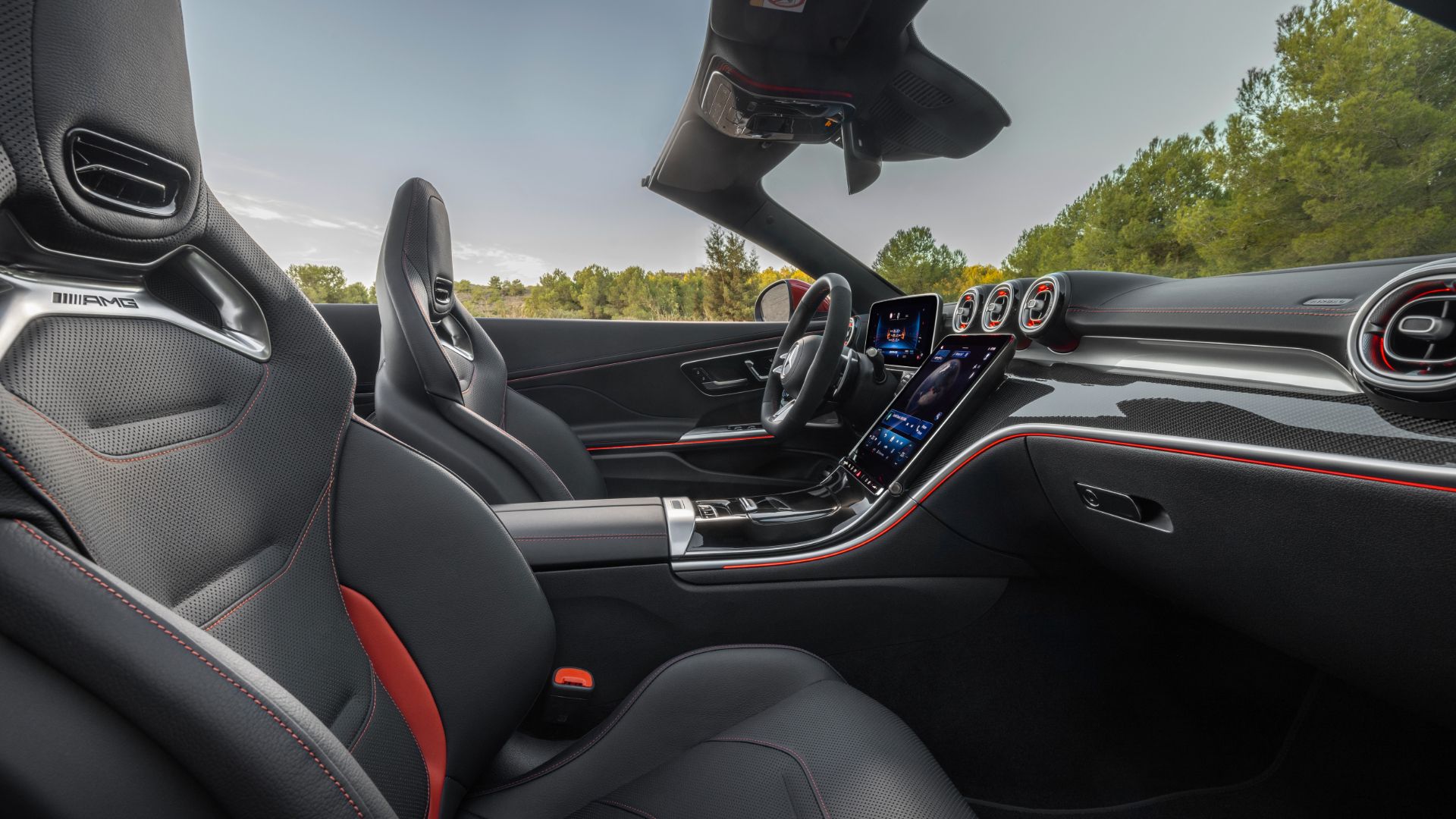


Every automaker on the planet seems to have a patent for combating motion sickness. Most of them read like science fiction — active vibration cancellation, haptic feedback systems, complex sensor arrays. Mercedes-Benz, though, is taking a different route.
Its recently filed patent tackles kinetosis, the clinical term for motion sickness, with something deceptively straightforward: cabin airflow and LEDs.
The patent, unearthed from the German Patent and Trademark Office, lays out a system that uses the car’s existing ventilation to give occupants physical cues about what the vehicle is doing. Speed up, and the air flowing toward you increases, simulating a headwind. Hit the brakes, and it dials back.
The idea is to bridge the sensory gap that makes people feel nauseated in the first place.
About five percent of the population deals with motion sickness to some degree. The root cause is a conflict between what your eyes see and what your inner ear feels. Read your phone in a moving car, and your eyes tell your brain you’re stationary while your vestibular system screams otherwise.
The result is that familiar wave of queasiness that ruins road trips.
Mercedes believes it can hack that disconnect by layering in extra sensory information. Beyond simply ramping airflow with speed, the patent describes pulsating air patterns and the use of multiple vents — including roof-mounted ones — to “code” movement information to passengers. The goal is to create what the filing calls a “highly immersive representation, for example, of a cabriolet.”

That means making you feel like you’re in a convertible even when the roof is up. This isn’t as far-fetched as it sounds. Mercedes already knows a thing or two about managing airflow around occupants with the top down, particularly from its work on the AMG SL 63.
Translating that knowledge into a closed-cabin ventilation strategy is a logical next step.
Then there’s the lighting component. The patent describes using matrix or planar LED arrangements built into air vents and potentially even the headliner to convey visual movement cues. Think color-coded signals — red light during braking, illuminated patterns and arrows indicating turns.
It’s subtle, not a disco ball. The intent is to give your eyes just enough information to reconcile with what your inner ear is telling your brain.
Vision is always central to motion sickness discussions. It’s why a window seat on a plane helps, and why staring at the horizon from the front seat of a car is the oldest remedy in the book. Mercedes is trying to engineer that relief into the cabin itself.
The catch? If the system requires the full suite of vents and LED arrays described in the patent to address all seating positions, it won’t be cheap. This is the kind of technology that would land in S-Class and Maybach territory first, if it lands anywhere at all.
Patent filings are intellectual property hedges as often as they are production roadmaps. Plenty of clever ideas die in the filing cabinet.
For now, the tried-and-true advice still applies. Roll the window down. Keep your eyes on the road ahead. Sit in the front seat if you’re prone to getting sick.
But Mercedes is clearly betting that the car of the future can do better than an open window. If this system works as described, it could be a genuine quality-of-life upgrade for millions of passengers who dread long drives. The engineering is grounded in real research on sensory conflict, not gimmickry.
Whether it ever makes it into a production vehicle is another question entirely. The gap between a patent and a feature on a window sticker is vast, and littered with abandoned ideas.
Still, in a world where most automakers are throwing computational horsepower at the motion sickness problem, there’s something refreshing about Mercedes reaching for the fan switch and a few well-placed LEDs. Sometimes the simplest answer is the smartest one.


Share this Story