



While Ford scales back, GM hedges, and Stellantis zigzags between platforms, Volvo just showed up in the Swedish woods with a 670-horsepower compact SUV that charges 173 miles in 10 minutes and promises 400 miles of range. The 2027 EX60 is either the bravest or most reckless move a legacy automaker has made this year. Probably both.
Three powertrains span the lineup. The rear-drive P6 starts the party at 369 horsepower with an 80-kWh battery and an estimated 290 miles of range. The all-wheel-drive P10 bumps to 503 horsepower and 91 kWh.
The range-topping P12 delivers the headline numbers — 670 horses, 583 pound-feet, 112 kWh, and that 400-mile estimate on 20-inch wheels. Volvo claims 3.8 seconds to 60 mph in the quickest trim. All variants are capped at 112 mph because Volvo is still, at its core, Volvo.
But the powertrain isn’t the real story here. The EX60 debuts Volvo’s SPA3 electrical architecture, a full nervous system overhaul running on Nvidia Drive AGX Orin hardware. The company openly called the EX90 launch “painful,” a rare admission from an automaker that usually buries its stumbles in quarterly earnings footnotes.
This time, Volvo brought software development in-house, ditching the one-size-fits-most supplier approach that kneecapped its bigger sibling.
The dimensions tell you this isn’t just an XC60 with a plug. The EX60 is 4.1 inches shorter in both wheelbase and overall length than the gas model it shadows. Yet it tows 4,500 pounds — a thousand more than the XC60 — and arrives with a NACS port, built and designed in Sweden, priced from around $60,000.
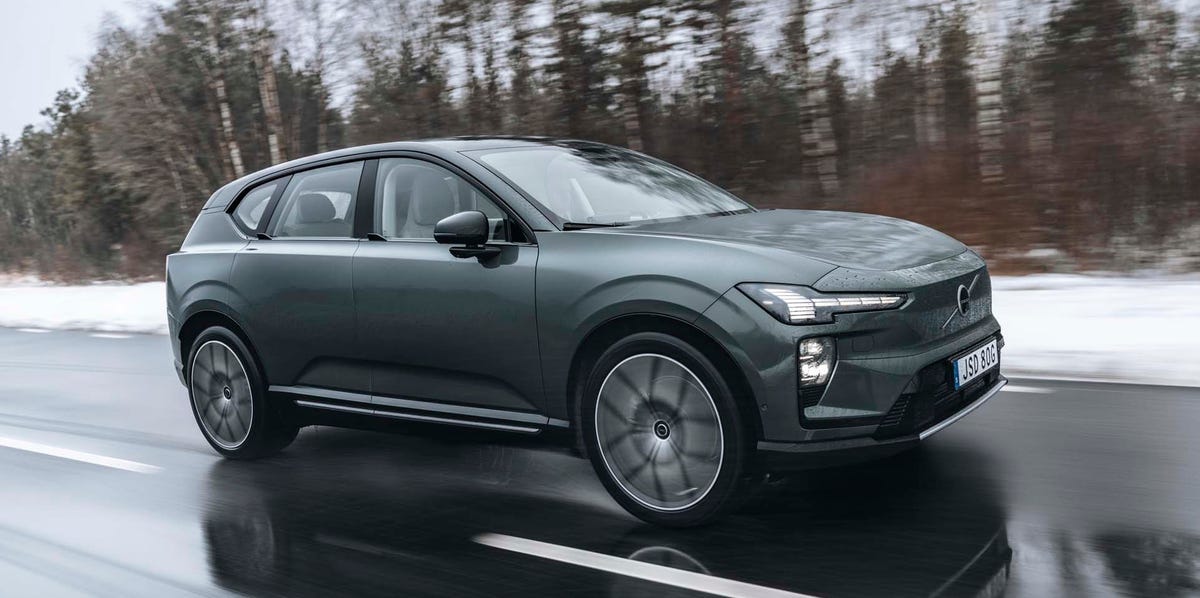
A 0.26 drag coefficient for an SUV is genuinely impressive, achieved through a raked roofline, flush “wing grip” door handles that Volvo says add two to three miles of range, full underbody panels, and active aero elements at the rear. A Cross Country variant follows in 2027 as a 2028 model, bringing standard all-wheel drive, air springs with 0.8 inches of lift, wider track, extended fender flares, and stainless-steel trim for the crowd that wants their EV to look like it could survive a logging road.
Inside, a 15.1-inch curved OLED screen runs Google software with the Gemini AI voice assistant. Early impressions from a ride-along suggest the voice interaction is genuinely conversational — no robotic enunciation required. One spoken sentence can route navigation, send a text, and push a shopping list to your phone.
Volvo is also pushing Gemini updates retroactively to 2021-and-newer models via free over-the-air updates, a move that rewards existing owners instead of punishing them for buying last year’s model.
A 28-speaker Bowers & Wilkins system with Dolby Atmos rounds out the cabin tech. During a passenger ride at Volvo’s Hällered proving ground, the chassis showed tight, well-controlled suspension behavior with no secondary impacts reverberating through the structure. ZF supplied the adaptive dampers, but Volvo wrote the tuning software.
A structural battery case, megacast body components, and hydraulic bushings throughout the chassis keep NVH in check.
Volvo hasn’t let journalists behind the wheel yet, which means the full verdict waits. But the specifications alone draw a line in the sand. At a moment when most Detroit competitors are quietly slow-walking their EV commitments, Volvo is shipping its most technologically ambitious vehicle ever from Gothenburg to American driveways later this year.
The company that built its reputation on saving your life now wants to prove it can also save the EV business case. Whether $60,000 American buyers agree will determine if this bet was visionary or just expensive.



Share this Story